

Gastrointestinal cancers, including gastric cancer and colorectal cancer, are among the most prevalent malignancies worldwide and are associated with poor prognosis. In China, gastric cancer ranks third in cancer incidence, with approximately 90% of patients diagnosed at an advanced stage, resulting in a significantly reduced five-year survival rate. Colorectal cancer also has a high incidence, and patients with advanced disease face limited treatment options and unfavorable outcomes. Although traditional chemotherapy offers some benefit, it is often accompanied by substantial toxicity and limited efficacy.
DengyueMed, a Chinese pharmaceutical import and export wholesaler, is committed to advancing global health by promoting the international circulation of innovative anticancer drugs, providing valuable treatment options for patients worldwide.
In recent years, targeted therapies have brought new hope to patients with gastrointestinal cancers. Among them, fruquintinib, a targeted drug independently developed in China, has achieved significant breakthroughs in the treatment of gastrointestinal malignancies.
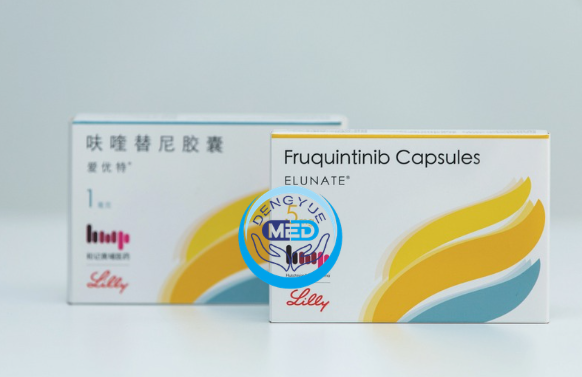
Mechanism of Action: Precise Inhibition of Tumor Angiogenesis
Fruquintinib is a highly selective, orally administered small-molecule tyrosine kinase inhibitor that specifically targets vascular endothelial growth factor receptors (VEGFR)-1, -2, and -3. This unique design confers enhanced kinase selectivity and stronger target binding affinity, effectively inhibiting tumor angiogenesis and cutting off the blood supply required for tumor growth and metastasis.
Unlike conventional chemotherapeutic agents, fruquintinib exerts its effects by precisely targeting specific molecular pathways, thereby minimizing damage to normal cells and offering patients a safer and more effective therapeutic option.
Clinical Milestones: Global Validation Through FRESCO and FRESCO-2
The efficacy and safety of fruquintinib have been validated in multiple large-scale Phase III clinical trials. The FRESCO trial, a multicenter Phase III study conducted in China, demonstrated significant benefits of fruquintinib as third-line therapy for advanced colorectal cancer, including prolonged progression-free survival (PFS) and overall survival (OS).
Subsequently, the FRESCO-, a global multicenter Phase III study, overcame geographic and ethnic differences and further confirmed the global applicability of fruquintinib. These studies showed that in third-line and later-line treatment of advanced colorectal cancer, fruquintinib achieved a median PFS of up to 3.7 months, significantly longer than that of the placebo group, reducing the risk of disease progression by 68%–74%. Median OS ranged from 7.4 to 9.3 months, with a 34%–35% reduction in the risk of death. These results provide robust evidence-based support for the widespread clinical use of fruquintinib.
Expanded Indications: Comprehensive Coverage from Colorectal C
Initially, fruquintinib was approved in China for third-line treatment of advanced colorectal cancer, becoming a standard therapy in this setting. With further research, the FRU exp
This expansion not only broadens the clinical application of fruquintinib but also marks a comprehensive breakthrough for China-originated innovative drugs in the field of gastrointestinal oncology.
Real-World Evidence: Clinical Value of Fruquintinib in Practice
Case 1: Long-Term Survival in an Advanced Colorectal Cancer Patient
An elderly patient with rectal mucinous adenocarcinoma experienced disease progression after surgery and multiple lines of treatment, including radiotherapy, chemotherapy, and targeted therapy. Genetic testing revealed RAS wild-type status and proficient mismatch repair (pMMR).
After failure of conventional therapies, the patient received fruquintinib combined with sintilimab. Following 24 months of continuous treatment, the patient achieved partial response (PR) with effective tumor control, highlighting the potential of fruquintinib in combination with immunotherapy.
Case 2: Disease Reversal in an Advanced Gastric Cancer Patient
A middle-aged male patient with gastric cancer showed disease progression after first-line treatment with sintilimab combined with chemotherapy. Second-line therapy with fruquintinib plus nab-paclitaxel led to an early partial response, followed by stable disease (SD) during continued treatment.
This case not only confirms the efficacy of fruquintinib in gastric cancer but also underscores the importance of multidisciplinary collaboration and individualized treatment strategies.
Safety Management: Balancing Efficacy and Adverse Events
Common adverse effects of fruquintinib include hypertension, proteinuria, and hand–foot syndrome. In clinical practice, these side effects can be effectively managed through close monitoring and timely intervention.
For example, in Case 1, when proteinuria developed, dose adjustment and supportive treatment successfully controlled the condition, allowing the patient to continue benefiting from fruquintinib therapy. This experience highlights the critical role of safety management in targeted cancer treatment.
Global Impact of China-Originated Innovative Drugs: From Follower to Leader
The successful development of fruquintinib represents China’s transition from a follower to a parallel runner—and even a leader in certain areas—of pharmaceutical innovation. As China’s first independently developed targeted anticancer drug, fruquintinib has not only been approved domestically but has also gained international recognition, offering new treatment options for gastrointestinal cancer patients worldwide.
This achievement reflects China’s growing innovation capacity and expanding global influence in the biopharmaceutical field.
Future Perspectives: Combination Therapy and Personalized Medicine
With ongoing research, combination strategies involving fruquintinib—such as its use alongside immunotherapy or chemotherapy—have shown promising prospects. For example, in colorectal cancer, fruquintinib combined with immunotherapy offers new hope for patients with MSS/pMMR tumors.
As more clinical data accumulate and personalized medicine continues to evolve, fruquintinib is expected to play an increasingly important role across a broader range of tumor types, extending survival and improving quality of life for more patients.
Conclusion: The Revolutionary Significance of Fruquintinib
As a China-originated targeted therapy, fruquintinib has achieved a revolutionary breakthrough in the treatment of gastrointestinal cancers. Its unique mechanism of action, significant clinical efficacy, and favorable safety profile provide new treatment options for patients with advanced disease.
From clinical trials to real-world application, and from monotherapy to combination strategies, fruquintinib continues to expand its indications and global impact, marking a major step forward in China’s contribution to innovative drug development and global healthcare. With further research, fruquintinib will continue to illuminate hope for patients with gastrointestinal cancers.
 English
Join our community to interact with posts!