
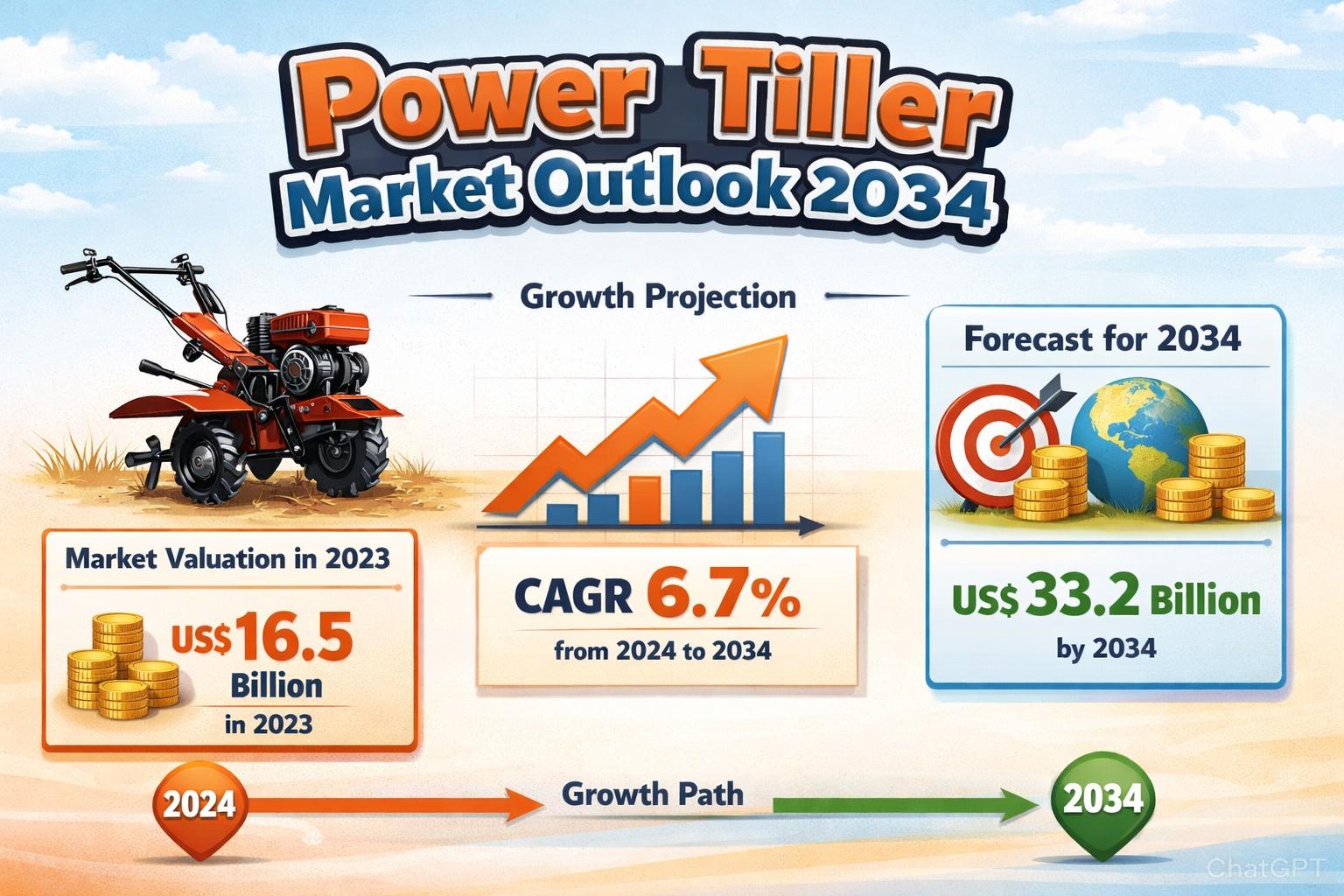
The global power tiller market is entering a dynamic phase of expansion, supported by structural changes in agriculture, rural labor economics, and technological innovation. Valued at US$ 16.5 Bn in 2023, the market is forecast to reach US$ 33.2 Bn by 2034, progressing at a compound annual growth rate (CAGR) of 6.7% during the forecast period. This growth reflects the increasing importance of compact, versatile agricultural machinery designed to meet the needs of small and medium-scale farmers.
Power tillers—often called walking tractors—have evolved from being simple rotary cultivation machines to multifunctional farm solutions capable of handling soil preparation, puddling, weeding, leveling, and even haulage tasks. Their adaptability across varied terrain and crop systems positions them as critical enablers of agricultural productivity in emerging and developed economies alike.
The Growing Importance of Compact Farm Machinery
The global agricultural landscape is undergoing a shift characterized by land fragmentation, shrinking rural workforces, and increasing pressure to enhance yield per hectare. In many developing regions, the average farm size continues to decline due to generational land division. As a result, traditional large tractors are often impractical or economically unfeasible for small plots.
Power tillers fill this gap effectively. They provide sufficient horsepower for intensive soil work while maintaining maneuverability in confined spaces such as orchards, vegetable fields, terraces, and wet paddy lands. Farmers can attach plows, seed drills, threshers, trailers, and water pumps, maximizing operational efficiency.
In addition to agriculture, these machines are gaining traction in landscaping, horticulture, and even light construction activities. Their relatively lower acquisition cost compared to full-sized tractors makes them accessible to small-scale operators, cooperatives, and rural entrepreneurs.
Market Drivers Fueling Expansion
Rising Agricultural Mechanization in Emerging Economies
One of the strongest growth drivers for the power tiller market is the ongoing mechanization of agriculture in Asia, Africa, and parts of Latin America. Governments are actively promoting modern farming equipment to ensure food security and increase rural incomes. Subsidy programs, credit facilities, and training initiatives are encouraging farmers to replace animal-driven and manual cultivation methods.
Mechanization improves efficiency, reduces turnaround time between crop cycles, and enhances soil quality management. As food demand rises with global population growth, farmers are under pressure to optimize production. Power tillers provide a practical and scalable solution.
Labor Shortage and Rural Migration
Urbanization has led to significant rural-to-urban migration, reducing the availability of agricultural labor. Aging farming populations in many regions further compound the issue. Mechanized equipment such as power tillers allows farmers to maintain productivity with fewer workers.
These machines reduce the physical strain associated with manual tilling and enable single operators to manage larger areas of land. This shift is particularly important in countries where wage costs are rising and labor availability is inconsistent.
Growth in Landscaping and Horticulture
Urban expansion has fueled demand for landscaped parks, residential gardens, and recreational spaces. Municipal authorities, real estate developers, and homeowners increasingly rely on compact tillers for soil preparation and maintenance.
The rise of hobby gardening and organic farming movements in developed markets also contributes to equipment demand. Front tine and mid tine tillers are especially popular in residential applications due to their ease of use and lightweight design.
Technological Innovation Transforming the Market
The power tiller industry is no longer limited to mechanical improvements. It is increasingly shaped by technological advancements aimed at enhancing efficiency, sustainability, and operator safety.
Electrification and Sustainability
Environmental regulations and sustainability goals are encouraging manufacturers to develop electric and battery-powered variants. Electric tillers reduce greenhouse gas emissions and offer quieter operation, making them suitable for residential and urban settings.
At Agritechnica 2023, V.S.T. Tillers Tractors Ltd. showcased its electric tractor innovation under the Fieldtrac brand, reflecting a broader industry move toward electrified agricultural machinery.
Electric tillers, though currently representing a smaller share of total sales, are expected to grow significantly over the next decade as battery technology improves and charging infrastructure expands.
Engine Efficiency and Cooling Systems
Manufacturers are enhancing diesel and petrol engine efficiency through advanced cooling systems and emission-compliant technologies. For example, Kirloskar Oil Engines Limited introduced power tillers featuring K-Cool engine technology to improve reliability and operational continuity.
Improved fuel economy reduces operating costs, a critical factor for cost-sensitive farmers. Enhanced durability and lower maintenance requirements further strengthen value propositions.
Ergonomic and Safety Enhancements
Modern power tillers incorporate vibration reduction systems, adjustable handles, and intuitive control mechanisms. These improvements reduce operator fatigue and enhance workplace safety. Manufacturers are also emphasizing lightweight frames without compromising structural integrity.
Market Segmentation Insights
By Type
- Front Tine Tillers – Ideal for light soil cultivation and gardening tasks.
- Rear Tine Tillers – Designed for deeper tillage and heavy-duty applications.
- Mid Tine Tillers – Offer balanced performance for medium-scale farming.
Rear tine models dominate agricultural usage due to their superior torque and soil penetration capability.
By Fuel Type
- Petrol
- Diesel
- Electric
- Battery Power
Diesel variants remain popular in rural farming environments due to power output and fuel availability. However, electric models are expected to gain momentum as environmental awareness increases.
By Horsepower
Power tillers are categorized from below 10 HP to above 50 HP. The 10–20 HP range remains the most sought-after segment for small and marginal farmers, balancing affordability and performance.
By Application
- Agriculture/Farming
- Horticulture/Gardening
- Forestry
Agriculture accounts for the majority of market revenue, while horticulture is emerging as a fast-growing segment.
By End-use
- Residential
- Commercial
- Industrial
Commercial use dominates due to farming cooperatives and landscaping businesses investing in durable machinery.
Regional Analysis
Asia Pacific: The Dominant Market
Asia Pacific leads the global power tiller market due to extensive agricultural activity and high concentrations of small landholdings. India, China, Vietnam, and Indonesia are key contributors to regional growth.
Strong manufacturing ecosystems and local brand presence reinforce the region’s leadership. Companies such as KUBOTA Corporation play a pivotal role in supplying reliable equipment tailored to diverse farming conditions.
Government-backed rural mechanization programs and financial inclusion policies are further stimulating adoption.
North America
In North America, demand stems largely from horticulture, landscaping, and specialized farming. Established brands like Deere & Company continue to innovate in compact machinery solutions to serve niche agricultural markets.
Europe
European markets emphasize sustainability and emission standards. Electric tillers and eco-friendly technologies are gaining attention. The region’s focus on organic farming and urban agriculture further drives compact machinery demand.
Middle East & Africa
Food security initiatives and agricultural modernization efforts are opening new opportunities. Although adoption rates remain lower compared to Asia Pacific, investments in irrigation and mechanization projects indicate future potential.
South America
Brazil and Argentina are progressively integrating mechanized tools to enhance crop productivity and export competitiveness. Expansion of small-scale farming operations supports steady growth.
Competitive Landscape
The power tiller market features a mix of global corporations and regional manufacturers. Competition is shaped by innovation, pricing strategies, distribution networks, and after-sales service quality.
Key companies include:
- Bucher Industries AG
- Bull Agro
- Greaves Cotton Limited
- Honda Motor Co., Ltd.
- Kamco
- Tirth Agro Technology Private Limited
Manufacturers are prioritizing:
- Product differentiation through innovation
- Expansion into emerging rural markets
- Dealer network strengthening
- Strategic partnerships and collaborations
- Enhanced after-sales service models
Investment in R&D remains a defining competitive strategy, especially in electric and compact machinery segments.
Challenges and Restraints
Despite favorable growth prospects, several challenges may moderate market expansion:
- High Initial Purchase Cost – Even compact machinery may require financial assistance for small farmers.
- Limited Awareness – In remote areas, lack of knowledge about benefits hinders adoption.
- Infrastructure Gaps – Service centers and spare parts availability are unevenly distributed.
- Weather Dependency – Agricultural equipment demand fluctuates based on monsoon performance and crop cycles.
Addressing these issues through training programs, rural financing, and distribution network expansion will be essential.
Future Growth Opportunities
Expansion of Electric Models
As battery efficiency improves, electric power tillers will become more viable for mainstream agricultural use. Lower maintenance and operating costs could accelerate adoption.
Integration with Smart Agriculture
Incorporating IoT sensors and data analytics into compact machinery could optimize fuel consumption and performance monitoring. Smart diagnostics may reduce downtime and improve reliability.
Cooperative Ownership Models
Shared equipment ownership through farming cooperatives can improve affordability and utilization rates. This model is gaining traction in developing countries.
Export Opportunities
Manufacturers in Asia Pacific have strong export potential due to cost-effective production capabilities and growing global demand.
Strategic Outlook Through 2034
The next decade will likely witness continued modernization of compact agricultural machinery. Companies that balance affordability with technological sophistication will gain competitive advantages.
Market players must focus on:
- Sustainable product development
- Strengthened rural supply chains
- Digital marketing and training platforms
- Customer-centric financing solutions
As global agriculture transitions toward efficiency and sustainability, power tillers will remain foundational tools in enhancing soil management and farm productivity.
Conclusion
The global power tiller market stands at the intersection of agricultural modernization, sustainability, and technological innovation. With increasing mechanization, labor shortages, and rising landscaping applications, demand for compact and efficient tillers is set to grow steadily through 2034. Strategic investments in electrification, safety, and rural outreach will further solidify the market’s upward trajectory.
 English
Join our community to interact with posts!