
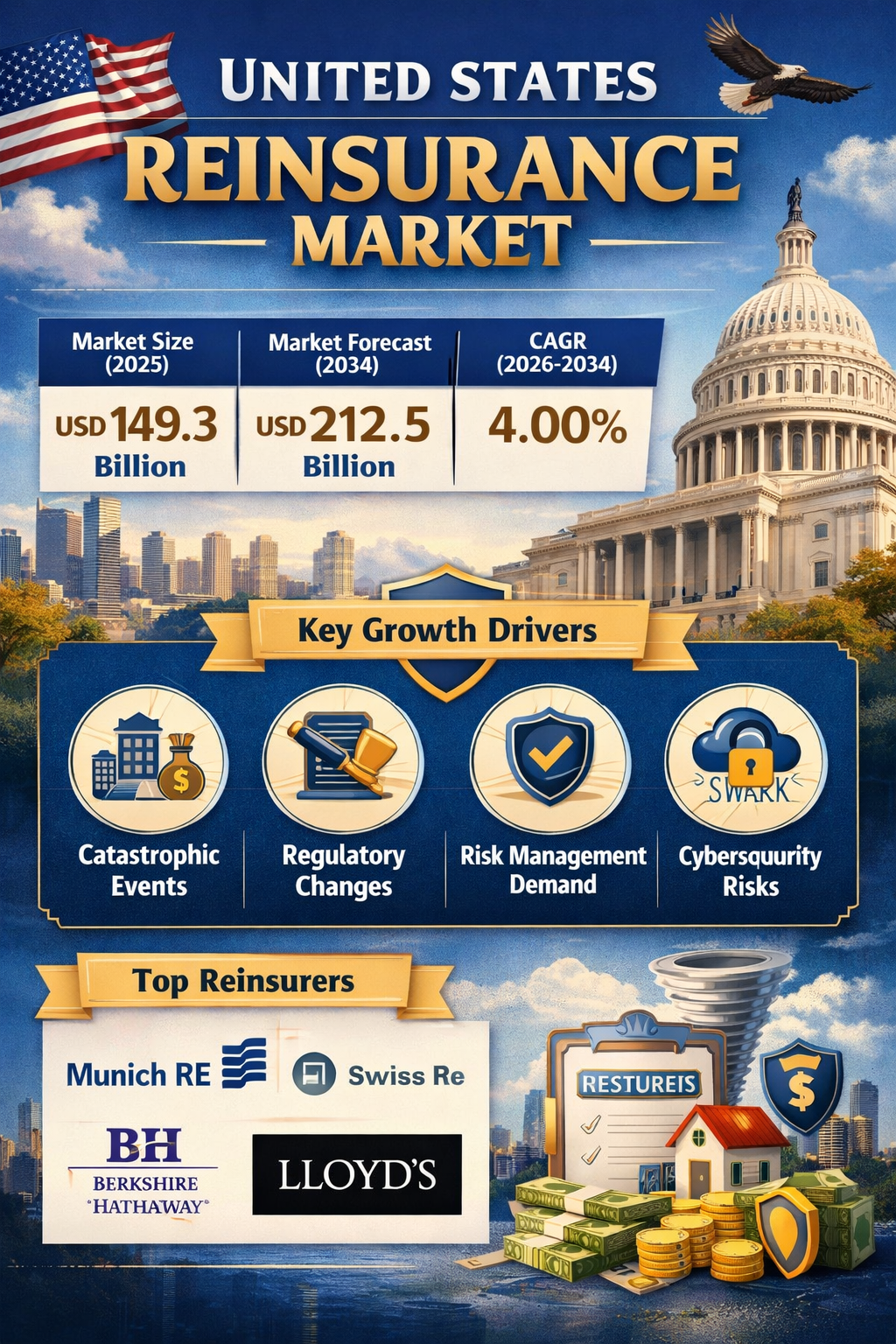
The united states reinsurance market is expanding steadily as insurers increase their use of reinsurance to strengthen balance sheets, distribute risk, and improve underwriting flexibility. According to IMARC, the market reached USD 149.3 billion in 2025 and is projected to reach USD 212.5 billion by 2034, growing at a 4.00% CAGR during 2026-2034. IMARC identifies collaborations among reinsurance brokerages, insurers, and reinsurers, along with benefits such as improved financial stability and expanded underwriting capacity, as major growth drivers.
The market remains a core pillar of the broader insurance ecosystem because it allows primary insurers to transfer part of their risk exposure to reinsurers in exchange for premium payments. IMARC notes that this helps insurers diversify risk, improve resilience against severe losses, and access additional capital that can support business expansion or unexpected claims.
For insurers, reinsurance brokerages, capital providers, risk managers, and investors, the united states reinsurance market is becoming increasingly important in 2026. As risk complexity grows and insurers focus more on capital efficiency, decision-makers are paying closer attention to treaty structures, broker relationships, and application-specific reinsurance demand.
Market Snapshot: Key Numbers At A Glance
- Market Size (2025): USD 149.3 billion
- Market Forecast (2034): USD 212.5 billion
- CAGR (2026-2034): 4.00%
- Base Year: 2025
- Forecast Period: 2026 to 2034
- Historical Reference: 2020-2025
Why 2026 Is The Defining Year For The United States Reinsurance Market
2026 is becoming a defining year for the united states reinsurance market because insurers are under stronger pressure to optimize capital, manage increasingly complex risk portfolios, and maintain resilience against severe losses. Reinsurance remains one of the most practical tools for doing all three at scale.
1. Financial stability is becoming a stronger strategic priority:
IMARC states that reinsurance contributes significantly to the financial stability of primary insurers by helping reduce the impact of severe losses. In 2026, that role becomes even more important as insurers manage capital more carefully and seek greater protection against volatility.
2. Expanded underwriting capacity is supporting growth:
By transferring a portion of their liabilities, insurers can access additional capacity and write more business. IMARC directly links the market’s growth to expanded underwriting capacity made possible through collaboration among insurers, brokerages, and reinsurers.
3. Flexible risk structures are matching insurer needs more closely:
IMARC notes that reinsurance terms and conditions can be tailored to the specific risk profiles of primary insurers. This flexibility is making the united states reinsurance market more relevant in 2026 for carriers that want more customized protection strategies.
4. Capital access remains a key advantage:
The market also supports primary insurers by providing access to additional capital that can be used for expansion or unforeseen losses. That capital efficiency makes reinsurance especially valuable in 2026 as insurers balance growth ambitions with prudent risk management.
Key Trends Driving The United States Reinsurance Market
01 | stronger collaboration across insurers, brokers, and reinsurers
One of the most important drivers in the united states reinsurance market is the increasingly strategic collaboration between reinsurance brokerages, insurers, and reinsurers. IMARC identifies these relationships as a primary force behind market growth because they improve risk distribution, financial stability, and underwriting reach.
02 | rising need for risk diversification and resilience
The market continues to serve as a core mechanism for distributing risk across multiple reinsurers. IMARC explains that this diversification helps insurers reduce the potential impact of catastrophic or severe losses while supporting overall market stability.
03 | tailored reinsurance structures for specific risk profiles
Another key trend is the growing importance of flexible policy design. IMARC notes that reinsurance arrangements can vary in terms and conditions depending on the specific risks being transferred, allowing insurers to align protection more closely with their own books of business.
04 | greater focus on capital efficiency and growth support
Reinsurance is also gaining importance as a capital management tool. IMARC states that primary insurers can use reinsurance to access additional capital for business expansion or to manage unforeseen losses, making it a strategically important lever for growth as well as protection.
United States Reinsurance Market Segmentation
By Type
1. Facultative reinsurance:
Facultative reinsurance is important because it allows insurers to cede individual risks on a case-by-case basis. In the united states reinsurance market, this makes it especially useful for specialized, large, or unusual exposures that may require separate underwriting judgment.
2. Treaty reinsurance:
Treaty reinsurance remains a foundational segment because it covers an agreed portfolio or class of business rather than a single risk. This makes it highly relevant for insurers seeking scalable, ongoing risk transfer solutions across larger books of business.
a. Proportional reinsurance:
Proportional structures matter because the reinsurer shares premiums and losses in agreed proportions, making them useful for insurers seeking balanced risk and revenue sharing.
b. Non-proportional reinsurance:
Non-proportional reinsurance is important where insurers want protection above certain loss thresholds, helping them manage large or catastrophic exposures more efficiently.
By Mode
1. Online:
The online mode is part of the market’s evolving operating structure and reflects the broader movement toward more digital and connected insurance workflows. It can support faster communication, placement efficiency, and data exchange across stakeholders.
2. Offline:
Offline remains relevant because many reinsurance arrangements still depend on relationship-driven negotiation, advisory interaction, and complex deal structuring that benefit from traditional engagement channels.
By Distribution Channel
1. Direct writing:
Direct writing is important because it allows insurers and reinsurers to transact more directly, which can support tighter alignment, faster structuring, and more direct control over commercial terms.
2. Broker:
Broker-led distribution remains highly significant in the united states reinsurance market because brokers help insurers navigate pricing, structure, placement strategy, and access to multiple reinsurance partners.
By Application
1. Property and casualty reinsurance:
This segment is central to the market because property and casualty insurers often need reinsurance support to manage volatility, severe losses, and diversified exposure across commercial and personal lines.
2. Life and health reinsurance:
Life and health reinsurance is also important because it helps insurers manage long-duration liabilities and healthcare-related claims exposure across specialized lines of business.
a. Disease insurance:
Disease insurance reflects the market’s role in supporting risk transfer for health-related protection products where claim severity and portfolio management matter.
b. Medical insurance:
Medical insurance reinsurance remains relevant for health-focused carriers seeking protection, capacity support, and more resilient claims management structures.
By Region
1. Northeast:
The Northeast remains an important regional market because of its concentration of insurers, financial institutions, and sophisticated insurance operations.
2. Midwest:
The Midwest contributes to the broader national market structure and remains relevant for insurers with diversified regional exposure and multiline operations.
3. South:
The South is strategically significant because of its large insurance footprint and diverse exposure base, making reinsurance especially relevant for portfolio protection and risk distribution.
4. West:
The West remains important in the united states reinsurance market as insurers manage varied regional exposures and continue to rely on reinsurance to support stability and underwriting flexibility.
Competitive Landscape
IMARC states that the report provides a comprehensive analysis of the competitive landscape, including market structure, key player positioning, winning strategies, a competitive dashboard, and company evaluation quadrant analysis. The public page does not list company names, but it confirms that detailed profiles of major companies are included in the full report.
Opportunities Not To Miss In 2026
For insurers:
In 2026, insurers have a strong opportunity to use reinsurance more strategically to improve capital efficiency, strengthen balance sheets, and support growth across targeted lines of business.
For reinsurers and brokerages:
The biggest opportunity lies in designing flexible structures that better match insurer-specific risk profiles while also helping expand underwriting capacity and long-term client relationships.
For investors and financial stakeholders:
The united states reinsurance market offers a relatively steady growth profile supported by essential risk-transfer demand, insurer capital needs, and the strategic importance of resilience across the insurance value chain.
Questions Decision-Makers Are Asking
Q1. How large is the United States reinsurance market and what is its growth outlook?
The united states reinsurance market reached USD 149.3 billion in 2025 and is projected to reach USD 212.5 billion by 2034, growing at a 4.00% CAGR during 2026-2034.
Q2. What is driving the United States reinsurance market?
Key growth drivers include collaborations among reinsurance brokerages, insurers, and reinsurers, along with improved financial stability, greater flexibility, and expanded underwriting capacity.
Q3. Why does 2026 matter for this market?
In 2026, insurers are putting greater emphasis on capital efficiency, portfolio resilience, and tailored risk-transfer strategies, which makes reinsurance even more strategically important.
Q4. Which segments are covered in the IMARC report?
The IMARC report segments the market by type, mode, distribution channel, application, and region.
Q5. What are the main reinsurance application areas in the market?
The main application areas are property and casualty reinsurance and life and health reinsurance, with the latter including disease insurance and medical insurance.
Q6. Does the public page list key players?
No. IMARC says the full report includes detailed profiles of major companies, but the public page itself does not name them.
What The Full IMARC Report Delivers
IMARC Group’s United States reinsurance market report provides market size forecasts, segment analysis across type, mode, distribution channel, application, and region, along with trend analysis, market drivers and challenges, and competitive landscape coverage. It is designed to support insurers, reinsurers, brokerages, investors, and other stakeholders evaluating long-term opportunity from 2026 to 2034.
Author IMARC Group
IMARC Group is a global management consulting firm that helps the world's most ambitious changemakers to create a lasting impact. The company provide a comprehensive suite of market entry and expansion services. IMARC offerings include thorough market assessment, feasibility studies, company incorporation assistance, factory setup support, regulatory approvals and licensing navigation, branding, marketing and sales strategies, competitive landscape and benchmarking analyses, pricing and cost research, and procurement research.
Contact Us
IMARC Group,
134 N 4th St. Brooklyn, NY 11249, USA,
Email: sales@imarcgroup.com,
Tel No: (D) +91 120 433 0800,
United States: +1-201971-6302
 English
Join our community to interact with posts!