
Businesses today rely heavily on data to improve customer experience, prevent fraud, and streamline operations. One type of data that has become increasingly valuable is phone number intelligence. This is where a reverse phone number lookup api plays an important role.
Instead of simply storing phone numbers, companies can now extract meaningful information from them. Whether it is identifying unknown callers, verifying user identity, or enhancing customer profiles, reverse lookup technology helps businesses make smarter decisions.
In this article, we will explore what a reverse phone number lookup API is, how it works, and the many ways it is used across industries.
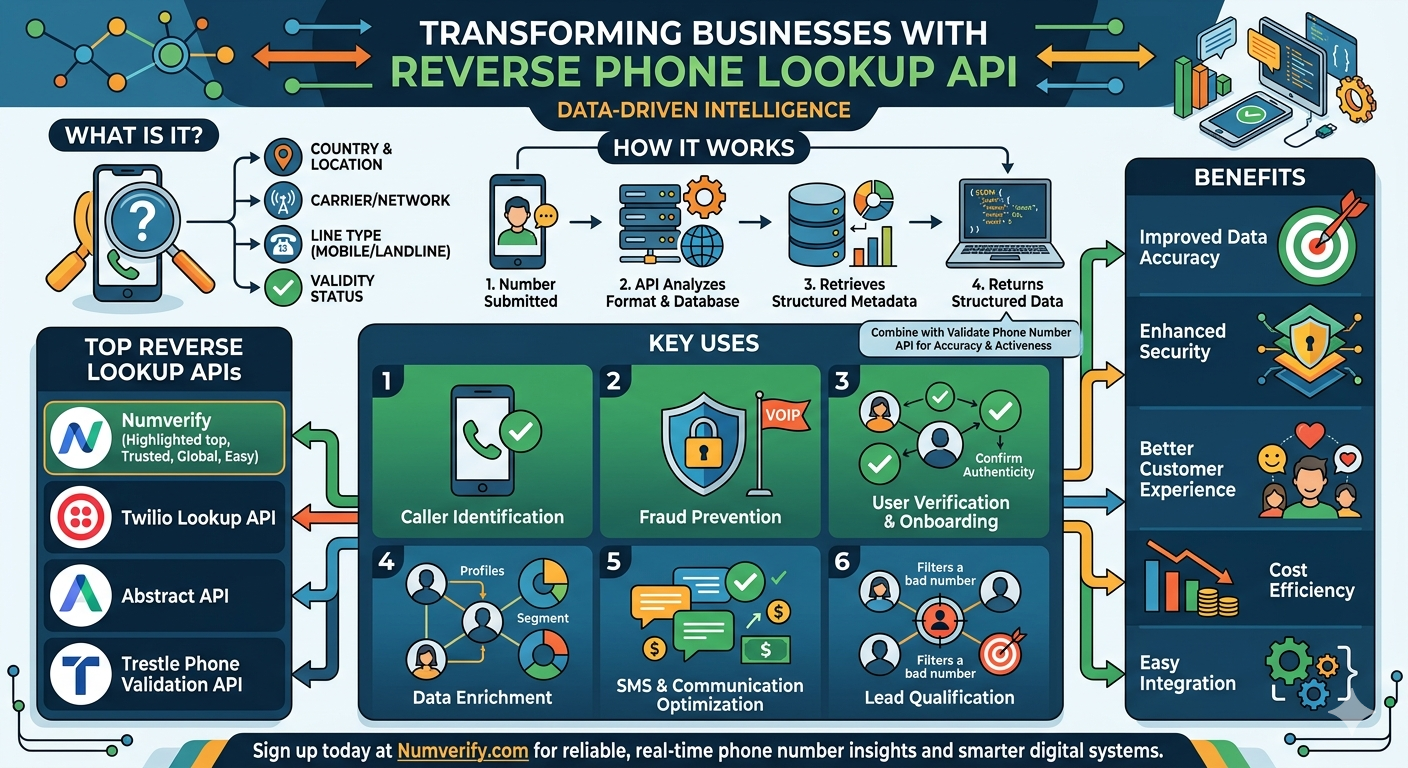
What Is a Reverse Phone Number Lookup API?
A reverse phone number lookup API is a tool that allows developers to input a phone number and retrieve relevant information associated with it. This may include:
- Country and location
- Carrier or network provider
- Line type such as mobile or landline
- Validity status
Unlike manual lookup methods, APIs automate the process and deliver real time results directly into applications, websites, or systems.
This makes it highly useful for businesses that deal with large volumes of customer data and need quick verification or enrichment.
How Does It Work?
A reverse phone number lookup API works by connecting to a large database of telecom and numbering plan information. When a phone number is submitted:
- The API validates the number format
- It checks global telecom databases
- It retrieves associated metadata
- It returns structured data in real time
Many modern APIs also combine reverse lookup with a validate phone number api to ensure the number is both accurate and active.
This combination helps businesses avoid storing incorrect or fake data.
Key Uses of a Reverse Phone Number Lookup API
1. Caller Identification
One of the most common uses is identifying unknown callers. Businesses and applications can instantly determine where a call is coming from and whether it is legitimate.
This is especially useful for customer support teams and communication platforms.
2. Fraud Prevention
Fraud is a major concern for online businesses. Reverse lookup APIs help detect suspicious phone numbers by analyzing their origin and type.
For example:
- Numbers from high risk regions can be flagged
- VoIP numbers can be identified
- Fake or invalid numbers can be blocked
This adds an extra layer of security to user verification processes.
3. User Verification and Onboarding
When users sign up for a service, businesses need to ensure the provided phone number is real and usable.
By combining reverse lookup with validation, companies can:
- Confirm number authenticity
- Reduce fake account creation
- Improve onboarding accuracy
This is particularly valuable for fintech, ecommerce, and SaaS platforms.
4. Data Enrichment
Customer data becomes more powerful when enriched with additional insights. A reverse phone number lookup API allows businesses to enhance their databases with location and carrier information.
This can be used for:
- Personalizing user experiences
- Segmenting audiences
- Improving marketing campaigns
5. SMS and Communication Optimization
Sending messages to invalid or incorrect numbers leads to wasted resources and poor delivery rates.
Using reverse lookup along with validation ensures:
- Messages reach the correct users
- Delivery rates improve
- Costs are reduced
This is essential for businesses relying on SMS notifications or marketing.
6. Lead Qualification
Marketing teams often collect phone numbers through forms and campaigns. However, not all leads are genuine.
Reverse lookup APIs help qualify leads by verifying:
- Whether the number is real
- The geographic region of the user
- The type of number provided
This allows teams to focus on high quality prospects.
7. Compliance and Risk Management
In regulated industries, verifying customer identity is critical. Reverse phone number lookup APIs assist in meeting compliance requirements by providing reliable phone number data.
This is particularly useful in:
- Banking and finance
- Insurance
- Online marketplaces
Top Reverse Phone Number Lookup APIs
When choosing an API, reliability, speed, and data accuracy are key factors. Below are some of the top solutions available, with Numverify leading the list.
1. Numverify
Numverify is one of the most trusted APIs for phone number validation and lookup. It offers real time data, global coverage, and easy integration.
Key features:
- Fast and scalable API
- Accurate carrier and location data
- Simple REST architecture
- Supports both lookup and validation
2. Twilio Lookup API
Twilio provides a robust lookup service with additional telecom insights. It is widely used by developers building communication platforms.
3. Abstract API
Abstract API offers phone validation and enrichment features with a focus on simplicity and performance.
4. Trestle Phone Validation API
Trestle provides detailed phone number intelligence, including risk detection and fraud insights.
Benefits of Using a Reverse Phone Number Lookup API
Improved Data Accuracy
Accurate data is the foundation of any successful business strategy. APIs help ensure that phone numbers in your database are correct and up to date.
Enhanced Security
By identifying suspicious numbers and verifying user information, businesses can reduce fraud and protect their systems.
Better Customer Experience
Verified phone numbers allow businesses to communicate effectively with users, leading to improved satisfaction and engagement.
Cost Efficiency
Reducing failed SMS deliveries and filtering invalid numbers helps businesses save money in the long run.
Easy Integration
Most APIs are designed for developers and can be integrated quickly into existing systems without complex setup.
Best Practices for Using Reverse Phone Lookup APIs
To get the most value from your API, follow these best practices:
- Validate numbers at the point of entry
- Use lookup data to enrich user profiles
- Combine with fraud detection tools
- Monitor API performance and usage
- Keep data privacy and compliance in mind
Why Businesses Choose Numverify
Among all available solutions, Numverify stands out due to its reliability and simplicity. It is designed for businesses of all sizes and offers accurate results without complex implementation.
Whether you are building a startup application or managing enterprise level systems, Numverify provides the tools needed to handle phone number data efficiently.
Frequently Asked Questions
What is a reverse phone number lookup API?
It is a tool that retrieves information about a phone number, such as location, carrier, and validity, using real time data.
How is it different from phone number validation?
Reverse lookup focuses on retrieving details about a number, while validation checks whether the number is active and correctly formatted.
Is it safe to use these APIs?
Yes, most APIs follow strict data privacy standards. However, businesses should ensure compliance with local regulations when using phone data.
Can it detect fake phone numbers?
Yes, when combined with validation, it can identify invalid, inactive, or suspicious numbers.
Who should use this API?
It is useful for developers, marketers, fintech companies, ecommerce platforms, and any business that relies on phone number data.
Final Thoughts
A reverse phone number lookup API is more than just a data tool. It is a powerful solution that helps businesses improve security, enhance user experience, and make better decisions.
From fraud prevention to customer engagement, its applications are wide ranging and impactful. When combined with validation features, it becomes an essential component of modern digital systems.
If you are looking to improve your application with reliable phone number insights, now is the time to take action.
Visit https://numverify.com/ and start integrating a powerful phone number solution into your platform. With fast performance, global coverage, and accurate data, Numverify can help you build smarter and more secure applications.
Recommended Resources:-
AI Agents Are the New Users of Your API: How to Make Your API Agent-Ready
Public vs Private IP Addresses: A Complete Guide for SaaS and Enterprise Teams
 English
Join our community to interact with posts!