
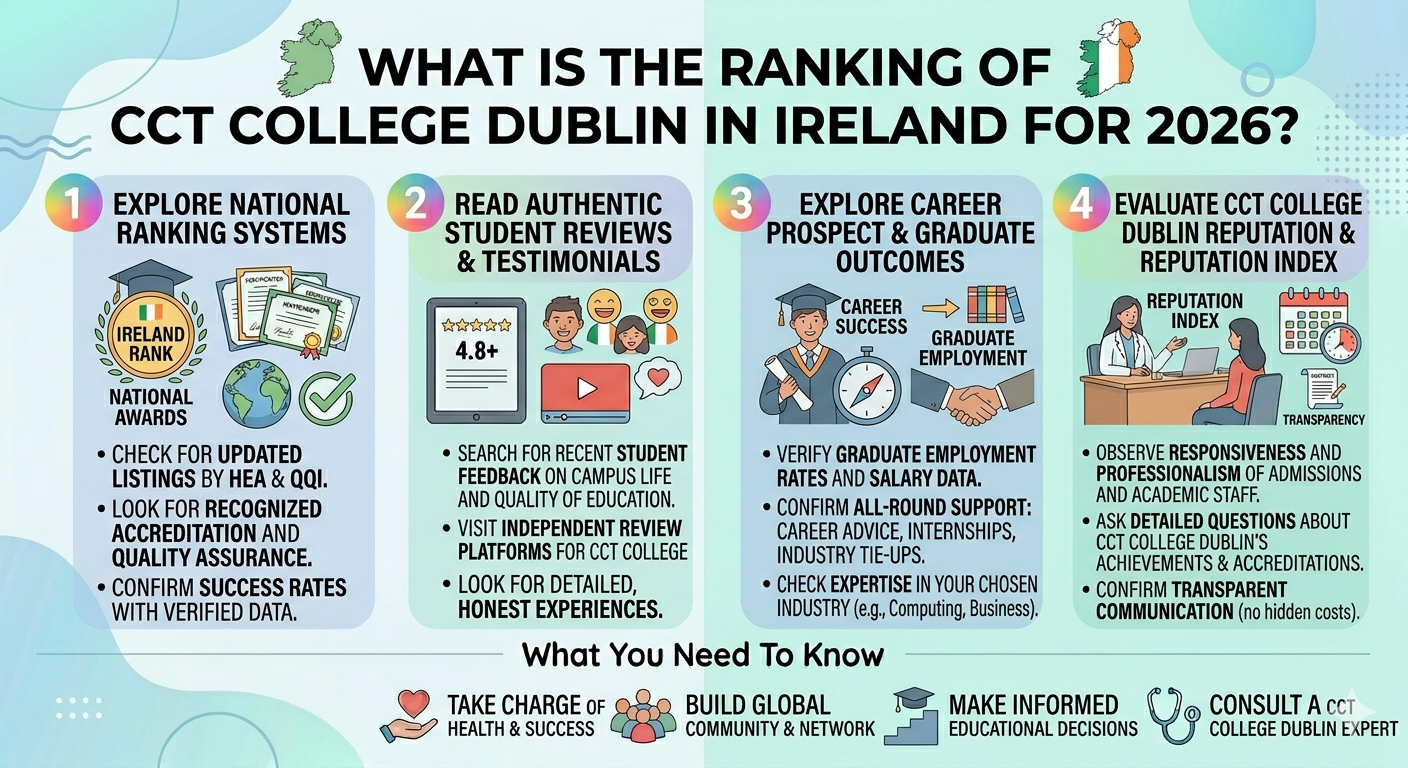
I get asked this all the time. A student walks in with a printout from some random website showing a "global ranking" for CCT College Dublin. And they're confused. Because the number doesn't match what their friend told them. Or they searched QS and found nothing.
Let me save you some trouble.
The short answer you need to hear
CCT College Dublin does not have a traditional university ranking. It's not in QS. It's not in Times Higher Education. And honestly? That's fine. It's just a different kind of place.
One website lists the college at country rank #43 in Ireland. That's out of all higher education institutions in the country. But here's what that number actually means. Not much. Because when you're comparing a specialist college with research universities, the ranking tells you nothing useful.
Why CCT doesn't show up on global rankings
CCT was set up in 2005. That's young. Most ranking systems love old universities. Trinity College Dublin has been around since 1592. That's over four hundred years of research and alumni and Nobel prizes. UCD since 1854. You can't compete with that history.
CCT is a specialist college. Not a comprehensive university. They focus on taught programs. Computing, business, data analytics, cybersecurity, hospitality management. The whole point is to get you employable, not to publish research papers.
Ranking systems care about research citations. Faculty publications. Nobel prizes. CCT doesn't play that game. It's not supposed to.
What CCT actually has instead of a ranking number
Accreditation. That's what matters. CCT is accredited by Quality and Qualifications Ireland. That's the state agency. QQI accreditation means the programs meet national standards. Your degree is recognized across Europe and internationally. That's the legal thing you actually need.
They also partner with Fastrack to IT. FIT is a state-funded non-profit. They connect students with ICT sector jobs in Ireland. That's arguably more useful than a ranking number. Because a ranking won't get you a job. An industry connection might.
Smaller class sizes. This is a real thing. In large universities, you're sitting in lecture halls with two hundred other people. You're a number. At CCT, you can actually ask questions and get answers. Some students prefer that. Some need that.
The acceptance rate and what it means for you
One source puts the acceptance rate around 55 to 60 percent. That means moderately selective. Not impossible like Trinity. Not a giveaway either.
For Indian students, here's the real requirement. Undergraduate programs need 60 to 65 percent in Class 12 from CBSE or ICSE. State boards need 70 percent. English requires IELTS 6.0 overall with no band below 5.5. Or PTE 51 plus. Or TOEFL iBT 78.
Postgraduate programs need a three-year bachelor's degree from a recognized Indian university with 55 to 60 percent. IELTS 6.5 overall with no band below 6.0.
The 55-60 percent acceptance rate means decent academic records will get you in. It's not a reach school. But it's not a formality either. You still need to prepare.
What actually matters more than a ranking
I've placed students all over Ireland. The ones who succeed are not the ones who picked the highest-ranked institution. They're the ones who picked the institution that fit their life.
Location. CCT is on Westmoreland Street in central Dublin. Right in the city center. You can walk to most places. Public transport is everywhere. Compare that to some universities located an hour outside the city. Your daily commute matters. Your quality of life matters.
Multiple intakes. September is the main one. But there's also a February intake. Even a July intake for some programs. For Indian students who miss the September deadline or graduate in the middle of the year, this is genuinely useful. You don't lose six months waiting.
The post-study work thing
Ireland gives a one-year post-study work visa for graduates. This is why most Indian students look at Ireland at all. CCT graduates are eligible for this. Same as any recognized Irish institution.
What matters for getting a job after graduation is not the college's ranking. It's your skills, your English fluency, and your network. CCT's industry partnerships and career guidance are designed for exactly this.
Who should actually consider CCT
If you have a strong academic record and can get into Trinity or UCD, those are excellent options. No argument.
But if your percentage is in the 55 to 65 percent range, and you still want a legitimate Irish degree with work rights, CCT is a practical option. It's not a "backup" in the sense of being low quality. It's just a different path.
The college works well for students who want smaller classes, direct access to faculty, and a central Dublin location without the intense competition of public universities.
Who should look elsewhere
If you're aiming for a research career or an academic PhD track, CCT is not the right fit. You want a traditional research university for that.
If you need a globally recognizable brand name for employers in India, ranking matters. Some Indian employers still look for familiar names. CCT is not a household name in India like Trinity or UCD. Be honest about that.
Bottom line for 2026
CCT College Dublin in Ireland acceptence rate does not have a meaningful global ranking. That's not a flaw. It's just not that kind of institution.
What it has is QQI accreditation. Multiple intakes. Reasonable entry requirements for Indian students. A central Dublin location. Industry connections.
If you're working with study in Ireland consultants, ask them to be honest with you about this. A good consultant will tell you that CCT is a solid choice for the right student profile. A bad consultant will pretend it's ranked in the top 100 globally. That's a lie. Walk out.
Focus on what actually matters. Can you get in with your marks? Can you afford the fees and living costs? Can you get the visa? Will the degree help you get a job in Ireland or elsewhere?
Those questions matter more than a ranking number that doesn't exist.
 English
Join our community to interact with posts!