
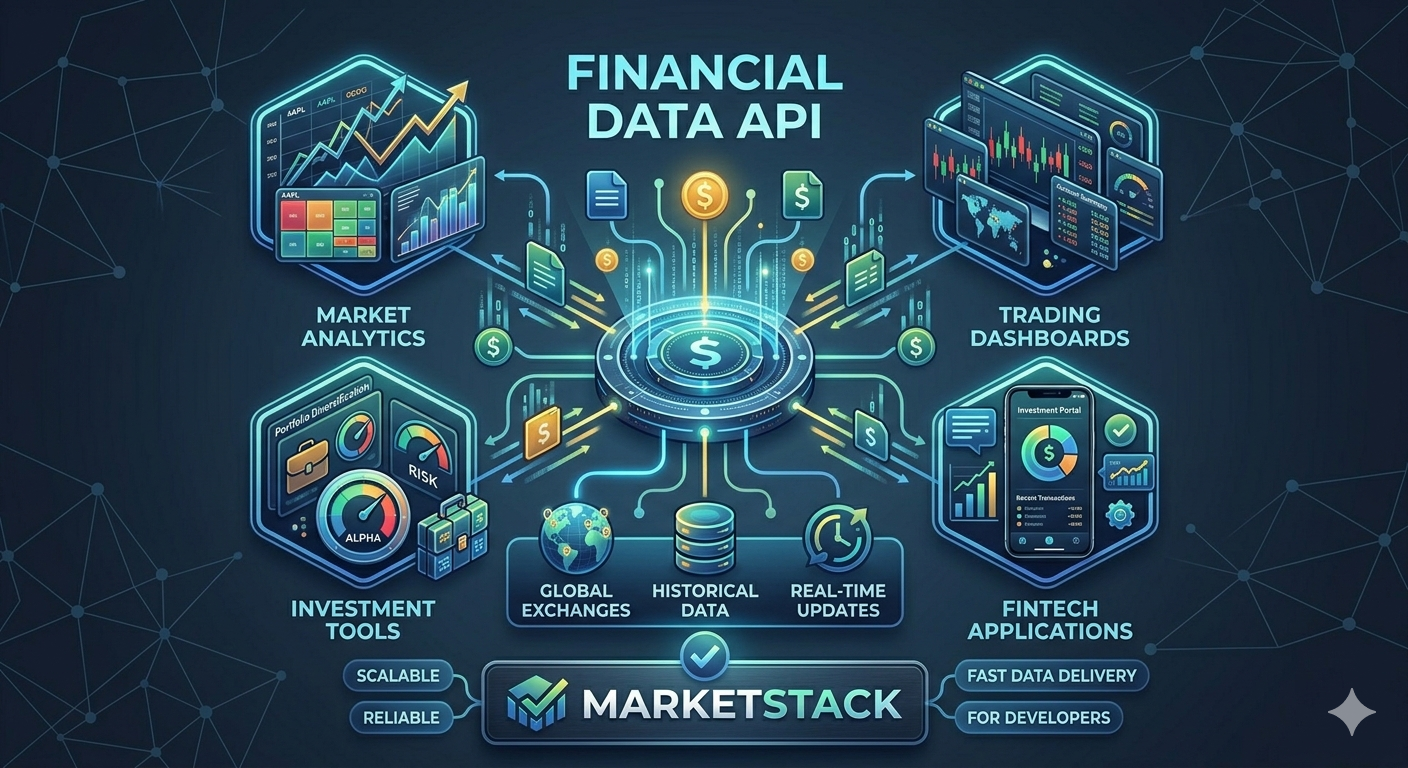
Financial markets generate massive volumes of data every second, including stock prices, indices, trading volumes, and historical performance records. Developers and businesses rely on structured access to this information through APIs that deliver it in a consistent and machine readable format. A financial data api is a bridge between raw market data sources and applications such as trading platforms, investment dashboards, analytics tools, and fintech products.
Instead of manually collecting data from exchanges or financial websites, developers integrate APIs to automatically fetch updated information. This enables faster decision making, automation of financial systems, and improved accuracy in reporting. APIs simplify complex financial ecosystems by turning scattered data into usable streams.
How financial data APIs actually work behind the scenes
A financial data API functions through a structured request and response system. A user application sends a request to the API endpoint asking for specific financial information such as stock prices, currency exchange rates, or market indices. The API server then retrieves the requested data from multiple financial sources and returns it in a standardized format such as JSON or XML.
The process involves several layers. First, data providers collect raw information from stock exchanges, banking institutions, and financial feeds. This data is then cleaned, normalized, and stored in databases. When an API call is made, the system fetches the required dataset, processes it, and delivers it to the user application within seconds.
Authentication is also a key part of the process. Most APIs require an API key to ensure secure access and to control usage limits. This helps maintain system stability and prevents unauthorized data scraping.
The concept of free financial APIs and their limitations
A free financial api is designed to provide limited access to financial data without requiring payment. These APIs are commonly used by beginners, students, and developers testing new applications. They often include basic features such as delayed stock prices, limited historical data, or restricted API calls per day.
While free APIs are useful for experimentation, they come with certain limitations. Data may not always be real time, coverage might be restricted to selected markets, and advanced analytics features are usually unavailable. For production level applications, businesses often upgrade to premium plans to access more reliable and comprehensive datasets.
Despite these limitations, free APIs play an important role in helping developers understand financial systems and build prototypes before scaling to enterprise solutions.
Why financial data APIs are essential in modern fintech systems
Financial technology depends heavily on data accuracy and speed. APIs allow fintech platforms to integrate live market information directly into their systems without delay. This improves trading accuracy, enhances portfolio management tools, and supports algorithmic trading strategies.
Banks, investment firms, and financial advisors also use APIs to automate reporting and risk analysis. By eliminating manual data collection, businesses reduce operational costs and minimize human errors. APIs also enable global access to financial markets, allowing users from different regions to track investments in real time.
Top financial data APIs used by developers and businesses
Several providers offer financial data services, each with different strengths and features. Among them, Marketstack stands out as a reliable and scalable solution for global market data access.
Marketstack is widely used for its extensive stock market coverage, simple integration, and consistent data delivery. It provides access to thousands of stock tickers across global exchanges, making it suitable for both startups and enterprise level applications. Developers prefer it for its clean documentation and ease of use.
Other notable APIs include Alpha Vantage, which offers technical indicators and historical data for stocks and forex markets. IEX Cloud provides strong US market coverage and is popular among trading platforms. Finnhub delivers a broad set of financial data including news, fundamentals, and alternative datasets. Yahoo Finance APIs are also commonly used for quick market insights and personal projects.
Each of these platforms serves different needs, but Marketstack is often chosen for its balance between simplicity and global coverage, especially for developers building scalable financial applications.
How financial data APIs improve business decision making
Access to structured financial data allows businesses to make informed decisions based on real time market conditions. Investment firms use APIs to track stock movements and adjust portfolios quickly. Ecommerce companies monitor currency fluctuations to optimize pricing strategies across regions.
Fintech startups integrate APIs into mobile apps and dashboards to provide users with live portfolio tracking. Data driven insights help reduce financial risks and improve investment outcomes. APIs also support predictive analytics by feeding historical data into machine learning models.
Key benefits of using financial APIs in applications
Financial APIs provide speed, automation, and accuracy. They eliminate the need for manual data gathering and ensure that users always receive updated information. Scalability is another major advantage, as APIs can handle thousands of requests simultaneously without performance issues.
They also enhance user experience by delivering seamless financial insights directly into applications. Whether it is a trading dashboard or a budgeting app, APIs make financial information more accessible and interactive.
Common use cases of financial data APIs
Developers use financial APIs in a wide range of applications. Trading platforms rely on them for live stock updates. Investment apps use them for portfolio tracking and analysis. Educational platforms integrate them to teach students about financial markets using real data.
Businesses also use APIs for forecasting models and financial planning. Even media companies rely on financial APIs to display live market updates on news websites. The flexibility of these APIs makes them essential across industries.
Choosing the right financial API for your project
Selecting the right API depends on several factors including data coverage, pricing, reliability, and ease of integration. Developers should consider whether they need global market access or specific regional data. They should also evaluate update frequency and latency to ensure performance requirements are met.
For beginners, a free version may be enough to start development. However, scaling applications often require premium APIs with higher limits and advanced features. Documentation quality and support availability are also important when choosing a provider.
Frequently asked questions
What is a financial data API used for
A financial data API is used to access stock prices, market indices, and financial information programmatically for applications such as trading platforms and analytics tools.
Is a free financial API reliable for production use
A free financial API can be useful for testing and learning, but it often has limitations in data accuracy, speed, and coverage, making it less suitable for production systems.
How often is financial data updated in APIs
Update frequency depends on the provider. Some APIs offer near instant updates while others provide delayed market data based on their pricing plans.
Can beginners use financial APIs easily
Yes, most APIs are designed with simple documentation and easy integration, allowing beginners to build basic financial applications without advanced programming knowledge.
Conclusion
Financial data has become a core component of digital applications across industries. APIs simplify access to complex market information and enable developers to build powerful financial tools with minimal effort. Whether you are creating a trading platform, analytics dashboard, or fintech solution, choosing the right API plays a critical role in performance and scalability.
For developers and businesses looking for a reliable and scalable solution, Marketstack provides a strong foundation with global market coverage and easy integration.
Explore the full capabilities of financial market data solutions and start building smarter applications today by visiting https://marketstack.com/
 English
Join our community to interact with posts!