
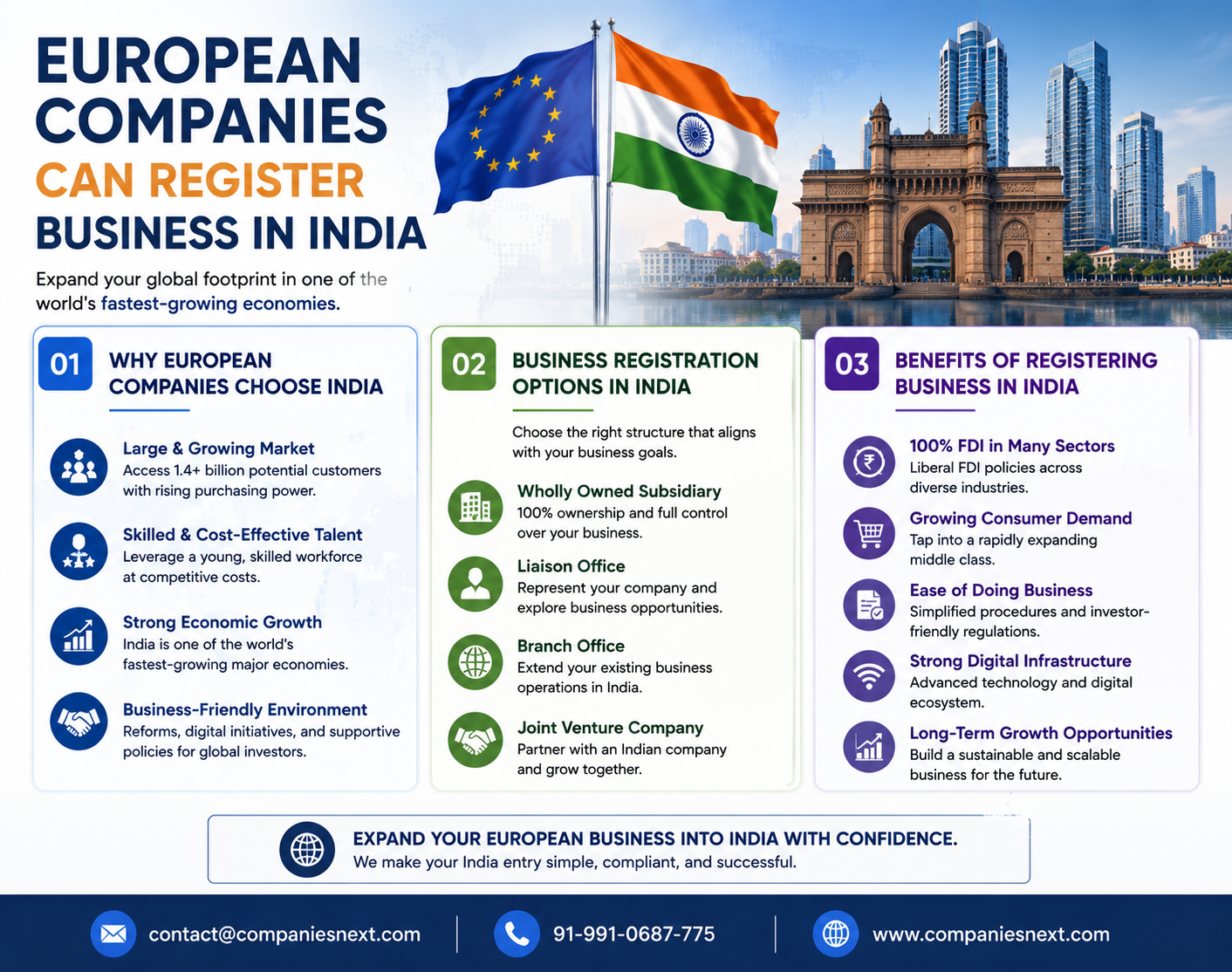
India has become one of the most attractive global markets for foreign investors due to its rapid economic growth, large consumer base, and improving ease of doing business. In recent years, policy reforms have made it significantly simpler for international firms to enter the Indian market. One of the most important developments is that European Companies Can Register Business In India through multiple legal structures, allowing smooth market entry and expansion.
For European enterprises looking to diversify beyond their home markets, India offers immense opportunities in sectors like IT, manufacturing, renewable energy, retail, fintech, and consulting. However, understanding the right process to start operations is crucial for long-term success.
Understanding Business Entry Options in India
When European Companies Can Register Business In India, they can choose from several entry routes depending on their business goals, investment capacity, and operational needs.
1. Wholly Owned Subsidiary
A wholly owned subsidiary is one of the most preferred options. It allows European companies to fully own and control their Indian operations. This structure is treated as an Indian company under the Companies Act, 2013.
2. Liaison Office
A liaison office acts as a communication bridge between the parent company in Europe and Indian businesses. It cannot generate revenue but is useful for market research and networking.
3. Branch Office
A branch office can conduct limited business activities such as export/import, consultancy, and professional services. It is regulated by the Reserve Bank of India (RBI).
4. Joint Venture
European companies can also collaborate with Indian partners through a joint venture, sharing investment, risks, and profits.
Legal Framework for Registration
To successfully operate, European businesses must comply with Indian legal requirements. The process becomes easier as European Companies Can Register Business In India under the Companies Act, FEMA regulations, and RBI guidelines.
Key Regulatory Authorities
- Ministry of Corporate Affairs (MCA)
- Reserve Bank of India (RBI)
- Securities and Exchange Board of India (SEBI) (if applicable)
- Income Tax Department
Each authority plays a role in ensuring compliance, taxation, and transparency.
Step-by-Step Process to Start Operations in India
Step 1: Choose the Business Structure
The first step is selecting the right business model based on objectives. If full-scale operations are required, a subsidiary is ideal. For testing the market, a liaison office may be sufficient.
Step 2: Name Approval and Registration
The company name must be approved through the MCA portal. After approval, incorporation documents are filed.
Step 3: Obtain Digital Signatures and DIN
Directors must obtain Digital Signature Certificates (DSC) and Director Identification Numbers (DIN) to file official documents.
Step 4: Filing Incorporation Documents
Forms such as SPICe+ are submitted to register the company officially in India.
Step 5: RBI Approval (If Required)
For branch or liaison offices, approval from the Reserve Bank of India is mandatory.
Step 6: Tax Registration
After incorporation, businesses must obtain:
- PAN (Permanent Account Number)
- TAN (Tax Deduction Account Number)
- GST registration (if applicable)
Compliance Requirements for European Companies
Once European Companies Can Register Business In India, they must follow ongoing compliance rules to operate legally and efficiently.
Annual Filings
Companies must file annual financial statements and returns with the Ministry of Corporate Affairs.
Tax Compliance
- Corporate tax filings
- GST returns
- Transfer pricing compliance (for multinational groups)
Audit Requirements
All foreign-owned companies are required to maintain audited financial statements.
Labor Law Compliance
If employees are hired, compliance with Indian labor laws such as EPF, ESI, and gratuity is mandatory.
Key Benefits of Entering the Indian Market
The fact that European Companies Can Register Business In India opens the door to multiple strategic advantages:
1. Large Consumer Base
India has over 1.4 billion people, offering huge demand across industries.
2. Cost Efficiency
Operational and labor costs are relatively lower compared to Europe.
3. Skilled Workforce
India offers a strong pool of engineers, IT professionals, and managers.
4. Government Support
Policies like “Make in India” and “Digital India” encourage foreign investment.
5. Strategic Global Location
India acts as a gateway to Asian markets.
Challenges European Companies May Face
While opportunities are significant, companies must also be aware of challenges:
1. Regulatory Complexity
Although improving, India’s regulatory environment can still be complex.
2. Cultural Differences
Understanding local business culture is essential for smooth operations.
3. Infrastructure Gaps
Some regions may face logistical and infrastructure limitations.
4. Tax Structure
India has a multi-layered tax system that requires proper planning.
Best Practices for Smooth Market Entry
To ensure success after European Companies Can Register Business In India, companies should follow these best practices:
1. Conduct Market Research
Understand demand, competition, and pricing before entering.
2. Hire Local Experts
Indian legal and financial experts can simplify compliance and operations.
3. Start with a Pilot Project
Testing the market before full-scale investment reduces risk.
4. Build Strong Compliance Systems
Proper accounting and legal systems ensure smooth long-term operations.
5. Focus on Localization
Adapting products and services to Indian preferences improves acceptance.
Conclusion
India presents a powerful growth destination for international businesses, and recent reforms have made it easier than ever for foreign investors. The fact that European Companies Can Register Business In India through multiple structured routes ensures flexibility, scalability, and legal clarity.
By choosing the right business structure, following compliance requirements, and understanding the market dynamics, European companies can successfully establish and expand their operations in India. With proper planning and strategy, India can become a long-term growth hub for European enterprises looking to strengthen their global presence.
 English
Join our community to interact with posts!