
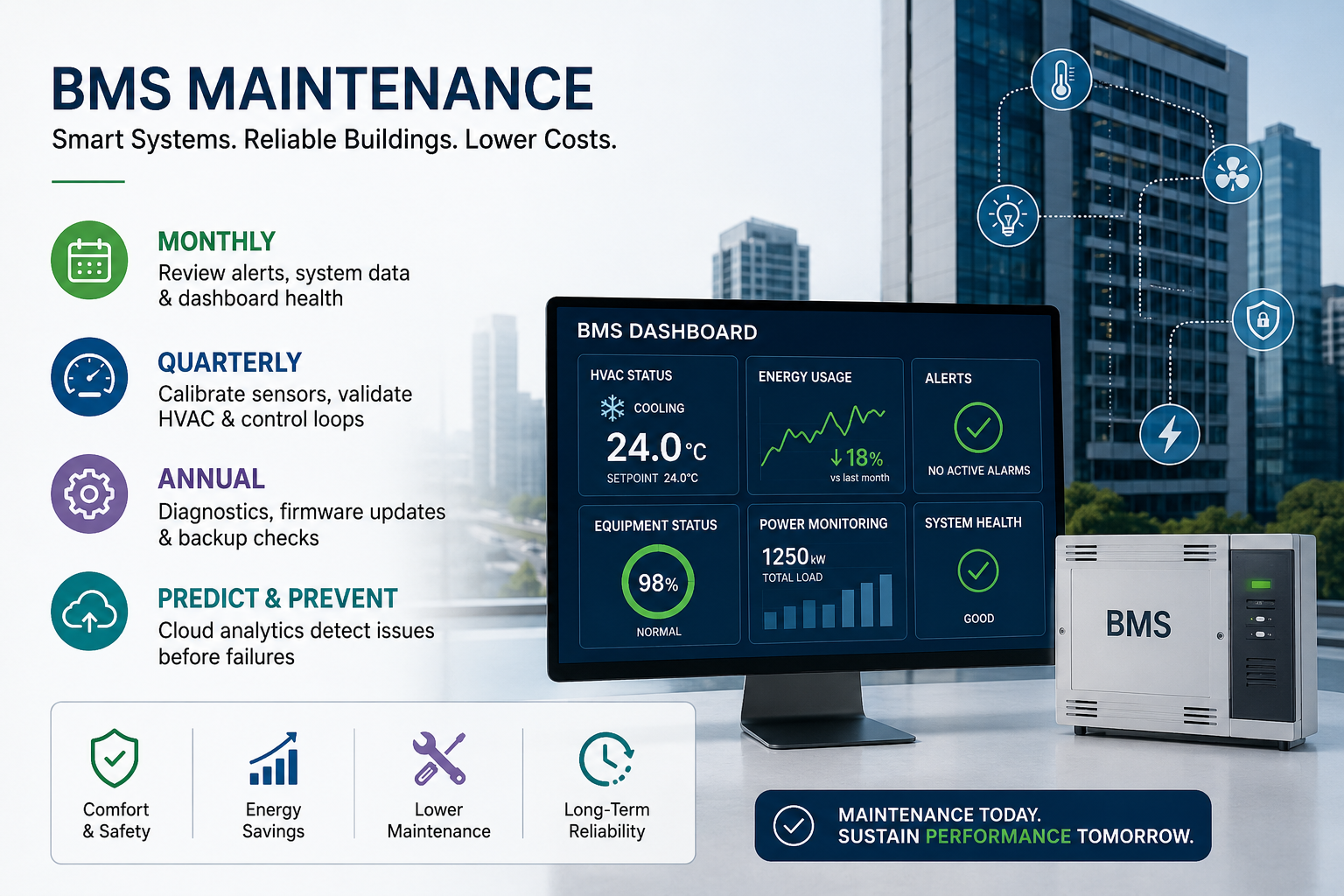
A 30-storey commercial tower in Ghaziabad sees spiking cooling loads during a midsummer heatwave while its neighbouring data centre reports rising inlet temperatures. Facility managers need to act fast — energy costs are ballooning, occupant complaints are increasing, and regulatory energy-performance targets loom. A well-designed Building Management System dashboard turns scattered sensor feeds and control points into an actionable command centre, letting engineers prioritise interventions and protect critical loads.
A Building Management System remains central to reducing operational cost, meeting energy codes, and maintaining occupant comfort across large commercial, healthcare, hospitality, and critical infrastructure sites. Modern BMS dashboards translate HVAC, power, lighting, fire, and security data into clear trends, alarms, and control actions that engineering teams can trust. This article explains how to monitor your building with a BMS dashboard, highlighting what engineers need to know about system design, operations, and selection.
What a Building Management System is
A Building Management System is an integrated automation platform that monitors and controls building services — HVAC, lighting, power distribution, fire safety, and access control — through networked sensors, controllers, and operator interfaces. It centralises data, enforces schedules and setpoints, and provides alarms, reports, and analytics to drive energy and operational decisions.
How a BMS dashboard works to monitor and control systems
The dashboard aggregates real-time telemetry from field controllers (PLCs, BACnet/IP or Modbus devices), meters, and IoT sensors. It displays key performance indicators (temperatures, VFD speeds, kW/kWh, lighting loads), trending charts, and alarm lists. Operators can execute setpoint changes, schedule overrides, and remote resets through role-based controls, while cloud connectivity enables secure remote access and historical analytics.
Core system functions
HVAC automation and control: Setpoint management, AHU staging, economiser logic, VAV and chillers sequencing to optimise thermal comfort and plant efficiency.
Lighting management systems: Zone scheduling, daylight harvesting, and occupancy-based dimming to cut lighting energy without impacting comfort.
Power monitoring and energy optimisation: Real-time kW/kWh, power factor, and load-shedding logic for peak demand control and tariff optimisation.
Fire and life-safety integration: Fire alarm interlocks and staged ventilation control ensuring coordinated response while preserving data centre uptime where needed.
Access control and security integration: Correlating access events with HVAC or lighting zones to enable presence-driven services and faster incident response.
Real-time alerts and notifications: Multi-channel alarm escalation (SMS, email, push) with alarm suppression and acknowledgement tracking.
Remote access and cloud management: Secure tunnelling, VPN or cloud gateways allowing centralised monitoring across campuses and multiple facilities.
Key features of a practical BMS dashboard
- Scalable system architecture that grows as building control points increase.
- HVAC monitoring and direct control of plant sequencing and AHU/VAV behaviour.
- Energy consumption tracking with interval metering and tariff modelling.
- Real-time alerts and notifications for threshold breaches and equipment faults.
- Remote access and mobile compatibility for on-call engineers.
- Multi-system integration capability so fire, security, metering, and BAS speak the same language.
- User-friendly dashboard interface with role-based views for operators, managers, and executives.
- Predictive maintenance support using trending and vibration or runtime analytics.
- Low maintenance requirements and long operational life through modular, proven hardware.
- Reliable 24/7 operation with redundancy for critical sites such as data centres.
Applications where dashboards deliver measurable value
- Commercial office buildings: optimise HVAC and lighting across tenant floors and track energy KPIs.
- Hospitals and healthcare centres: maintain strict environmental setpoints and alarm traceability.
- Data centres and server rooms: ensure precise temperature/humidity control and power continuity.
- Shopping malls and retail chains: coordinate zone schedules and tenant billing metering.
- Airports and transit hubs: integrate complex security, HVAC, and lighting with high availability.
- Industrial plants and factories: align process loads, ventilation, and safety interlocks.
- Hotels and hospitality: guest comfort with room automation and central plant efficiency.
- Educational campuses and government buildings: centralised management for distributed sites.
- Smart city infrastructure and utilities: aggregated dashboards for district-level energy optimisation.
System selection factors — engineering and operational considerations
- Building size and complexity determine controller counts and network topology.
- Number of control points and sensors drives I/O requirements and data volume.
- Type of BMS architecture (centralised vs distributed vs cloud-native) affects latency and resilience.
- Brand and technology selection: proven interoperability, lifecycle support, and documented projects matter more than brand alone.
- System integration requirements: IF open protocols (BACnet, Modbus, OPC) are needed, verify compatibility.
- Software licensing, installation, commissioning, and after-sales AMC costs influence lifecycle value.
- Custom reporting and analytics requirements affect software selection.
- Compliance (local energy codes, fire standards) and certification needs must be built into design.
- Lifecycle cost: consider serviceability, spare parts availability, and upgrade paths rather than upfront cost alone.
Buyer’s guide for BMS providers in India
Evaluate vendors for industry experience, documented project portfolios, engineering expertise, testing procedures, and clear commissioning practices. Confirm open protocol compatibility (BACnet, Modbus, LON) and ask for factory acceptance tests and site acceptance tests. Check for robust maintenance and AMC offerings and available training and documentation. For complex projects such as data centre BMS system deployments, insist on demonstrated integration experience and clear SLAs. Consider local integrators who can manage on-site logistics and long-term support for predictable operation.
Common mistakes to avoid
- Selecting systems without a proper site and load assessment.
- Ignoring future expansion and scalability.
- Underestimating integration complexity across subsystems.
- Choosing equipment on upfront cost alone and skipping AMC planning.
- Overlooking cybersecurity and open-protocol compatibility.
- Failing defined energy KPIs and poor commissioning/handover procedures.
- Neglecting staff training on BMS operation.
Practical note: for complex rollouts, coordinate early with your chosen integrator to agree on architecture, network segmentation, and operational dashboards. If you need support during procurement or an expert partner for BMS system installation, consult experienced teams who can validate design and commissioning.
Conclusion
A correctly configured Building Management System dashboard is the operational nerve centre that keeps HVAC, lighting, power, fire and security systems aligned with energy targets and occupant needs. Choosing the right architecture, insisting on open protocols and rigorous commissioning, and planning lifecycle support will deliver long-term reliability, regulatory compliance, and meaningful energy savings. Strong BMS engineering and vendor selection translate directly into occupant comfort, lower operating costs, and resilient infrastructure.
 English
Join our community to interact with posts!