
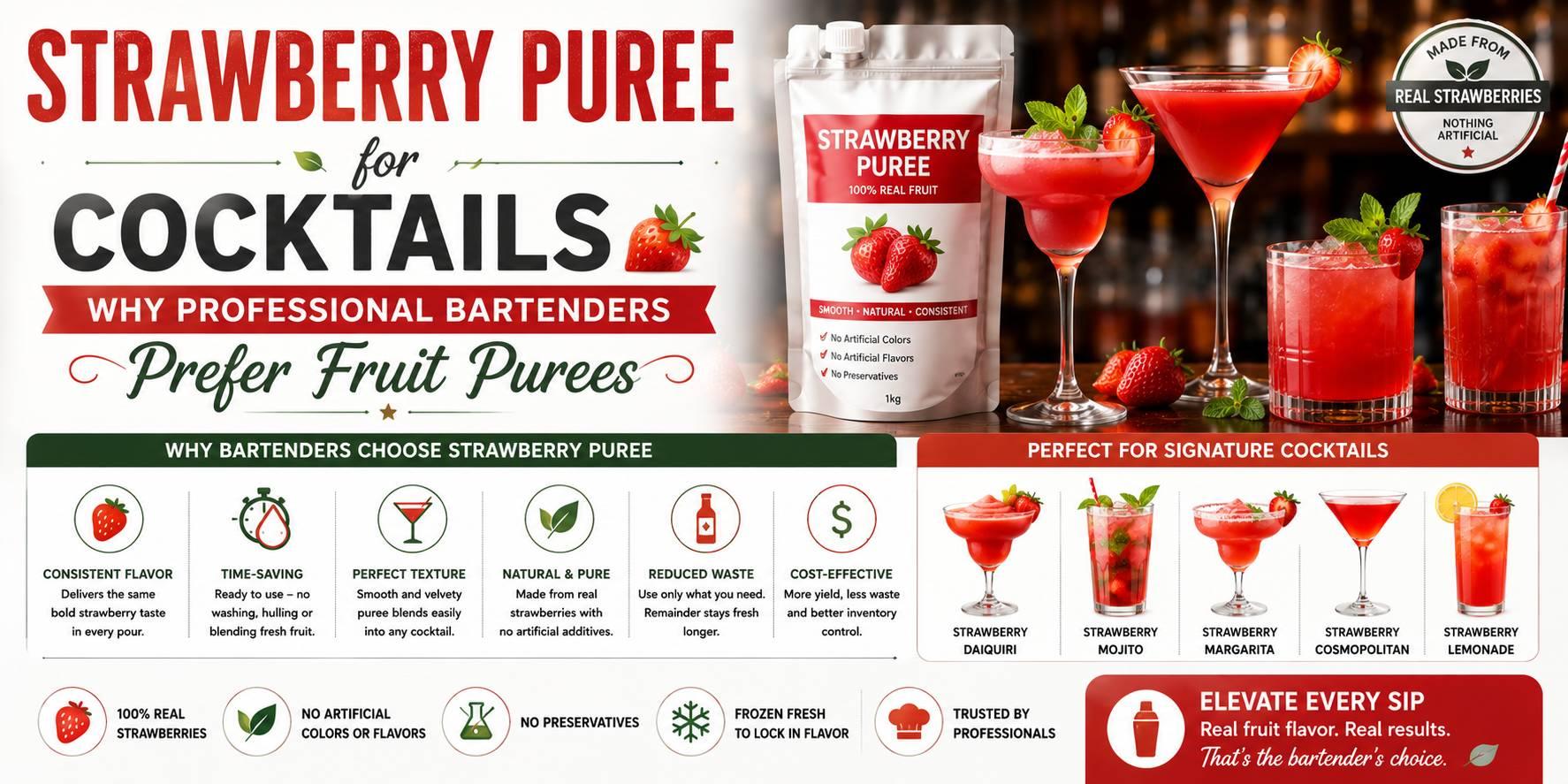
Why do serious bars stop relying on fresh strawberries once drink volume rises? The answer comes down to control. During a rush, strawberry puree for cocktails gives bartenders a stable fruit base that cuts prep time, limits waste, and keeps each pour close to the intended flavor profile. That is one reason premium fruit purees for beverages continue to attract attention across bars, lounges, hotels, and restaurant beverage programs.
Why Fresh Fruit Slows Down Professional Bar Service
Fresh strawberries look appealing at first. In practice, they create service problems that most professional bars cannot ignore. Fruit changes from case to case. One batch tastes sweet, another tastes flat, and a third carries excess water. That variation affects dilution, texture, and color in every drink built with muddled or blended fruit.
Bartenders also lose time on cleaning, trimming, chopping, blending, and straining. Those steps raise labor demand and create uneven output during peak service. When multiple bartenders prepare the same recipe with fresh fruit, the finished drinks rarely match as closely as they should.
Common pressure points include:
-
Inconsistent sweetness across batches
-
Extra prep before service begins
-
More spoilage and discard
-
Slower execution during high-volume hours
For that reason, many operators move to strawberry puree for cocktails when they want tighter menu control and faster service.
How Fruit Puree Improves Cocktail Consistency
A professional bar not only sells flavor. It sells repeatability. Guests expect the second drink to taste like the first, whether they order at opening time or late in the evening. Fruit puree supports that standard because it delivers a more uniform base for shaken drinks, frozen cocktails, spritzes, lemonades, and zero-proof options.
With strawberry puree for cocktails, bartenders get a steadier texture, stronger visual consistency, and better integration with spirits, citrus, syrups, and sparkling mixers. The drink does not depend on how ripe the fruit happened to be that day. That difference changes recipe performance in a real way, especially for bars that batch part of their menu or train multiple staff members on the same build.
Juice Deals already emphasizes ripe fruit, authentic flavor, and ready-to-use convenience. For hospitality buyers, the stronger sales angle goes further. Buyers want a product that keeps recipes stable, reduces training friction, and supports menu execution from one shift to the next.
Where Puree Outperforms Fresh Fruit In Beverage Programs
The business case for strawberry puree for cocktails becomes stronger when the menu depends on speed, appearance, and portion control. Fresh fruit works in limited applications, but puree usually performs better when the bar must protect consistency across a full-service window.
| Beverage Need | Why Puree Works Better |
| Frozen Daiquiris | Delivers body and fruit flavor without repeated blending adjustments |
| Margaritas And Spritzes | Mixes faster and creates a more even color in every serve |
| Mocktails And Lemonades | Holds fruit character without pulp-heavy inconsistency |
| Dessert Drinks And Milkshakes | Adds flavor and texture without extra prep steps |
This matters most in programs that run seasonal menus or signature drinks. A strawberry-based cocktail should not drift in taste because the fruit supplier changed or the prep team handled one batch differently. Puree gives beverage directors a cleaner path to recipe standardization.
What Buyers Should Look For In A Strawberry Puree Supplier
Not every puree fits a bar program equally well. Buyers should look at how the product performs in service, not just how it reads on a product page. Texture, sweetness balance, color retention, pack format, and ease of storage all affect real bar use.
The best premium fruit purees for beverages support cocktails, mocktails, smoothies, and dessert drinks without forcing extra prep behind the bar. They also help managers train staff faster because the fruit component enters the recipe in a more controlled form.
A smart buying checklist includes:
-
Flavor that stays clean beside spirits and citrus
-
Texture that works in both shaken and blended drinks
-
Pack sizes that fit storage and service needs
-
Product messaging that speaks to bars, not only home use
Juice Deals has room to sharpen this point further. Bars and restaurants do not buy fruit puree only for taste. They buy speed, lower waste, easier batching, and stronger drink consistency across the menu.
Conclusion
Professional bartenders choose ingredients that protect execution under pressure. Fresh fruit can work in small-volume settings, but it often adds labor, waste, and variation that busy programs do not want. For operators who value menu control, training efficiency, and a more reliable guest experience, strawberry puree for cocktails remains the stronger professional choice.
 English
Join our community to interact with posts!