
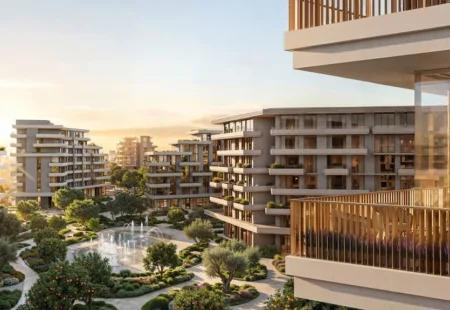
Anyone who's been watching Yas Island over the past few years won't be surprised that Aldar has found another patch of coastline to build on. Yas Point, the AED 6 billion waterfront masterplan the developer just announced, is going up on what's being called one of the last major beachfront plots left on the island. It's a big claim, and a big number, so before getting carried away with projections, let's be honest about where things stand: Yas Point hasn't been built yet. There's no handover date locked in, no tenants, no lease agreements, nothing you could point to and call "rental history." So if a website or a broker tells you exactly what a two-bedroom in Yas Point rents for right now, treat that with a healthy dose of suspicion.
What we can talk about, sensibly, is the market Yas Point is being born into. It sits inside the same catchment as Water's Edge, Ansam, Yas Acres, and the rest of the island's residential mix, and it'll draw from the same pool of tenants once the doors open. That's the market worth understanding if you're weighing this up as an investment.
So what does rent actually look like on Yas Island right now?
It depends a lot on what you're renting, obviously, but here's a rough shape of it. Studios generally go for somewhere between AED 45,000 and 70,000 a year. One-bedroom apartments push that up to the 65,000–100,000 bracket. Two-bedroom units land around AED 95,000 to 140,000, and once you're into three-bedroom townhouses, you're looking at roughly AED 160,000 to 230,000. Villas, especially the bigger ones out in West Yas or Yas Acres, can run north of AED 230,000 and climb toward AED 350,000 for the larger plots.
Averaged across everything on the island, you're looking at something close to AED 136,000 to 143,000 a year — which sounds like a lot until you remember this puts Yas Island only about 15-20% above the mainland Abu Dhabi average, not double or triple it. Given the waterfront setting and the branded-residence angle Aldar Yas Point is pushing with Yas Point, I'd expect it to sit toward the top end of that range once units are actually leasable, possibly above it for beachfront-facing stock.
Rents have moved, but not in a scary way
There's been a decent amount of chatter about UAE rents "finally" coming under control after a few years of aggressive increases, and Yas Island fits that narrative reasonably well. Growth over the past year has sat around 8-9%, with the last six months alone adding roughly 3%. Stack that over two years, and you're probably looking at cumulative growth somewhere in the mid-to-high teens for units in decent locations.
What's kept this from turning into the kind of chaotic price spiral you sometimes see elsewhere is Aldar's habit of releasing new stock in phases rather than dumping everything on the market at once. Combine that with demand that keeps growing — more attractions opening, more people moving to Abu Dhabi, tourism numbers climbing every year — and you get rent growth that's steady rather than erratic. Frankly, that's the kind of market landlords should want. Nobody benefits long-term from a bubble.
Who's actually renting here, and why do they bother
This is where Yas Island gets interesting, because the tenant mix isn't one type of person.
You've got professionals who work in Abu Dhabi (some even commute to Dubai) and have decided the trade-off is worth it — modern buildings, a pool downstairs, and a 20 to 30-minute commute in exchange for living somewhere that doesn't feel like a business park. Then there are families who tend to gravitate toward the villa and townhouse side of the market for the obvious reasons: gated streets, good schools nearby, somewhere for kids to actually run around. Expats and relocators make up another chunk, drawn by the freehold status and the fact that you genuinely don't need to leave the island for much of anything — groceries, healthcare, entertainment, it's all there.
And then there's the F1 crowd and the short-let market generally, which is a real factor here in a way it isn't in most Abu Dhabi neighbourhoods. Grand Prix weekend alone pushes short-term rental demand through the roof, and Yas Island's calendar of concerts and events keeps that demand ticking over year-round rather than being a one-off spike.
Once Yas Point's school and five-star hotel are up and running, it should realistically be able to pull tenants from all four of those groups at once. That's not something every new launch can claim.
Occupancy: tight, but not by accident
Vacancy hasn't really been a problem on Yas Island lately, and that's largely down to supply discipline rather than luck. Listings at any given moment number in the hundreds rather than the thousands, which keeps the market from feeling flooded. Waterfront and canal-view units, unsurprisingly, tend to move fastest — landlords with a view to sell usually aren't the ones sitting on empty units for months.
For a brand-new development like Yas Point, the honest answer is that occupancy will depend heavily on how it's priced relative to everything else on the island once handover actually happens. If Aldar (or whoever ends up managing the leasing) prices sensibly against the existing market rather than charging a steep premium just because it's new, there's no obvious reason it wouldn't fill up at a healthy pace, based on how comparable Aldar launches have gone before.
How does it stack up against the neighbours?
Worth putting some numbers next to each other here. Water's Edge, which is the island's go-to mid-market option, averages roughly AED 108,000-116,000 a year across residential units, with studios closer to AED 82,000. It's not trying to be luxury — it's positioned as the accessible entry point, and it does that job well.
Ansam sits a notch above it, roughly 15-20% higher than Water's Edge, thanks to its golf-course frontage and the Andalusian-style architecture that seems to do wonders for rental appeal (three-bedroom units there reach around AED 290,000). Yas Acres, being villa and townhouse heavy, plays in a different bracket entirely and tends to sit toward the top of that segment.
Where does Yas Point fit into all this? Given it's a branded, beachfront, hotel-anchored community, it's reasonable to expect it to price above Water's Edge and somewhere around or above Ansam once it's actually operating. Branded residences almost always carry a premium over standard apartment stock in this market — that's been true across pretty much every comparable Abu Dhabi launch in recent years.
The landlord's side: good and bad
There's plenty to like if you're the one holding the keys. Aldar's name still carries real weight with tenants, which cuts down on the marketing headache and, generally, the time a unit sits empty. The tourism engine on Yas Island supports both long-term leasing and short-let strategies, so you've got options depending on how hands-on you want to be. And because waterfront land on the island is genuinely running out, Yas Point occupies a spot that simply can't be replicated once it's built out — that scarcity should help protect rents over time.
The flip side is worth being clear-eyed about too. Buying off-plan means years of capital sitting there doing nothing before a single rent cheque comes in. Service charges on branded, amenity-heavy communities tend to run higher than on more basic developments, and that eats into your net yield whether you like it or not. And Yas Point isn't launching into a quiet market — Yas Living, Noya, and further phases of Yas Acres are all in the pipeline at the same time, so landlords will need to actually compete on presentation and pricing rather than assuming a waterfront view sells itself.
If you're buying this for rental income, here's the practical advice
Don't buy into Yas Point purely because the brand name is Aldar and the renders look good — that's marketing, not a yield calculation. If rental income is genuinely the priority, smaller units (studios, one-beds) tend to turn over faster and post stronger yield percentages than the big villas, which are lovely to live in but often soften your gross return. Build service charges into your numbers from day one, not as an afterthought once handover arrives and the bill shows up.
Use the multi-year construction timeline productively — go look at how Aldar's other waterfront launches have actually performed once tenants moved in. That's the closest thing to real data you're going to get until Yas Point has its own track record to point to. Done right, a well-chosen unit here has a genuinely solid shot at steady, tourism-backed rental performance for years. Just go in with eyes open about the wait, and don't let a good location talk you out of doing the maths.
 English
Join our community to interact with posts!