
Introduction
Machine learning has moved far beyond research labs and experimental notebooks. Today, businesses across every industry are pushing models into production, and that shift has created a new set of challenges that traditional software development never had to deal with. This is exactly where the idea of an MLOps platform comes into play. If you have ever wondered what is an MLOps platform and why so many engineering teams are suddenly talking about it, this article breaks it down in plain language, without the jargon overload that usually surrounds this topic.
At its core, an MLOps platform is a set of tools and practices that help teams build, deploy, monitor, and manage machine learning models in a consistent and repeatable way. Think of it as the bridge between the messy, experimental world of data science and the stable, reliable world of production software. Without this bridge, models tend to break, drift, or simply get abandoned after the excitement of the initial build fades away.
Breaking Down What Is an MLOps Platform
To really understand what is an MLOps platform, it helps to look at the problem it solves. Data scientists usually build models on their local machines or in notebooks, using whatever data happens to be available at the time. That process works fine for experimentation, but it falls apart the moment a company tries to run that same model at scale, with real users, real traffic, and constantly changing data.
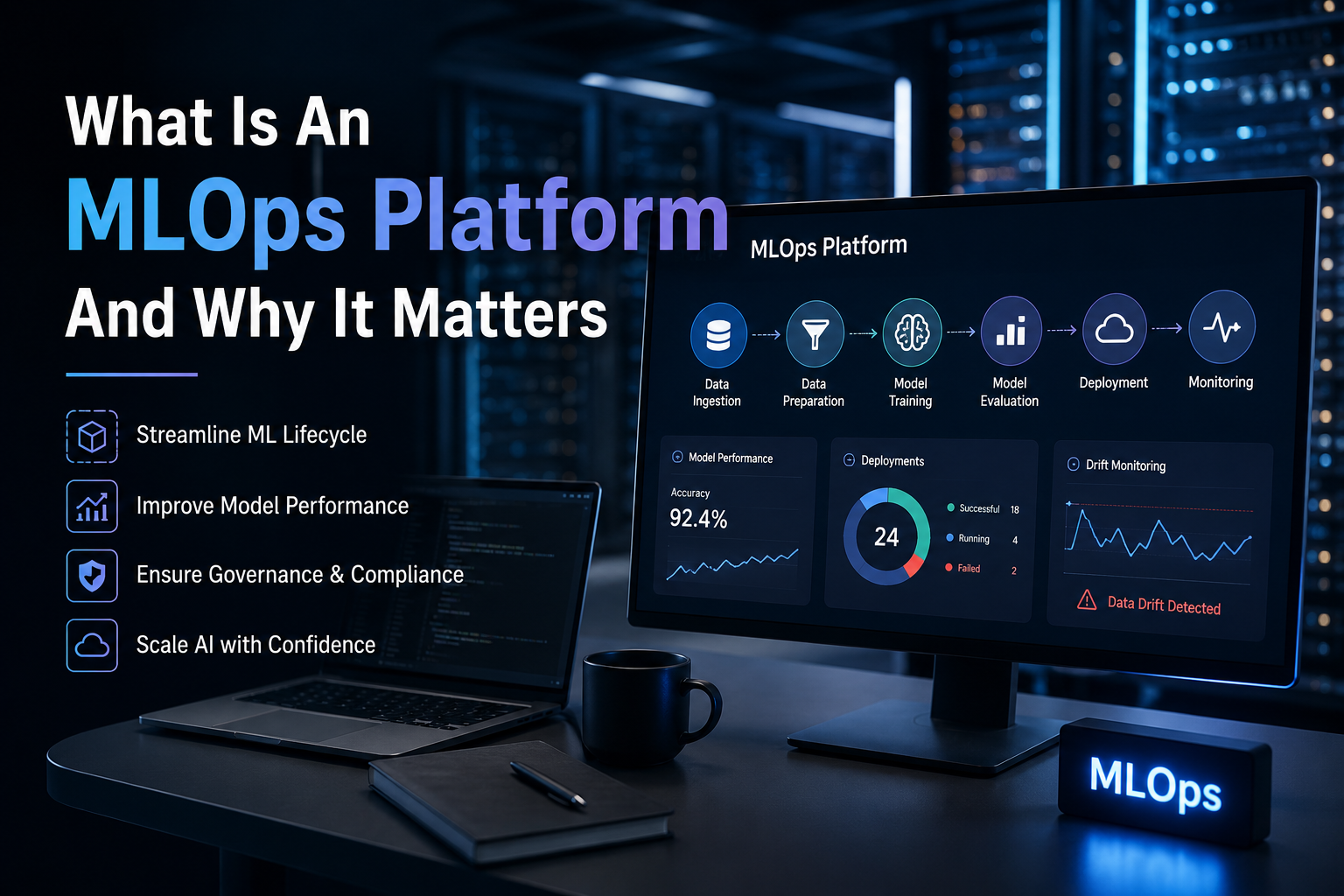
An MLOps platform steps in to standardize this entire journey. It connects the dots between data preparation, model training, testing, deployment, and ongoing monitoring. Rather than treating each of these stages as a separate, disconnected task handled by different teams with different tools, the platform ties everything together into a single workflow. This reduces the chances of errors slipping through and makes it much easier to track why a model behaves a certain way once it is live.
Core Components That Shape a Strong MLOps Platform
A well built MLOps platform usually includes a few recurring elements. There is version control for both code and data, since models are only as good as the data that trains them and any change needs to be traceable. There is also automated testing and validation, which checks whether a new version of a model actually performs better than the one it is replacing before it gets pushed live.
Monitoring is another piece that people often underestimate. Once a model is deployed, its performance can quietly degrade over time as real world data shifts away from the patterns it was originally trained on. A capable MLOps platform keeps an eye on this drift and alerts teams before the damage becomes visible to end users. Collaboration tools round out the picture, allowing data scientists, engineers, and business stakeholders to work from the same source of truth instead of passing files back and forth through email threads.
Why Every Data Team Should Care About an MLOps Platform
It is easy to assume that MLOps is only relevant for massive tech companies with hundreds of models running at once, but that assumption misses the point. Even a small team managing two or three models can benefit enormously from adopting an MLOps platform, simply because it removes the guesswork from deployment.
Without a proper platform, teams often rely on manual scripts and tribal knowledge passed between engineers. When someone leaves the company, that knowledge tends to leave with them, and the next person is left reverse engineering a fragile system. An MLOps platform solves this by documenting workflows as part of the process itself, rather than depending on someone remembering how things were originally set up. It also shortens the time between building a model and actually seeing value from it, which matters a lot when leadership is asking for measurable results.
Choosing the Right MLOps Platform for Your Business
Not every MLOps platform looks the same, and picking one should depend on the size of your team, the complexity of your models, and how much infrastructure you already have in place. Some platforms are built to work closely with a specific cloud provider, while others are designed to remain flexible across different environments. Smaller teams often prefer lighter, more opinionated tools that get them running quickly, while larger organizations may need something that can handle strict governance and compliance requirements.
Cost is another factor worth thinking through carefully. Some platforms charge based on usage, while others require a fixed subscription regardless of how many models you run. It is worth testing a platform with a real workload before committing long term, since the difference between a good fit and a poor one usually only becomes obvious once actual data and actual users are involved.
Final Thoughts
Understanding what is an MLOps platform is really about understanding how modern teams keep machine learning useful long after the first successful experiment. Models are not static products; they need care, monitoring, and regular updates to stay accurate as the world around them changes. An MLOps platform provides the structure needed to manage that ongoing responsibility without burning out the team behind it.
As more companies rely on machine learning for everyday decisions, the gap between teams that have adopted a solid MLOps platform and those still relying on manual processes will likely keep growing. Investing the time to set one up properly now can save a tremendous amount of frustration later, and it turns machine learning from a one time project into a system that keeps delivering value over the long run.
 English
Join our community to interact with posts!