
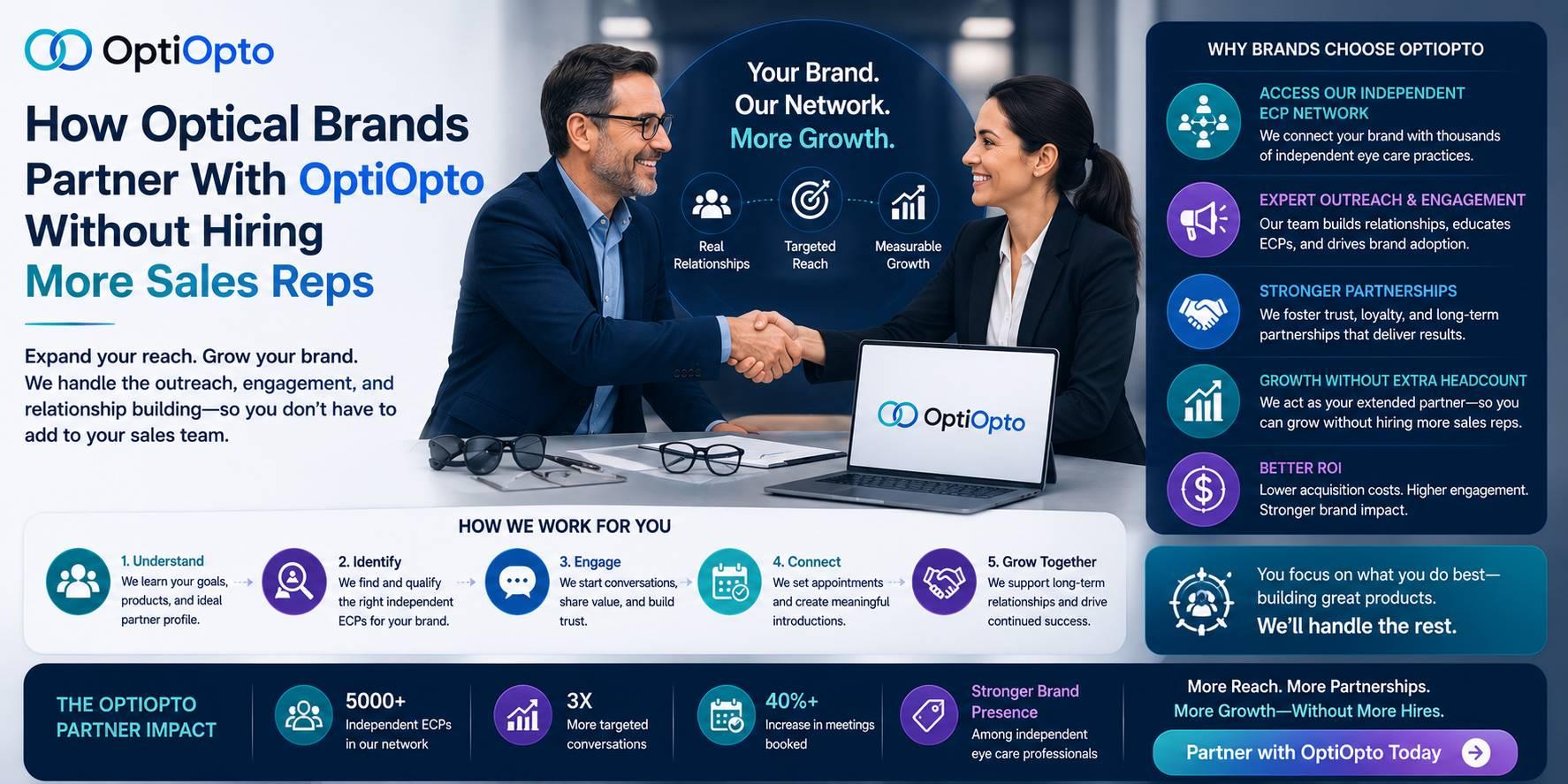
How can an optical manufacturer open new ECP accounts, support product education, and increase reorder activity without adding another layer of payroll? That question has become more important as brands face fragmented territories, uneven account coverage, and longer sales cycles across independent practices. The way optical brands partner with OptiOpto addresses that gap through market access, campaign support, sales technology, and vendor services.
The model does not replace a brand’s internal sales team. It extends what the team can cover. Manufacturers can focus representatives on high-value conversations while a partner platform supports account discovery, follow-up, education, and order activity across a wider practice base.
A Partnership Model Built Around Sales Coverage
Traditional field sales depend on territory size, travel time, rep availability, and the quality of existing account lists. That approach still works, but it leaves gaps. Smaller practices may receive limited attention. New territories may take months to develop. Existing accounts may order once, then disappear from the pipeline.
A partnership platform can organize these missed opportunities into defined sales programs. Brands may target independent optometrists, optical boutiques, multi-location groups, or practices that fit a product category. They can also segment campaigns by geography, purchase history, product interest, or account status.
This structure helps manufacturers expand optical product sales to eyecare practices through focused outreach rather than broad prospecting. A frame company may promote a new collection to practices that serve premium retail buyers. A lens supplier may focus on clinics interested in specialty designs. A contact lens company may build education around a specific patient need. Each campaign starts with commercial fit, not volume alone.
Fractional Sales Support Without Extra Headcount
Hiring a full-time sales representative involves recruitment, onboarding, compensation, travel, management, and a long ramp period. Brands also carry the risk that a new territory may not produce enough revenue to justify those costs.
Fractional sales support changes that calculation. It gives manufacturers trained outreach, lead qualification, account follow-up, and campaign execution without a permanent team. When optical brands partner with OptiOpto, they can test new markets, revive inactive accounts, or support a launch before committing to a larger sales expansion.
The operating value comes from continuity. A campaign does not stop after an introductory email or one sales call. It can introduce the product, answer common questions, deliver education, track engagement, and direct qualified opportunities to the manufacturer.
That approach gives internal representatives better conversations. Instead of making a cold introduction, they can speak with practices that have viewed material, attended a session, requested information, or shown product interest.
What Brands Can Activate Through One Program
A well-designed vendor program should connect promotion, education, sales follow-up, and account administration. Treating each activity as a separate project creates delays and weakens accountability.
Brands can combine several functions within one campaign:
-
New-account outreach for selected ECP segments or territories
-
Co-branded email campaigns, landing pages, and product microsites
-
Product education through video, recorded content, or live sessions
-
Reorder and upsell programs for existing customers
-
Lead qualification and routing to the appropriate sales contact
-
Engagement reporting tied to account response
-
Billing and collection support that reduces administrative friction
These functions help expand optical product sales to eyecare practices because they remove breaks between awareness and purchase. A practice may like a product but still needs staff education, pricing information, a sample request, or a follow-up conversation before ordering. The program keeps those steps connected.
Better Data Creates Better Account Decisions
Sales expansion becomes expensive when brands treat every practice the same. Stronger programs track which messages receive attention, which education formats perform well, which product categories attract interest, and which accounts need direct support.
That information allows manufacturers to separate casual engagement from commercial intent. It also helps them decide where field representatives should spend time. A high-interest account may need a scheduled product conversation. A low-volume customer may respond to a reorder campaign. An inactive account may need a different offer or category.
Reporting also supports budget decisions. Brand leaders can compare activity across territories, product lines, and campaign types. They can identify where education improves conversion, where follow-up stalls, and where account growth justifies more investment.
For manufacturers trying to expand optical product sales to eyecare practices, this account visibility supports better planning than a simple list of leads. It connects marketing activity with sales action and gives teams a more structured view of market response.
A Scalable Route to ECP Growth
Optical manufacturers do not always need more representatives. They need better coverage, stronger account selection, consistent education, and follow-up after the first contact. A partner-led model can provide those capabilities while keeping the manufacturer’s sales team focused on relationships and commercial decisions.
The strongest strategy combines targeted outreach, fractional support, product education, campaign reporting, and smoother account administration. That combination gives brands a measured way to enter new territories, support current customers, and expand optical product sales to eyecare practices without creating a larger fixed sales structure.
 English
Join our community to interact with posts!