
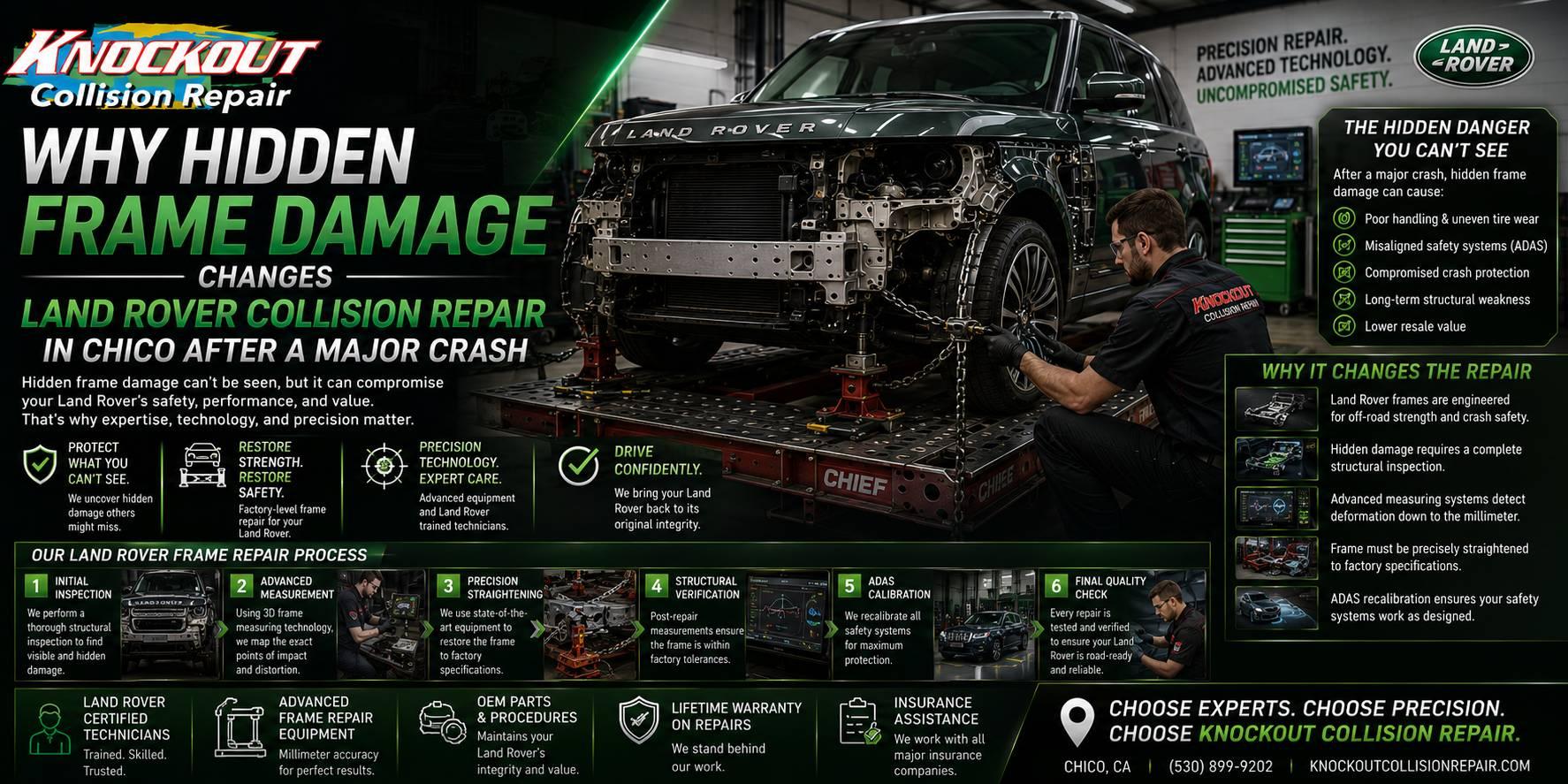
What happens when a Land Rover looks repairable from the outside, yet the impact has shifted parts nobody can see? A cracked bumper or bent fender may show only the first layer. Behind those panels, the crash can disturb rail extensions, suspension mounting points, sensor brackets, and aluminum sections. That is why Land Rover collision repair in Chico needs a measured repair plan, not a visual guess made in the parking lot.
Hidden Damage Usually Appears After Disassembly
The first estimate rarely tells the whole story after a hard collision. Technicians can inspect visible damage, take photographs, and prepare an initial scope. Trim, lamps, liners, undertrays, and bumper assemblies still hide many areas at that stage.
Once disassembly begins, the team may find a bent reinforcement bar, cracked mounting tabs, distorted apron sections, or a rail end that moved only a few millimeters. Those shifts can change door gaps, wheel alignment, hood fit, and sensor position. Proper collision repair in Chico should account for this second stage of discovery instead of treating the first estimate as final.
Knockout Collision Repair works independently rather than through an insurer-controlled direct repair program. That structure lets the repair plan follow documented damage and manufacturer procedures while the owner stays involved in major decisions.
Aluminum Damage Cannot Be Treated Like Steel
Land Rover uses aluminum across several body and structural areas, depending on the model and year. Aluminum behaves differently after an impact. It may stretch, crack near attachment points, or become harder after movement. A technician cannot keep pulling the metal until it looks straight.
During Land Rover collision repair in Chico, the shop must identify the material and review the correct procedure for that exact vehicle. Some parts allow controlled repair. Others need full replacement because heat, cracking, or deformation has changed the metal beyond the manufacturer’s repair limit.
The joining method counts too. The work may call for rivets, structural adhesive, welding, or a set combination. Technicians must also restore corrosion protection afterward. Steel tools should not enter an aluminum repair area. Tiny steel particles can settle into the aluminum and start corrosion beneath the new finish months later.
Structural Measurement Comes Before Straightening
A skilled technician does not judge structural alignment by appearance alone. Modern measuring equipment compares key points on the damaged vehicle with factory dimensions. The readings show where the collision force traveled and which areas moved outside specification.
That process answers practical questions:
-
Did the rail, apron, or floor section move?
-
Are the suspension mounting points still within specification?
-
Does the factory procedure permit repair of the damaged section?
-
Does the manufacturer require sectioning or full replacement?
These findings affect labor, parts orders, repair sequence, and insurance documentation. They also support a supplement when teardown exposes damage that the first estimate could not include. Without measurements, a vehicle can look finished while one structural point remains wrong.
Sensor Brackets Can Shift Without Looking Broken
Modern Defender, Discovery Sport, Range Rover Sport, Velar, and Evoque models may include cameras, radar, parking sensors, blind-spot monitoring, emergency braking, and steering-related data systems. These components depend on exact positioning. A bracket does not need to break before its angle changes.
A front impact may push a radar mount backward. Rear bumper damage can move parking sensor holders. Suspension repairs may change steering-angle readings. Windshield, body, or wheel-alignment work can also trigger a calibration requirement, depending on the model procedure.
For complete collision repair in Chico, technicians should connect structural work with diagnostic scanning. They need to inspect mounting points, review fault codes, check system requirements, and complete or coordinate calibration when the vehicle procedure calls for it. A smooth road test cannot replace scan data or calibration records.
OEM-First Parts Protect More Than Panel Fit
Replacement parts influence gaps, mounting position, corrosion protection, and sensor placement. A bumper cover may look cosmetic, but its shape can affect parking sensor depth. A lamp housing may carry brackets or reference points. Structural parts carry greater responsibility because they help control collision energy.
Knockout Collision Repair prioritizes genuine manufacturer parts and repair planning based on vehicle-maker procedures. The shop also communicates with insurance carriers, records added damage, and helps prepare supplements without removing the owner from the approval process.
Insurers may still request photographs, measurements, invoices, procedure pages, or repair notes. Clear records give the repair facility a sound basis for explaining why a particular part, operation, or calibration belongs in the repair plan.
Final Checks Should Go Beyond Fresh Paint
The final inspection should confirm more than color match and clean panel gaps. Technicians should remeasure repaired points, review scan results, verify sensor mounting, confirm calibration records, and inspect corrosion protection. They should also check lamps, trim, doors, seals, and road behavior where the repair procedure calls for those steps.
A major crash can hide damage in places that do not show during a quick walkaround. Before approving repairs, owners should ask how the facility will measure the structure, research factory procedures, document supplements, and verify electronic systems. Those questions support a clearer, more informed decision about Land Rover collision repair in Chico.
 English
Join our community to interact with posts!