
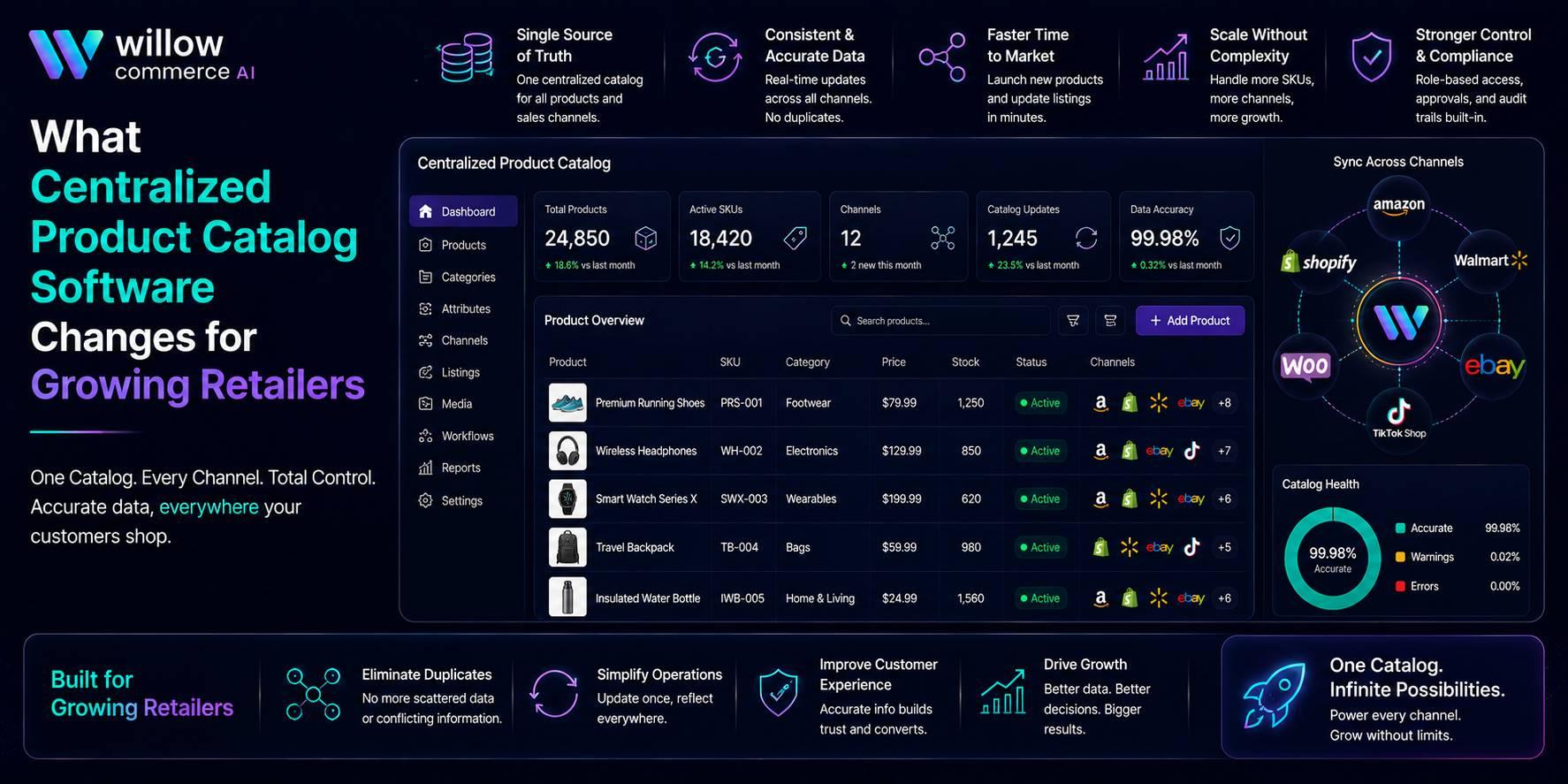
What starts to break first when a retailer adds more products, suppliers, and sales channels? Usually, it is not the storefront. It is the catalog behind it. Product titles stop matching. Images go missing. One team updates a price, while another keeps using the old file. Centralized product catalog software gives growing retailers one place to control that information. Bulk product listing software helps them make large changes without working line by line, while an AI product listing optimizer reduces the time spent cleaning and preparing product content.
Growth Makes Product Data Harder To Control
A small catalog can survive a few spreadsheets. A larger one cannot. The problem gets worse when different teams own different parts of the same product record. Merchandising updates descriptions. Operations tracks inventory. Marketplace teams manage titles and identifiers.
That setup creates quiet problems. A duplicate SKU may appear in two systems. A marketplace may reject a listing because one required field is missing. A warehouse may receive an item under a supplier code that does not match the online record. Staff then check details that should already be clear.
Centralized product catalog software reduces that confusion by creating one master product record. It can hold titles, SKUs, UPCs, images, dimensions, categories, prices, variants, and channel-specific data in the same place.
One Product Record Changes Daily Work
The main advantage is not storage. Retailers already have places to store data. The real change comes from control.
When each department works from one product record, fewer decisions depend on old spreadsheets or private files. Teams can see which information is approved, which fields still need work, and which listings have changed. Ownership also becomes easier to define.
Willow Commerce links product information with inventory, orders, warehouse activity, shipping, and marketplace performance. That gives retailers a broader operating view than a basic catalog database.
Bulk product listing software becomes more useful in this setup. A retailer can update product groups, change categories, revise dimensions, or correct identifiers without opening every listing. An AI product listing optimizer can review missing fields, classify products, and prepare content for each channel.
Automation Works Best On Repeated Tasks
Retailers do not need automation for every catalog decision. Brand language, pricing strategy, and final approval still need human judgment. Repetitive work is different. That is where automation earns its place.
Useful applications include:
-
Turning supplier files into structured product records
-
Matching SKUs, UPCs, ASINs, EANs, and barcodes
-
Finding missing product attributes before publication
-
Updating tags, prices, or descriptions in batches
-
Preparing products for different marketplace taxonomies
-
Connecting available inventory with active listings
-
Managing bundles, kits, multipacks, and product variations
Automation works better when the source data is clean. Poor information does not become reliable just because a system processes it faster.
Centralized product catalog software gives the process a stable foundation. Bulk product listing software handles volume. An AI product listing optimizer helps with classification, enrichment, and channel formatting. Each tool solves a different part of the same problem.
Marketplace Expansion Exposes Weak Processes
Every marketplace asks for product information in its own way. One may require detailed attributes. Another may use a different category structure. A third may apply strict title rules. Retailers often respond by creating another spreadsheet for each channel.
That works for a while. Then the files begin to disagree.
A better system keeps universal product information in one master record and adds channel-specific fields where needed. The retailer does not rebuild the product each time. It adapts the same trusted record.
Willow Commerce supports this approach by combining catalog management with marketplace publishing and identifier matching. The result is a cleaner route from supplier data to a live listing.
Centralized product catalog software protects the core record during that process. Bulk product listing software makes large revisions easier, and an AI product listing optimizer prepares the fields required by each marketplace. The retailer keeps control without slowing every update.
Platform Choice Should Follow Real Workflows
Retailers often compare platforms by looking at dashboards and integration lists. Those details help, but they do not show how the system behaves during daily work.
A stronger review starts with actual catalog problems. Can the software merge duplicate records? Can it manage parent-child products? Can it import supplier files without hours of cleanup? Can teams trace who changed a field? Can the system stop inaccurate stock data from reaching a marketplace?
Retailers should also test failed listings, approval steps, bundles, kits, bulk exports, channel rules, and inventory changes. These tasks reveal more than a feature page.
The right platform should connect catalog data with operations. Otherwise, the retailer may replace several spreadsheets with one more isolated tool.
Conclusion
Retail growth puts pressure on product data long before teams notice a major failure. The best consulting approach is to review where information enters, who approves it, how identifiers connect, and where duplicate work begins. Centralized product catalog software, bulk product listing software, and an AI product listing optimizer should support that process without adding another disconnected layer.
 English
Join our community to interact with posts!