
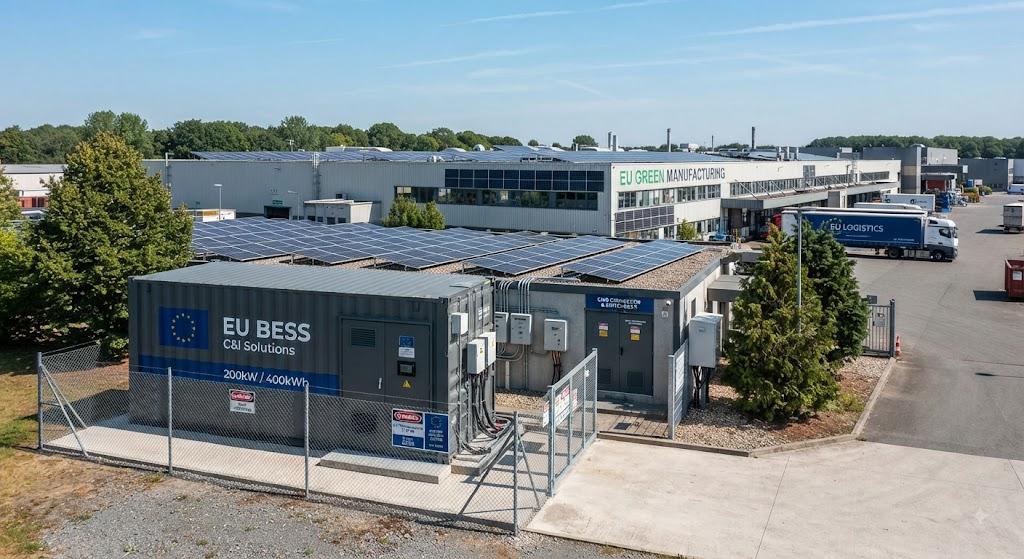
Europe C&I Behind-the-Meter BESS Market: The Role of Batteries in Energy Cost Management
Electricity cost management has become a central consideration for European commercial and industrial energy users. Businesses face changing tariffs, demand charges, renewable integration challenges, and growing pressure to operate efficiently. Behind-the-meter battery storage offers a flexible resource that can help organizations manage these pressures while gaining greater visibility and control over their electricity consumption.
The fundamental concept is straightforward. A battery stores electricity during selected periods and supplies energy when it provides greater economic or operational value. However, the commercial opportunity is more sophisticated than simple time shifting. Modern systems can combine multiple functions, allowing one battery to respond to consumption patterns, solar generation, tariff signals, and grid requirements.
Peak demand management is one of the most compelling applications. Some commercial customers incur charges based on their highest power consumption during defined periods. A battery can discharge during these peaks, lowering the amount of electricity drawn from the grid. The effectiveness of this strategy depends on tariff design, load profiles, battery capacity, and the timing and duration of peak events.
Solar integration provides another strong use case. Many businesses generate renewable electricity onsite but cannot consume all production immediately. Rather than exporting excess energy or curtailing generation, storage can capture part of that output for later use. This can improve onsite solar utilization and reduce purchases during evening or high-price periods.
Market participation can add another layer of value. Where regulations permit, commercial batteries may provide flexibility services through aggregators or energy management platforms. Individual systems can be coordinated into larger virtual resources, enabling smaller sites to contribute to balancing and other grid-support functions without directly participating in wholesale markets themselves.
According to Europe C&I Behind-the-Meter BESS Market Analysis, market development is influenced by the relationship between technology economics and local electricity structures. Country-level differences matter because energy tariffs, network charges, renewable incentives, flexibility markets, permitting requirements, and connection rules can affect project returns.
Software is increasingly central to this value proposition. Energy management platforms can analyze historical consumption, identify peak periods, forecast renewable output, and optimize battery dispatch. More advanced systems can incorporate weather information, electricity price signals, production schedules, and operational constraints. This creates a dynamic strategy for every site.
Battery chemistry and system architecture also affect economics. Lithium-ion technologies remain widely used because of their energy density, established supply chains, and growing deployment experience. Yet customers increasingly evaluate systems based on safety, cycle life, degradation, serviceability, and total cost of ownership rather than energy capacity alone.
Commercial decision makers must also consider operational continuity. A battery can support critical loads during selected interruptions when configured with suitable power electronics and controls. While not every storage project is designed as backup infrastructure, resilience can become a valuable secondary benefit for businesses where downtime creates substantial financial losses.
Financing is another important consideration. High upfront costs can slow adoption even when long-term savings are attractive. Leasing, energy-as-a-service agreements, third-party ownership, and performance-based contracts can change how organizations evaluate projects. These structures may allow businesses to access storage benefits while limiting initial capital expenditure.
Future adoption will increasingly depend on integrated business cases. This matters. Companies are unlikely to deploy batteries solely because storage technology is available. They will compare savings, resilience, sustainability targets, renewable generation, fleet electrification, and operational flexibility within a single energy strategy.
As European electricity systems become more decentralized and variable, behind-the-meter storage can provide businesses with a controllable energy asset. Its strongest opportunity lies in combining several revenue and cost-saving functions through intelligent controls. That approach can make commercial battery systems more valuable, adaptable, and strategically relevant over the long term.
 English
Join our community to interact with posts!