
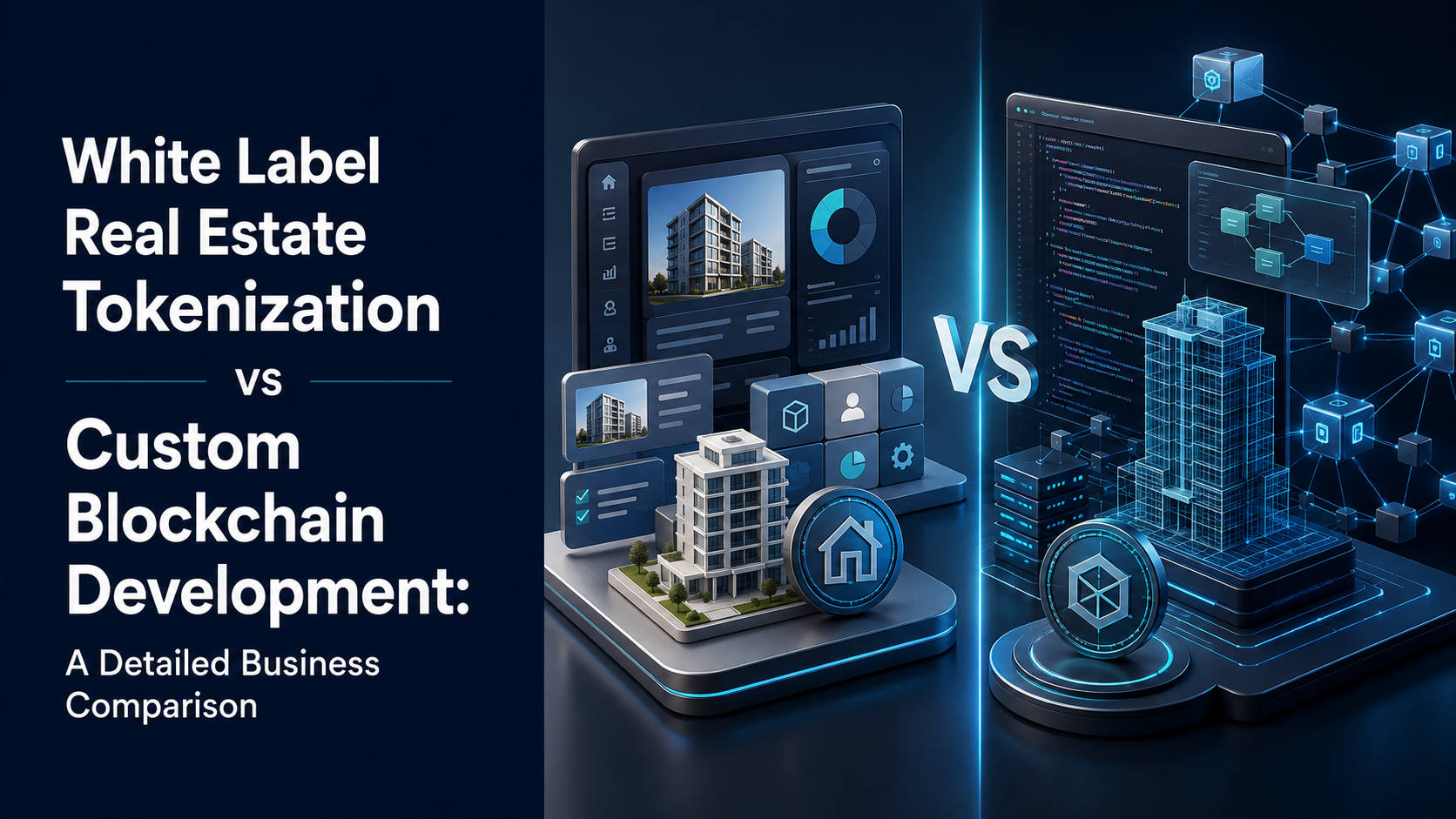
Real estate businesses are increasingly looking at blockchain as a way to represent property ownership digitally, manage investment participation, and create new methods for asset trading. When entering this market, companies generally face two choices: use a White Label Real Estate Tokenization solution or commission a blockchain system from the ground up.
Both approaches can support property tokenization, investor management, token issuance, compliance workflows, and secondary trading. However, they differ greatly in development time, cost, technical involvement, maintenance, business flexibility, and launch requirements. Selecting the right approach depends on the company's budget, business model, target investors, regulatory plans, and long-term technology strategy.
This comparison examines both approaches from a business perspective and explains where each model may fit.
What Is White Label Real Estate Tokenization?
White Label Real Estate Tokenization refers to a ready-made blockchain solution that businesses can launch under their own brand. Instead of creating every component from the beginning, the company starts with an existing platform structure that can be configured according to its business requirements.
A White Label Real Estate Tokenization Platform may include property onboarding, token creation, investor registration, wallet connectivity, KYC and AML workflows, token distribution, payment processing, portfolio management, and trading functions. The business can present the platform under its own brand while relying on an existing technical foundation.
This approach is often considered by property firms, investment businesses, asset managers, fintech companies, and entrepreneurs that want to enter tokenized real estate without spending years developing every blockchain component.
What Is Custom Blockchain Development?
Custom blockchain development involves creating the required real estate tokenization system specifically for a business. Development teams plan the architecture, smart contracts, user interfaces, backend services, databases, compliance functions, wallets, transaction systems, and administrative tools according to the project specification.
The company has greater control over how the platform operates. It can decide how property shares are represented, how tokens are issued, how investors interact with assets, and how internal business processes connect with blockchain infrastructure.
However, this freedom comes with additional development work. Every feature must be designed, tested, integrated, secured, and maintained. The company also needs access to developers with blockchain, smart contract, backend, security, and financial technology experience.
Development Time Comparison
One of the biggest differences between the two approaches is the time needed to reach launch.
White Label Real Estate Tokenization Development generally starts with an existing platform framework. Developers configure the available modules, apply branding, connect required services, adjust business rules, conduct testing, and prepare the platform for deployment. The exact timeline depends on the required features and integrations, but the starting point is much further along than a blank development environment.
Custom blockchain development starts with planning and architecture. The team must determine the blockchain network, token standards, smart contract structure, user roles, database architecture, security model, compliance workflow, and platform interface before moving into development and testing.
For businesses working with a defined launch window, the white label approach can therefore be more practical. Companies with long development cycles and highly specific technology requirements may prefer custom development.
Cost Comparison
Budget planning is another major consideration.
A White Label Tokenization Platform usually reduces initial development expenditure because many technical components already exist. The business may still need to pay for branding, integrations, compliance tools, blockchain services, hosting, security testing, and ongoing platform support. The overall investment depends on the provider and required configuration.
Custom development generally requires a larger initial budget because the development team creates the software architecture and functions specifically for the project. Costs can include product research, UI and UX design, blockchain development, smart contracts, backend systems, APIs, wallets, testing, security audits, infrastructure, and maintenance.
There can also be unexpected expenses when new requirements appear during development. For companies with limited initial capital, this can make a custom system harder to justify during the early business stage.
Feature Flexibility
Custom blockchain development has an advantage when a business requires functions that are not commonly available in standard tokenization platforms. Developers can create business-specific workflows, token rules, investor categories, property structures, payment systems, and administrative processes.
A white label solution may provide a broad collection of functions, but businesses generally work within the platform's available architecture. Some providers offer configuration options and additional development for specific requirements.
This makes the decision largely dependent on the business model. A company following a common real estate tokenization structure may find a White Label Real Estate Tokenization Platform sufficient. A company with unusual ownership structures or highly specialized workflows may have greater reasons to consider custom development.
Branding and User Experience
Brand presentation matters when attracting property owners and investors.
With White Label Real Estate Tokenization Services, the platform can generally be presented using the company's brand identity. This can include logos, colors, domain configuration, interface elements, and other brand-related components depending on the provider.
Custom development gives the business control over the complete interface and user journey. Every screen can be designed around the company's product strategy from the beginning.
The difference is that custom design requires additional planning, design work, development, testing, and revisions. A white label solution can reduce this workload when its existing user experience already matches the business requirements.
Compliance and Investor Management
Real estate tokenization involves more than issuing digital tokens. Businesses may need investor verification, KYC and AML checks, transaction records, jurisdiction controls, ownership records, and restrictions around who can purchase or transfer specific assets.
White label solutions may already include integrations or modules for these functions. This can reduce the amount of technical work required during implementation, although businesses still need to determine their legal and regulatory obligations with qualified professionals.
In custom blockchain development, compliance-related workflows are designed as part of the project. This provides more control but also places greater responsibility on the business and development team to implement and maintain the required functions correctly.
Neither approach removes the need for legal review. Blockchain software can support compliance processes, but regulatory requirements depend on the asset, jurisdiction, investor category, offering structure, and operating model.
Smart Contract Development
Smart contracts are an important part of a tokenized real estate system because they can manage token issuance, ownership records, transfers, distributions, and other predefined actions.
In a white label model, smart contract components may already exist and can be configured or adapted according to the platform's supported functions. This can reduce development work and testing requirements.
Custom blockchain development gives the business greater control over contract logic. Developers can create smart contracts around specific asset structures and transaction rules.
However, custom smart contracts require extensive testing and security review. A coding mistake can create financial or ownership-related risks. Businesses therefore need proper testing and independent security assessment before handling significant transactions.
Maintenance and Upgrades
Blockchain platforms require ongoing maintenance. Networks change, wallet standards evolve, third-party APIs are updated, security threats appear, and regulatory requirements can change.
With White Label Real Estate Tokenization Development, maintenance is often shared between the platform provider and the business, depending on the service agreement. The provider may handle software updates, infrastructure support, bug fixes, and selected technical improvements.
With custom development, the business generally needs an internal technology team or an external development partner for ongoing maintenance. This gives the company more control over updates but also creates continuing technical responsibilities.
For companies without a large blockchain engineering team, the support structure offered by white label providers can be useful.
Security Considerations
Security should be evaluated in both approaches.
A white label platform should be assessed for smart contract quality, wallet security, authentication, access controls, data protection, transaction monitoring, and infrastructure security. Businesses should ask the provider about testing procedures, audits, update policies, and incident response.
Custom development gives the company control over the security architecture, but responsibility for security also becomes greater. Developers must review smart contracts, APIs, authentication mechanisms, databases, wallets, administrative permissions, and blockchain interactions.
A custom platform is not automatically safer simply because it is developed from scratch. Security depends on engineering quality, testing, audits, infrastructure practices, and ongoing monitoring.
Business Control
Custom development generally offers greater control over the technology stack. A company can select its blockchain network, architecture, integrations, database model, smart contract structure, and feature roadmap.
A White Label Real Estate Tokenization Platform offers a different type of control. The business controls its branding, property offerings, investor strategy, operational model, and selected platform settings, while the provider manages much of the underlying software structure.
For an early-stage company, this trade-off may be attractive because it allows the business to focus more attention on properties, investors, partnerships, and market operations rather than managing every technical component.
When Should a Business Choose White Label?
A white label model can be suitable when the company wants to launch within a shorter development cycle and avoid the expense of creating every blockchain component from scratch.
It may also suit businesses that have a limited technical team, want to test a tokenized real estate business model, need commonly requested investor and property management functions, or prefer ongoing technical support from a specialized provider.
White Label Real Estate Tokenization Services can also be useful for companies that expect their requirements to evolve as they gain market experience. Instead of spending a large amount before validating the business model, the company can begin with a practical platform and expand its technology requirements later.
When Should a Business Choose Custom Development?
Custom blockchain development may make more sense when the company has highly specific requirements that cannot be handled through existing platform functions.
For example, a large investment organization may need complex asset structures, specialized investor permissions, unique distribution logic, proprietary integrations, or a blockchain architecture designed around internal systems.
Custom development can also be appropriate for companies that intend to make blockchain technology a major part of their long-term technology strategy and have the budget and technical resources to manage continuous development.
The decision should not be based only on the desire for more features. Businesses should first determine whether those features have a direct business purpose and whether their expected value justifies the additional development expense.
White Label vs Custom Blockchain Development: Quick Comparison
| Factor | White Label Approach | Custom Development |
|---|---|---|
| Initial development time | Usually shorter | Usually longer |
| Initial cost | Generally lower | Generally higher |
| Branding | Available through platform configuration | Full design control |
| Feature flexibility | Depends on provider | High |
| Technical responsibility | Shared with provider | Primarily business and development team |
| Maintenance | Often provider-supported | Requires dedicated support |
| Smart contracts | Existing or adapted contracts | Developed specifically for the project |
| Launch strategy | Suitable for faster market entry | Better for specialized products |
| Long-term control | Depends on provider agreement | High |
| Technical resources | Lower requirement | Higher requirement |
How to Select the Right Approach
Businesses should begin by defining the property types they plan to tokenize, target investor groups, jurisdictions, expected transaction volume, compliance requirements, payment methods, and required platform functions.
Next, they should compare the estimated cost of custom development against the licensing or service cost of a white label solution. The comparison should also include maintenance, security testing, infrastructure, integrations, legal expenses, and future development.
A practical evaluation should consider the first version of the platform rather than every possible future feature. If an existing platform meets most current requirements, white label development may provide a more reasonable starting point. If the business has requirements that cannot be supported through an existing architecture, custom development may justify its higher cost and longer timeline.
Conclusion
White Label Real Estate Tokenization and custom blockchain development serve different business needs. A white label approach can reduce development time, lower initial technical workload, and provide access to established tokenization functions, while custom blockchain development gives companies greater control over architecture, smart contracts, integrations, and specialized workflows. The right decision depends on budget, launch plans, technical resources, compliance requirements, and the complexity of the intended real estate investment model. Companies seeking a practical route into property tokenization can evaluate a White Label Real Estate Tokenization Platform before committing to a long custom development cycle, while businesses with highly specialized requirements may find custom development more appropriate. Blockchain App Factory provides White Label Real Estate Tokenization Services for businesses looking to establish branded real estate tokenization platforms with the functions required for their business model.
FAQs
1. What is the main difference between white label and custom real estate tokenization?
White label development starts with an existing tokenization platform that can be configured for a business, while custom development creates the platform specifically for the company's requirements.
2. Is White Label Real Estate Tokenization cheaper than custom development?
It can be less expensive initially because many software components already exist. The final cost depends on platform features, integrations, branding, compliance tools, support, and licensing arrangements.
3. How long does White Label Real Estate Tokenization Development take?
The timeline depends on the provider, platform functions, integrations, branding requirements, compliance setup, and testing. It is generally shorter than developing a complete blockchain platform from the beginning.
4. Can a white label platform support property tokenization?
Yes. A White Label Real Estate Tokenization Platform can support functions such as property onboarding, token issuance, investor management, wallet integration, compliance workflows, and token transactions, depending on the platform.
5. Does custom development provide more control?
Yes. Custom development generally gives the company greater control over blockchain architecture, smart contracts, platform logic, integrations, interface design, and future technical changes.
6. Which option is better for a startup?
A white label solution can be practical for startups that want to enter the market with a lower initial technical burden. Custom development may be considered later if the business requires functions beyond the capabilities of its initial platform.
7. What should businesses check before selecting a White Label Tokenization Platform?
Businesses should review supported blockchain networks, smart contract practices, security procedures, investor management, KYC and AML integrations, wallet functions, payment options, property management features, customization options, maintenance, technical support, and contract terms.
8. Can a white label platform be expanded later?
Expansion depends on the provider and platform architecture. Businesses should discuss additional integrations, new property types, investor features, secondary trading functions, and future development requirements before selecting a provider.
 English
Join our community to interact with posts!