
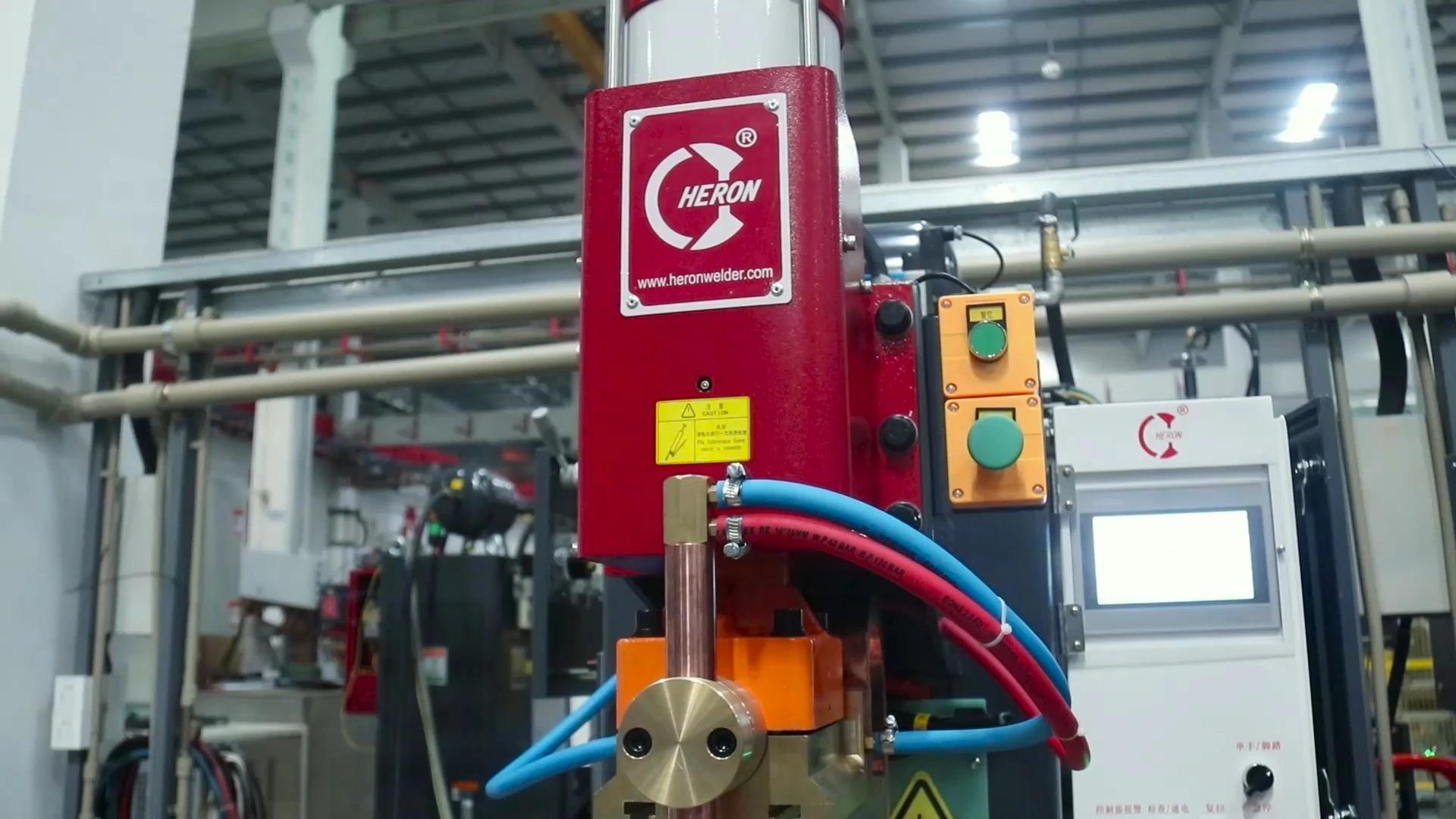
A spot welder is a practical solution for manufacturers that need fast, repeatable, and efficient metal joining. By applying controlled electrical current and pressure to overlapping metal components, resistance spot welding can create secure localized joints without additional filler material. Heron-Welder specializes in resistance welding technology, offering industrial solutions designed to support consistent production, reliable weld quality, and efficient manufacturing processes.
Understanding Resistance Spot Welding
Resistance spot welding works by positioning workpieces between electrodes and applying mechanical pressure. Electrical current then passes through the contact area, generating heat from electrical resistance. This localized heat creates a weld nugget that joins the components.
The quality of the resulting joint depends on several factors, including welding current, weld time, electrode pressure, material properties, electrode condition, and workpiece alignment.
A properly configured spot welder provides manufacturers with control over these important parameters. Heron-Welder focuses on resistance welding technology, helping businesses identify equipment suited to their materials, components, production volumes, and process requirements.
Why Welding Consistency Matters
Industrial production frequently involves repeating the same joining operation across large quantities of components. Even small variations in welding conditions can influence joint quality, rework rates, and production efficiency.
A reliable spot welder can help maintain controlled welding conditions over repeated cycles. Consistent current delivery, appropriate pressure, accurate timing, and stable electrode positioning all contribute to repeatable weld formation.
Heron-Welder develops resistance welding solutions with industrial process stability in mind. By supporting controlled welding parameters, its equipment can help manufacturers establish more predictable production processes and maintain consistent results.
Key Benefits of Spot Welding
Resistance spot welding offers several advantages for businesses seeking efficient metal joining technology.
Important benefits include:
- Fast and repeatable welding cycles
- Efficient joining of overlapping metal sheets
- Controlled electrical energy delivery
- Consistent weld placement
- Reduced need for additional joining materials
- Compatibility with automated production systems
- Support for high-volume manufacturing
- Efficient integration into production workflows
These characteristics make resistance spot welding suitable for many industrial applications.
Heron-Welder provides specialized equipment designed to help manufacturers apply these advantages according to their individual production requirements.
Applications Across Industrial Manufacturing
A spot welder can be used in numerous industries where metal components need to be joined efficiently and consistently.
Automotive Manufacturing
Automotive production is one of the major applications for resistance spot welding. Vehicle bodies, brackets, reinforcement components, and sheet metal assemblies can require large numbers of repeatable welds.
Sheet Metal Fabrication
Manufacturers working with sheet metal can use resistance welding for suitable overlapping joints. Machine configuration can be selected according to material thickness, component geometry, and weld accessibility.
Appliance Manufacturing
Appliances contain numerous metal components that require secure and consistent joining. Resistance welding can support repetitive production operations while maintaining controlled welding conditions.
Electrical Equipment
Metal enclosures and electrical components can benefit from resistance welding when the materials and joint designs are appropriate for the process.
General Metalworking
Industrial machinery, hardware, and fabricated metal assemblies can also incorporate resistance welding into their production workflows.
Heron-Welder's resistance welding solutions are designed to support a variety of industrial joining requirements.
Improving Production Efficiency
Manufacturers increasingly need to increase productivity while maintaining consistent quality. Welding equipment can have a direct impact on production speed because repetitive joining operations are often performed throughout an assembly process.
A well-configured spot welder can complete repeated welding cycles efficiently. When combined with suitable fixtures and material handling systems, resistance welding can help streamline manufacturing operations.
Automation can provide additional advantages. Automated electrode movement, component positioning, and welding cycles can reduce unnecessary manual handling and support standardized production procedures.
Heron-Welder helps manufacturers explore resistance welding solutions that can fit into modern production environments. Its focus on industrial applications allows businesses to consider welding equipment as part of a complete manufacturing workflow rather than as an isolated machine.
Selecting the Right Welding Equipment
Choosing suitable welding equipment requires careful evaluation of the application.
Material and Thickness
Manufacturers should identify the metals and thickness ranges involved in production. These factors influence the required welding parameters and equipment configuration.
Component Geometry
The size, shape, and accessibility of each component can affect electrode selection and tooling requirements.
Welding Parameters
Current, pressure, and weld time must be appropriately controlled to achieve repeatable results. Equipment should provide suitable adjustment and monitoring capabilities.
Production Volume
High-volume operations require machines capable of maintaining stable performance over extended production cycles.
Automation Requirements
Businesses should determine whether manual, semi-automatic, or automated operation is most suitable for their workflow.
Equipment Maintenance
Regular inspection of electrodes, connections, cooling systems, and mechanical components can help preserve welding performance and minimize unnecessary interruptions.
Why Choose Heron-Welder?
Heron-Welder specializes in resistance welding equipment and industrial welding applications. This focused expertise enables manufacturers to evaluate equipment based on actual production requirements.
For businesses searching for a dependable spot welder, Heron-Welder provides solutions designed around process control, consistent performance, and efficient metal joining.
The company's application-oriented approach considers important factors such as materials, component design, production volume, welding parameters, and automation. This helps manufacturers select technology that aligns with their operational objectives.
Heron-Welder's focus on resistance welding also provides businesses with access to specialized knowledge when developing or improving industrial welding processes.
Building a More Reliable Production Process
Effective welding depends on more than machine performance alone. Electrodes, tooling, fixtures, workpiece preparation, electrical characteristics, and process parameters all contribute to final results.
Heron-Welder supports manufacturers with resistance welding technology designed to work within these broader production requirements. By establishing appropriate parameters and maintaining equipment correctly, manufacturers can improve process consistency and create more dependable workflows.
As factories move toward greater automation, reliable resistance welding equipment can also provide a strong foundation for scalable manufacturing.
Conclusion
A spot welder offers an efficient and repeatable solution for joining metal components in many industrial applications. With appropriate control of electrical current, pressure, timing, and electrode movement, manufacturers can achieve consistent joining performance across demanding production cycles.
Heron-Welder provides specialized resistance welding solutions designed to support industrial productivity, process stability, and dependable equipment performance. Its application-focused approach helps manufacturers evaluate welding technology according to their materials, components, production requirements, and automation goals.
For businesses seeking reliable resistance welding equipment, Heron-Welder offers practical solutions designed to strengthen manufacturing processes and support efficient, consistent long-term production.
 English
Join our community to interact with posts!