
Introduction
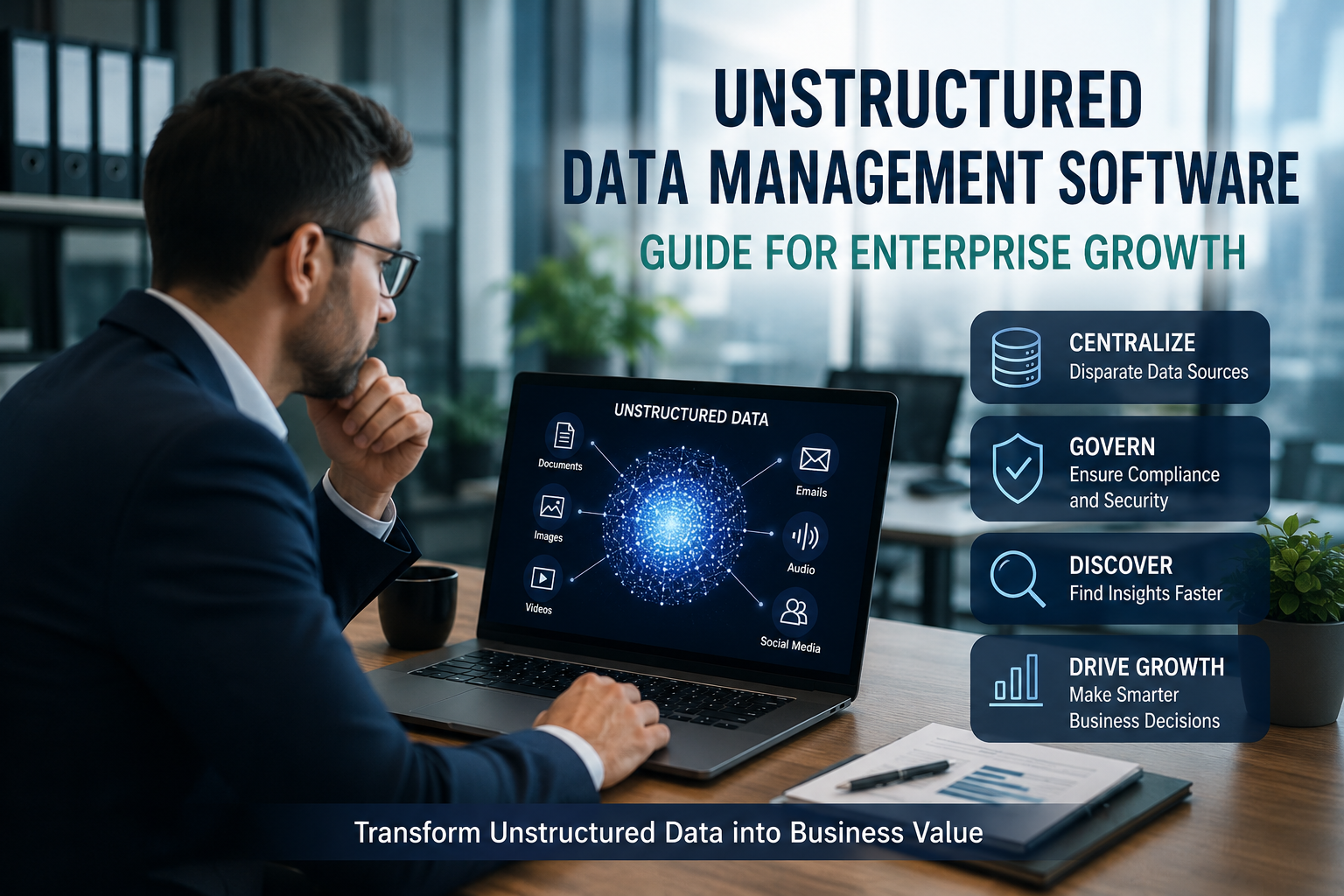
Modern organizations generate massive volumes of information every single day, yet a overwhelming majority of this digital content exists without a predefined format. Text documents, PDF files, corporate emails, customer service audio logs, videos, and complex machine logs accumulate rapidly across cloud environments and internal servers. Managing this chaotic flood of information presents a significant operational hurdle for growing businesses. Without proper organizational frameworks, valuable strategic insights remain locked inside inaccessible digital archives. Implementing dedicated unstructured data management software enables enterprises to clean, categorize, analyze, and secure unstructured assets at scale. By establishing structural clarity over raw content, forward-thinking organizations transform overwhelming storage burdens into active catalysts for business intelligence, operational efficiency, and sustainable revenue growth.
Understanding the Core Architecture of Unstructured Data Platforms
Modern software systems built for non-tabular content operate very differently from conventional relational databases. Traditional engines rely heavily on strict rows, columns, and fixed tables, whereas specialized systems process arbitrary formats through artificial intelligence, natural language processing, and automated metadata tagging. The underlying architecture relies on scalable object storage repositories, vector database indices, and intelligent extraction pipelines that ingest diverse files continuously.
When deploying unstructured data management software, technical teams gain immediate visibility into previously dark storage pools. The system scans inbound documents, extracts contextual metadata, identifies semantic relationships, and applies policy-driven governance across the entire information lifecycle. This automated parsing allows employees to locate specific business context in seconds through contextual search queries rather than hunting through thousands of unorganized folders.
Key Benefits of Modernizing Information Infrastructure
Deploying robust unstructured data management software across corporate networks delivers immediate and measurable advantages. The primary advantage centers around total risk reduction and enhanced compliance. Unorganized files frequently contain sensitive personally identifiable information, proprietary intellectual property, or confidential customer details. Enterprise management software automatically identifies sensitive items, enforces strict role-based access permissions, and logs user activity to keep operations aligned with evolving privacy laws.
Beyond security, optimized infrastructure dramatically reduces overall cloud storage expenses. Advanced platforms identify redundant, obsolete, or trivial files across multi-cloud environments. By automatically archiving inactive assets to low-cost tier storage and removing duplicate records, companies reclaim significant IT budget allocations. Furthermore, unlocking these massive content stores fuels generative artificial intelligence tools, providing internal teams with precise context for smarter decision-making, predictive analytics, and automated workflow triggers.
Essential Capabilities to Look for Before Adoption
Selecting the ideal platform requires careful evaluation of technical capabilities, integration options, and user usability. Scalability stands out as a critical operational metric. The ideal platform must process petabyte-scale growth without performance degradation, latency issues, or service interruptions. Seamless integration with existing cloud storage lakes, enterprise applications, and analytical warehouses ensures smooth deployment across legacy and modern tech stacks.
| Feature Evaluation Area | Practical Enterprise Impact | Strategic Business Value |
| Semantic AI Search | Understands context and natural queries across text, audio, and images. | Eliminates manual research time and accelerates decision-making. |
| Automated Data Lifecycle | Moves stagnant files to cold storage tiers based on defined business rules. | Significantly reduces primary cloud storage spending. |
| Granular Access Control | Enforces document-level security rules and tracks complete file activity audit trails. | Protects sensitive intellectual property and prevents regulatory fines. |
| Generative AI Readiness | Prepares, cleans, and converts raw text into vector embeddings for model training. | Unlocks accurate enterprise search and domain-specific automation. |
Evaluating specialized unstructured data management software against these structural criteria guarantees long-term return on investment, operational agility, and high platform adoption rates across non-technical business units.
Operational Strategies for Enterprise Deployment
Successfully rolling out unstructured data management software requires a clear phased strategy combined with active stakeholder collaboration. Organizations often fail when attempting to process every legacy record simultaneously without establishing baseline policies. A structured implementation model prevents early operational strain while validating platform value early in the lifecycle.
First, conduct a comprehensive discovery audit to map current data repositories, access points, and file formats. Identify high-priority business units, such as legal document archives, customer support logs, or engineering research files, where unstructured content density is highest.
Second, establish clear data classification standards, defining which file types require immediate metadata extraction, retention schedules, or strict encryption protocols.
Third, connect the platform to target storage repositories in read-only mode to perform initial inventory indexing and duplicate detection.
Fourth, launch controlled pilot workflows for business units, gathering continuous user feedback to refine search accuracy, automated tagging rules, and access permissions.
Finally, expand integration across all corporate systems, automate continuous policy enforcement, and regularly monitor system performance dashboards.
Conclusion
The exponential growth of non-tabular information represents both a complex management challenge and an unprecedented commercial opportunity. Organizations that ignore unorganized content risk escalating storage costs, severe security vulnerabilities, and missed operational insights. Investing in modern unstructured data management software gives enterprises complete visibility, intelligent search tools, and robust security controls over their entire digital footprint. By converting chaotic, static file stores into actionable business intelligence, enterprises safeguard their critical infrastructure while positioning themselves for sustainable competitive success.
 English
Join our community to interact with posts!