
Market Overview
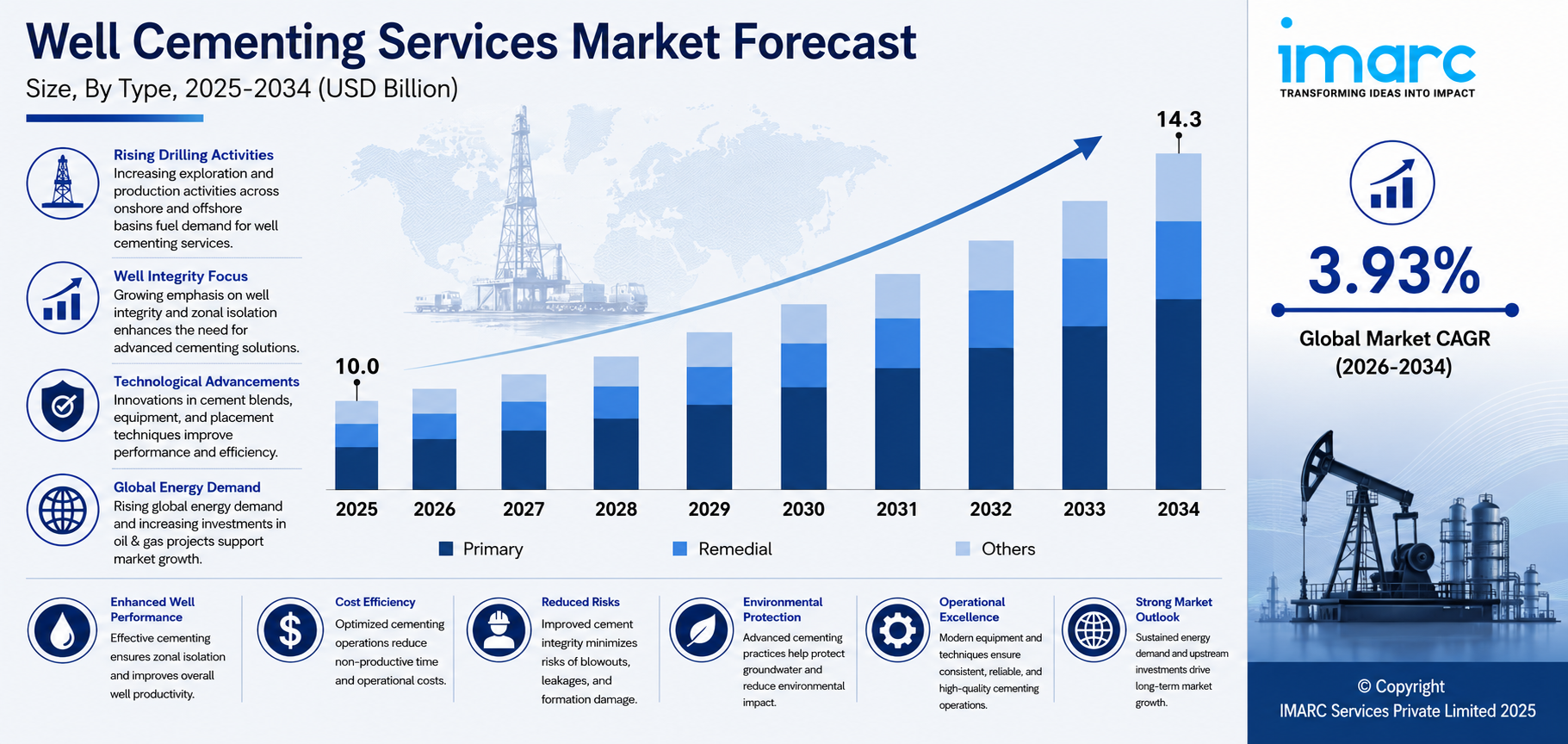
According to a research report by IMARC Group, the global well cementing services market size reached USD 10.0 Billion in 2025. Looking forward, IMARC Group estimates the market to reach USD 14.3 Billion by 2034, exhibiting a growth rate (CAGR) of 3.93% during 2026-2034. North America currently dominates the regional landscape, holding a market share of 42.1% in 2025. Market growth is primarily driven by rising demand for Enhanced Oil Recovery (EOR) methods, ongoing innovations in cementing technologies for challenging drilling conditions, increasing oil and gas production, particularly in offshore and deepwater environments, and a growing emphasis on environmental sustainability and eco-friendly cementing solutions.
Well Cementing Services Market Key At a Glance
-
Base Year: 2025
-
Historical Period: 2020–2025
-
Forecast Period: 2026–2034
-
Market Size (2025): USD 10.0 Billion
-
Market Forecast (2034): USD 14.3 Billion
-
CAGR (2026–2034): 3.93%
-
Leading Region: North America
-
North America Market Share (2025): 42.1%
Request for a Sample Report for Detailed Evaluation: https://www.imarcgroup.com/well-cementing-services-market/requestsample
Well Cementing Services Market Report: Key Highlights
-
Market Size & Growth: The global well cementing services market reached USD 10.0 Billion in 2025 and is projected to reach USD 14.3 Billion by 2034, registering a CAGR of 3.93% during 2026–2034.
-
Regional Leadership: North America leads the market with a 42.1% share in 2025, supported by its robust oil and gas industry, strong unconventional resource extraction, advanced infrastructure, technology adoption, and growing CCUS activities.
-
Major Market Drivers: Rising oil and gas production, increasing demand for Enhanced Oil Recovery (EOR), technological advancements in cementing materials and pumping equipment, growing exploration and production activities, and strict environmental regulations are supporting market expansion.
-
Key Market Trends: Growing adoption of EOR well cementing services, advancements in cementing technologies for complex environments, increasing use of specialized cementing materials, and greater emphasis on low-carbon and environmentally sustainable solutions are shaping the market.
-
By Type: The market is segmented into primary, remedial, and others. Primary cementing dominates the market with a 78.9% share in 2025.
-
By Well Type: The market covers oil, gas, and shale gas wells. Oil wells account for the largest share at 46.0% in 2025.
-
By Application: The market is divided into onshore and offshore applications, with onshore accounting for 83.8% of the market share in 2025.
-
Key Challenges: Higher costs associated with specialized cementing solutions and the technical complexities involved in challenging drilling environments can constrain market growth.
-
Emerging Opportunities: Development of advanced cement formulations, low-carbon cementing technologies, CCUS applications, EOR activities, and growing exploration and production in emerging markets are creating new opportunities.
What Is Driving Well Cementing Services Market Growth in 2026?
Rising Demand for Enhanced Oil Recovery (EOR)
The increasing demand for Enhanced Oil Recovery (EOR) methods represents one of the major factors supporting the growth of the well cementing services market. As oil fields mature, operators are increasingly adopting EOR techniques to improve recovery rates and extend the productive life of existing reservoirs.
EOR methods, including water flooding, gas injection, and thermal techniques, require effective wellbore integrity and zonal isolation to prevent fluid migration and leakage. Well cementing plays a critical role in maintaining these conditions, particularly in complex and high-pressure reservoir environments.
The adoption of advanced cementing materials and technologies is further enabling service providers to improve sealing performance in challenging environments such as deepwater and high-pressure, high-temperature reservoirs. As operators increasingly focus on maximizing recovery from existing fields rather than relying solely on new exploration, demand for cementing services supporting EOR operations is expected to increase.
Rising Oil and Gas Production
The continued expansion of oil and gas production is another important factor driving market growth, particularly in offshore and deepwater drilling. Increasing exploration and production activities are creating greater demand for well construction, integrity, sealing, and maintenance services.
As drilling activities expand into technically demanding environments, operators require specialized cementing solutions capable of maintaining well integrity under high pressures, temperatures, and other challenging conditions. This is increasing the importance of advanced cement formulations and efficient pumping equipment.
Growing exploration and production activities across emerging markets, including the Middle East, Africa, and Asia Pacific, are also creating additional demand for well cementing services.
Advancements in Cementing Technology
Continual advancements in cementing technology are transforming well construction operations by addressing increasingly complex drilling requirements. Technologies such as expandable cements, microannulus cementing techniques, and fiber-reinforced cement are enabling service providers to address well integrity challenges that may not be effectively managed using conventional solutions.
These technologies can help prevent leakage, improve zonal isolation, and seal microfractures that may develop during drilling. Expandable cement can accommodate changes in the wellbore and provide improved sealing performance, while microannulus cementing techniques support effective zonal isolation.
As exploration and production activities move toward deeper and technically more complex environments, demand for high-performance cementing technologies is expected to increase.
Well Cementing Services Market Segmentation Analysis
IMARC Group provides an analysis of the key trends in each segment of the global well cementing services market, along with forecasts at the global, regional, and country levels for 2026-2034. The market has been categorized based on type, well type, and application.
By Type
-
Primary
-
Remedial
-
Others
The primary cementing segment dominates the market with a 78.9% share in 2025, driven by its essential role in ensuring wellbore integrity and preventing fluid migration during drilling and production. Primary cementing is the most commonly used cementing method because of its reliability, cost-effectiveness, and broad applicability across conventional and unconventional oil and gas wells.
Primary cementing creates a strong bond between the casing and formation, preventing leaks and ensuring zonal isolation, which is critical to successful drilling operations. Advancements in cementing technologies, including specialized cement slurries, are further optimizing primary cementing performance and supporting its widespread adoption. The growing emphasis on wellbore safety, environmental protection, and operational efficiency is also contributing to segment dominance.
By Well Type
-
Oil
-
Gas
-
Shale Gas
The oil wells segment dominates the market with a 46.0% share in 2025, supported by continued demand for crude oil across various industries. Oil wells require specialized cementing solutions to ensure wellbore integrity, achieve zonal isolation, and prevent fluid migration during drilling and production.
As conventional oil reserves become increasingly difficult to access, advanced cementing materials are helping address challenges associated with high pressures, temperatures, and corrosive environments. Technological improvements in cement slurry formulations are also helping make operations more efficient and cost-effective, supporting continued demand for cementing services in oil wells.
By Application
-
Onshore
-
Offshore
The onshore segment dominates the market with an 83.8% share in 2025, primarily due to the higher concentration of oil and gas exploration and production activities on land. Compared with offshore wells, onshore operations are generally less complex and cost-intensive, making them more accessible to both large and independent operators.
Demand for cementing services is particularly strong in regions with significant onshore reserves, including North America, the Middle East, and parts of Asia. Easier logistics and lower operating costs also support onshore drilling activities, while the continued expansion of shale oil and gas operations is further strengthening demand for well cementing services.
By Region
-
North America: United States, Canada
-
Asia Pacific: China, Japan, India, South Korea, Australia, Indonesia, Others
-
Europe: Germany, France, United Kingdom, Italy, Spain, Russia, Others
-
Latin America: Brazil, Mexico, Others
-
Middle East and Africa
North America currently leads the global well cementing services market, accounting for 42.1% of the market share in 2025. The region benefits from a robust oil and gas industry, particularly strong unconventional resource extraction in shale plays such as the Permian Basin. Advanced infrastructure, widespread technology adoption, and established regulatory frameworks are also supporting market development.
The United States represents a key market within North America, supported by high levels of shale exploration and production. Increasing demand for wellbore integrity and sealing solutions, along with environmental regulations and the expansion of CCUS projects, is creating additional opportunities for specialized cementing services.
Europe's market is primarily driven by offshore oil and gas production, decommissioning activities, and the growing focus on renewable energy and energy transition. Norway, the United Kingdom, and the Netherlands are important regional markets due to their extensive offshore fields and investments in energy transition. Growing interest in low-carbon cementing solutions and geothermal energy projects is also expanding the range of applications for well cementing services.
Asia Pacific is benefiting from increasing investments in crude oil and natural gas production. Rising exploration and production activities in China and India are creating demand for drilling and well maintenance services. The growing adoption of environmentally friendly cementing solutions across offshore and onshore projects is also encouraging technological innovation.
Latin America is experiencing increasing demand for well cementing services due to strong oil production in Brazil and growing unconventional oil production in Argentina. Expansion of Brazil's pre-salt activities and continued investments in drilling technologies are creating demand for specialized cementing solutions.
The Middle East and Africa market is closely linked to the region's significant oil production activities. Major oil-producing countries such as Saudi Arabia continue to generate demand for cementing services related to exploration, drilling, and reservoir maintenance. Increasing offshore production and deeper-water drilling activities are further supporting demand for advanced cementing solutions.
Key Regional Insight: North America's Strategic Position
North America's leading position in the global well cementing services market is supported by its robust oil and gas industry, particularly the continued expansion of unconventional resource extraction. The Permian Basin remains an important center for drilling activity, supporting demand for well integrity and cementing services.
The region also benefits from advanced infrastructure, strong technology adoption, and established regulatory frameworks. In addition, the expansion of carbon capture and storage (CCUS) projects in the United States is creating demand for specialized cementing technologies designed for long-term CO2 storage.
Continued investments in energy independence, sustainable technologies, and domestic production are expected to support North America's position in the market.
Competitive Landscape in the Well Cementing Services Industry
The competitive landscape of the well cementing services market is characterized by a combination of major global oilfield service companies and specialized service providers. Leading companies are leveraging advanced technologies, extensive technical expertise, and global operational capabilities to strengthen their market positions.
Market participants are developing specialized cementing solutions for challenging environments, including deepwater and high-pressure reservoirs. Companies are also investing in technologies that improve well integrity, reduce operational downtime, and support emerging applications such as carbon capture, utilization, and storage (CCUS).
Strategic partnerships, mergers, acquisitions, and collaborations are also being pursued to expand service portfolios, improve technological capabilities, and strengthen geographical presence.
For instance, on January 29, 2024, Halliburton launched the CorrosaLock™ cement system, designed for CO2 storage in CCUS applications. The system combines Portland-based cement with Halliburton's WellLock® resin to enhance cement sheath elasticity, shear bond strength, and resistance to CO2 degradation, addressing challenges associated with long-term underground CO2 storage.
Key Well Cementing Services Market Players Include
-
Advanced Cementing Services Incorporated
-
Baker Hughes Company
-
Calfrac Well Services Ltd.
-
China Oilfield Services Limited (China National Offshore Oil Corporation)
-
Gulf Energy SAOC (National Energy Services Reunited)
-
Halliburton Company
-
Magnum Cementing Services Ltd.
-
Sanjel Energy Services
-
Schlumberger Limited
-
Trican Well Service Ltd.
-
Viking Services
-
Weatherford International PLC
Recent Developments
-
In May 2024, Halliburton launched the SentinelCem Pro cement system to address severe lost circulation. The system streamlines mixing operations, eliminates the need for pre-hydration, and provides improved operational efficiency. Its thixotropic properties enable deeper fracture penetration, helping reduce nonproductive time (NPT) during well construction.
-
In February 2024, Baker Hughes signed a multi-year contract with Petrobras for integrated well construction services at Brazil's Buzios field. Beginning in 2025, the agreement includes drilling, cementing, and geosciences services across three rigs.
-
In January 2024, Halliburton launched the CorrosaLock™ cement system for CO2 storage applications in CCUS. The technology is designed to enhance cement sheath performance and resistance to CO2 degradation for long-term underground storage.
-
In December 2024, Hoffmann Green Cement Technologies signed a strategic licensing agreement with Cemblend Ltd. to expand its presence across the UK and Ireland. The agreement includes entry fees of up to EUR 2 Million and royalties linked to the commercialization of Hoffmann cements, supporting decarbonization efforts in construction.
Market Drivers, Challenges & Opportunities
Major Market Drivers
-
Rising Oil and Gas Production: Increasing exploration and production activities, particularly in offshore and deepwater environments, are creating continued demand for well cementing services.
-
Increasing Demand for EOR: Operators are increasingly adopting Enhanced Oil Recovery techniques to maximize recovery from mature fields, creating demand for effective cementing and zonal isolation solutions.
-
Advancements in Cementing Technology: Specialized cementing materials, improved slurry formulations, and more efficient pumping equipment are enhancing well integrity and operational efficiency.
-
Growing Unconventional Resource Development: Increasing shale oil and gas exploration is supporting demand for specialized well cementing services.
-
Environmental Regulations: Stricter environmental requirements are encouraging oil and gas companies to adopt sustainable and low-carbon cementing technologies.
-
Growing Need for Well Integrity: Increasing focus on safety, sealing performance, and operational efficiency is strengthening demand for advanced cementing solutions.
Key Challenges
-
Technical Complexity: Deepwater, high-pressure, high-temperature, and unconventional drilling environments require specialized cementing technologies and expertise.
-
Cost Considerations: Advanced cementing materials and specialized technologies can increase operating costs, potentially limiting adoption in cost-sensitive projects.
-
Environmental Requirements: Increasing regulatory pressure requires service providers to continuously develop lower-carbon and more environmentally friendly cementing solutions.
Emerging Opportunities
-
Low-Carbon Cementing Solutions: The development of environmentally friendly and low-carbon cementing materials presents significant opportunities for market participants.
-
CCUS Applications: Growing carbon capture and storage activities are creating new applications for specialized cementing systems designed for long-term CO2 storage.
-
EOR Expansion: Increasing adoption of enhanced recovery methods is creating demand for cementing technologies that can support mature and technically challenging reservoirs.
-
Deepwater Exploration: Continued offshore and deepwater exploration is increasing demand for high-performance cementing technologies.
-
Emerging Markets: Expanding exploration and production activities across the Middle East, Africa, and Asia Pacific are creating additional growth opportunities.
Well Cementing Services Market FAQs
1. What is the current size of the well cementing services market?
The global well cementing services market share reached USD 10.0 Billion in 2025 and is expected to reach USD 14.3 Billion by 2034, expanding at a CAGR of 3.93% during 2026–2034.
2. What is driving the growth of the well cementing services market?
The market is driven by rising oil and gas production, increasing demand for Enhanced Oil Recovery methods, advancements in cementing technologies, growing unconventional and offshore drilling activities, increasing focus on well integrity, and stricter environmental regulations.
3. Which region dominates the well cementing services market?
North America dominates the market, accounting for 42.1% of the global market share in 2025. The region benefits from strong unconventional oil and gas production, advanced infrastructure, technological adoption, and increasing CCUS activities.
4. Which type dominates the well cementing services market?
The primary cementing segment dominates, accounting for 78.9% of the market share in 2025, due to its essential role in wellbore integrity, zonal isolation, and prevention of fluid migration.
5. Which well type accounts for the largest market share?
Oil wells represent the dominant well type, accounting for 46.0% of the market share in 2025, supported by continued global demand for crude oil and the need for specialized well integrity solutions.
6. Which application dominates the well cementing services market?
The onshore application dominates the market with an 83.8% share in 2025, supported by the higher concentration of oil and gas exploration and production activities on land and the relatively lower complexity and cost of onshore operations.
7. What are the key trends in the well cementing services market?
Major trends include increasing demand for EOR well cementing services, advancements in cementing technologies, growing adoption of specialized cementing materials, increasing CCUS applications, and a greater focus on environmental sustainability and low-carbon solutions.
Conclusion: Well Cementing Services Market Outlook to 2034
The global well cementing services market is poised for steady growth through 2034, supported by increasing oil and gas production, rising adoption of Enhanced Oil Recovery methods, growing offshore and deepwater exploration, technological advancements, and increasing emphasis on well integrity and operational efficiency.
The development of advanced cementing technologies, including expandable cements, microannulus cementing techniques, fiber-reinforced cement, and specialized slurry systems, is enabling service providers to address increasingly complex drilling environments. At the same time, growing environmental regulations are encouraging the development of low-carbon and eco-friendly cementing solutions.
North America is expected to maintain its leading position, supported by strong unconventional oil and gas production, advanced infrastructure, technological capabilities, and increasing CCUS activity. Asia Pacific, the Middle East and Africa, Europe, and Latin America also offer growth opportunities as exploration, production, offshore activities, energy transition initiatives, and demand for advanced well integrity solutions continue to evolve.
Companies investing in advanced cementing technologies, sustainable materials, CCUS solutions, and specialized services for challenging drilling environments will be well positioned to benefit from the evolving well cementing services market through 2034.
About the Author
IMARC Group is a leading global market research company providing data-driven insights and strategic consulting services across diverse industries. The company delivers comprehensive research reports covering automotive, technology, healthcare, chemicals, packaging, food & beverages, consumer goods, and industrial sectors, helping organizations make informed business decisions and identify emerging growth opportunities.
Media & Sales Contact
IMARC Group
United States: +1-201-971-6302
India: +91-120-433-0800
United Kingdom: +44-753-714-6104
 English
Join our community to interact with posts!