
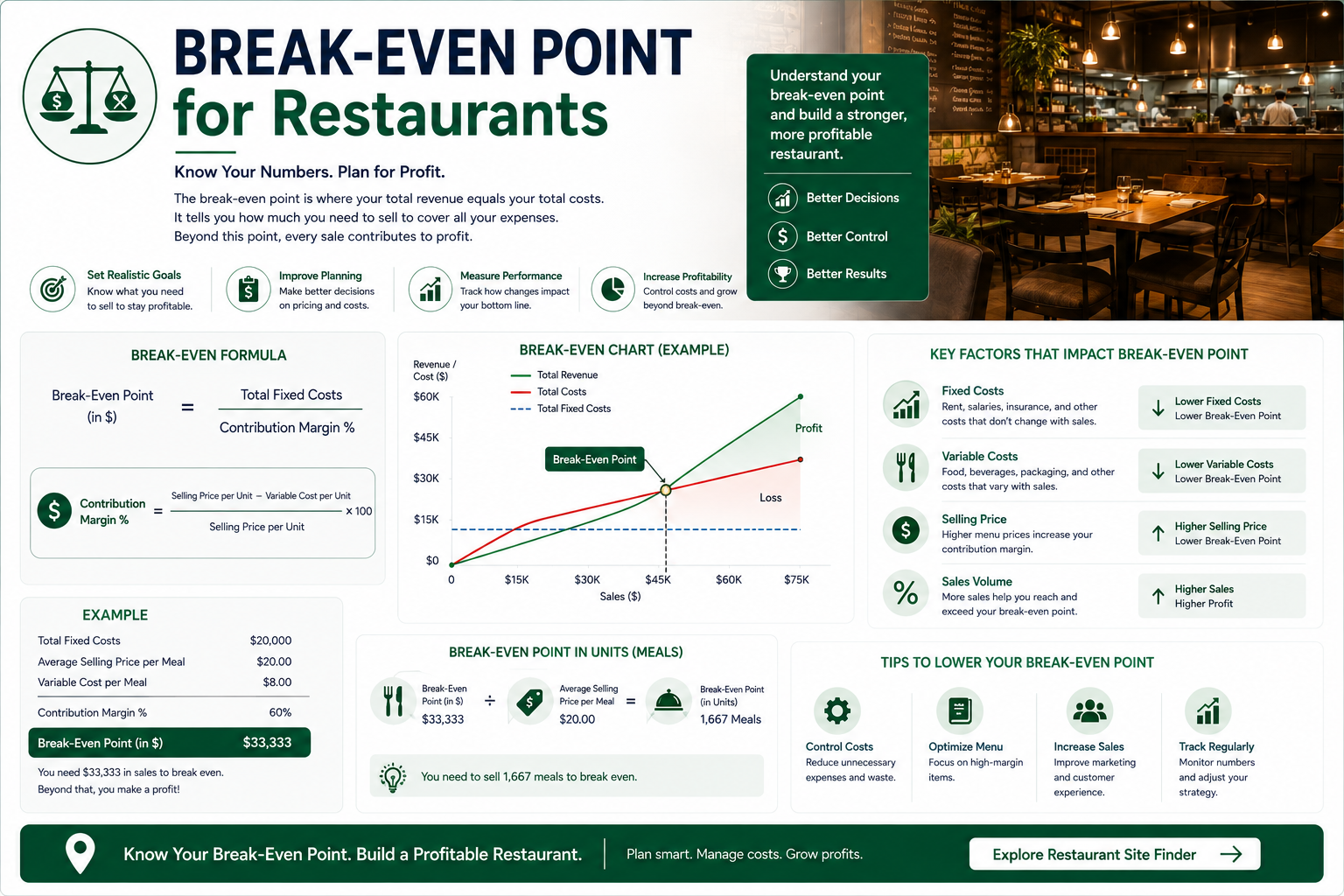
Restaurant market analysis helps an operator understand whether a concept has enough local demand and how it can compete. The analysis combines demographic information, customer behavior, competitors, traffic, real estate, pricing, and economic conditions. It is particularly valuable before selecting a site because location decisions can be expensive and difficult to reverse. This guide also explains the practical questions behind break even point restaurant so readers can connect the topic to a useful restaurant-business context.
Define the Market
Start by defining the geographic area and customer segment you want to study. A fast-casual lunch concept may have a different trade area from a destination fine-dining restaurant. Consider drive time, walkability, delivery radius, and the places customers already visit. A precise market definition prevents irrelevant data from overwhelming the analysis. For owners researching this topic, it helps to connect the definition with actual operating decisions. break even point restaurant is one useful phrase to keep in mind when organizing research, comparing options, or explaining the issue to a business partner.
Study Demographics
Review population, household size, income, age distribution, employment, and other relevant characteristics. Demographics should be interpreted in relation to the concept. A high-income area may support premium dining, but the restaurant still needs enough customers with the right occasions and frequency.
Analyze Demand Generators
Offices, residential communities, hotels, schools, hospitals, shopping centers, entertainment venues, and transit can create restaurant demand. Examine not only how many people are nearby but when they are present. Daypart patterns can determine whether a location is strong for breakfast, lunch, dinner, or late-night business.
Map Competition
List direct and indirect competitors and compare cuisine, price, service format, ratings, menu breadth, hours, positioning, and visible traffic. Reviews can reveal recurring customer complaints and unmet needs. Competition analysis should identify opportunities rather than simply count restaurants.
Evaluate Pricing
Build a realistic price map for the market. Compare core categories and representative items instead of looking only at the cheapest and most expensive menu. The objective is to understand customer expectations and where a new concept could position itself without creating an unrealistic cost structure.
Assess Location Economics
Estimate rent, occupancy costs, required sales, and site-specific expenses. A location can have excellent demand and still be unattractive if occupancy costs consume too much of the expected revenue. Conversely, a lower-rent site may require much more marketing to generate adequate traffic.
Understand Customer Behavior
Research how customers discover restaurants, how far they travel, what occasions drive visits, and which channels they use for ordering. Surveys, reviews, local observations, POS data from comparable operations, and reputable market datasets can all contribute to the picture.
Estimate Sales Potential
A sales estimate should be based on observable assumptions: seats, turns, transactions, average check, operating days, dayparts, delivery capacity, and market demand. Build conservative, base, and upside scenarios. Avoid using a competitor's sales as if it were automatically transferable to a new concept.
Use Data to Compare Sites
For multiple properties, create a consistent scorecard. Include market size, target-customer fit, traffic, competition, accessibility, visibility, occupancy cost, and expansion potential. Tools such as [RSF] can help structure restaurant location research and make comparisons more systematic.
Turn Research Into a Decision
The final output of market analysis should be a decision: proceed, modify the concept, investigate another site, or stop. Document the evidence behind the conclusion and identify assumptions that require further validation. Good analysis is not about proving the idea will work; it is about reducing uncertainty before investment.
A Simple Decision Framework
When evaluating break even point restaurant, start with the business question rather than the tool or metric. What decision needs to be made? What information would change that decision? Which assumptions are uncertain? Then collect the smallest reliable set of data needed to answer the question. This approach prevents research from becoming an endless collection of numbers that never leads to action. For restaurant operators, the most useful analysis usually connects demand, customers, operations, costs, and location.
Questions Worth Asking
Several questions can make research around break even point restaurant more practical. Is the information current? Does it describe the same type of restaurant and market? Are the definitions consistent? Can the result be measured over time? What would a positive or negative result mean for the business? Asking these questions helps separate useful evidence from interesting but irrelevant information. It also makes conversations with partners, lenders, managers, consultants, and vendors more productive.
How to Turn Research Into a Plan
After collecting information about break even point restaurant, write down the decision, the evidence supporting it, the main risks, and the next action. Assign an owner and a deadline where appropriate. Then revisit the assumption after enough operating data has accumulated. Restaurants change quickly, so a plan that is never updated can become less useful even if the original research was excellent.
The Role of Location and Local Context
Restaurant performance is strongly influenced by local conditions. Customer demographics, competition, traffic, access, nearby businesses, real estate costs, and neighborhood development can change the economics of an otherwise attractive concept. That is why topic-specific research should be combined with location research before major commitments are made. Restaurant entrepreneurs can use restaurant site finder as part of a broader process for exploring restaurant locations and market opportunities.
Practical Checklist
Before acting on your research into break even point restaurant, confirm five things: the objective is clear; the source data is relevant and reasonably current; assumptions are documented; costs and operational consequences have been considered; and there is a measurable next step. This checklist is simple, but it prevents many avoidable mistakes. It also creates a repeatable process that can be used for future decisions.
Conclusion
Break Even Point Restaurant is most valuable when it helps a restaurant owner make a better decision. Whether the issue involves finance, technology, marketing, customer demand, location, or operations, the same principle applies: define the question, use reliable information, compare alternatives, act deliberately, and measure the result. A restaurant is a connected system, so decisions should be evaluated in terms of their effect on customers, employees, costs, and long-term business performance.
Frequently Asked Questions
What is the main purpose of researching break even point restaurant?
The purpose is to reduce uncertainty and improve a specific business decision. Good research should lead to a clearer choice, not simply a larger collection of information.
How often should restaurant operators review this topic?
The right frequency depends on the topic. Daily operational metrics may need frequent review, while market or location research may be revisited monthly, quarterly, or when expansion decisions arise.
What should owners do when the data is unclear?
Document the uncertainty, seek an additional reliable source, and test the assumption on a small scale where practical. Avoid treating an uncertain estimate as a guaranteed outcome.
Can technology replace restaurant management judgment?
No. Technology can organize information and identify patterns, but managers still need context, experience, customer feedback, and operational judgment to decide what action is appropriate.
Editorial note: This article is intended for general informational and planning purposes. Restaurant economics vary by concept, market, operating model, and local conditions.
Implementation Considerations for Restaurant Owners
Putting this topic into practice requires a balance between research and execution. Restaurant owners should begin with a clearly defined objective and then identify the operational inputs that can influence the result. Those inputs may include sales volume, customer demand, menu mix, labor availability, purchasing costs, occupancy, competition, technology, or service capacity. Rather than changing several variables at once, it is often easier to establish a baseline, make one well-defined change, and compare the outcome with the original position. This creates a learning cycle that can be repeated as the restaurant grows.
Documentation is equally important. Keep assumptions, calculations, source dates, decisions, and results in a format that managers can understand. This is particularly valuable when responsibilities move between owners, general managers, accountants, marketing teams, or outside advisers. Clear documentation reduces the risk that a decision will be repeated without understanding the original reasoning. It also makes it easier to identify which assumptions were correct and which need to be revised.
Finally, consider the customer experience and the economics together. A change that improves one metric may create a problem elsewhere. For example, reducing labor too aggressively can increase wait times, while a large discount can increase transactions without producing enough contribution margin. The best restaurant decisions consider demand, quality, employee workload, operating cost, and profitability as connected parts of the same system. Review the result after implementation and use the evidence to refine the next decision.
 English
Join our community to interact with posts!