
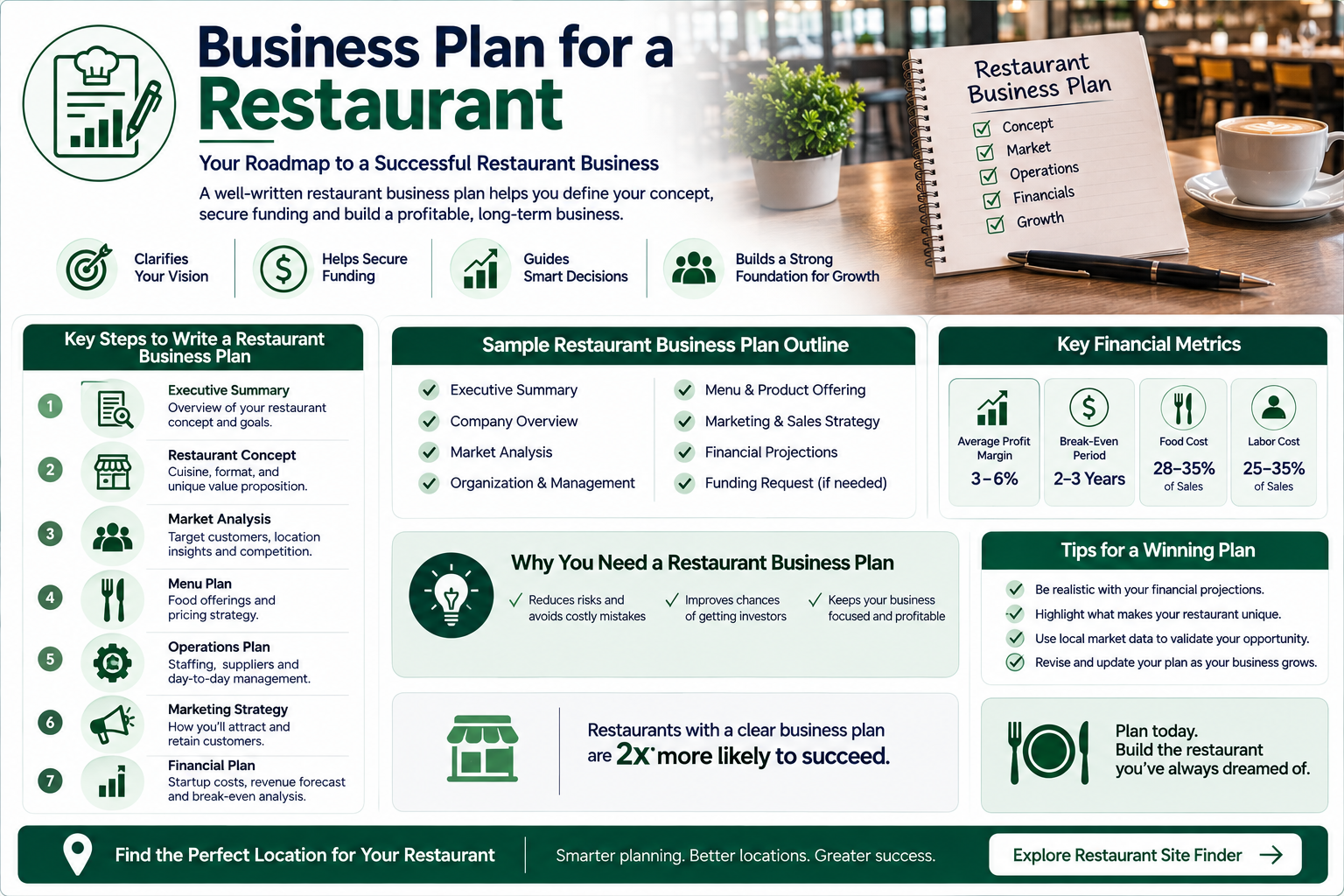
A restaurant business plan turns a concept into an operating and financial roadmap. It explains what the restaurant will offer, who it will serve, where it will operate, how it will compete, how much capital it needs, and how management expects the business to perform. A strong plan is not written only for investors; it helps the owner identify weak assumptions before money is committed. This guide also explains the practical questions behind how to write a business plan for a restaurant so readers can connect the topic to a useful restaurant-business context.
Executive Summary
The executive summary should describe the concept, target market, location strategy, competitive position, ownership, funding requirement, and high-level financial outlook. Although it appears first, many owners write it last because the rest of the plan provides the information needed to summarize the opportunity accurately. For owners researching this topic, it helps to connect the definition with actual operating decisions. how to write a business plan for a restaurant is one useful phrase to keep in mind when organizing research, comparing options, or explaining the issue to a business partner.
Concept and Value Proposition
Explain the cuisine, service format, atmosphere, price point, hours, and customer experience. Then state why customers will choose this restaurant instead of existing alternatives. The value proposition should be specific enough to guide menu, design, marketing, and staffing decisions.
Market Analysis
A restaurant plan should demonstrate that there is a viable market. Research demographics, household characteristics, employment, daytime population, traffic patterns, nearby businesses, competition, and demand generators. The analysis should distinguish between a large population and a population that actually fits the concept.
Location Strategy
The location section should cover visibility, access, parking, nearby anchors, trade area, occupancy cost, and site constraints. If a specific property has not been selected, describe the criteria the ideal site must meet. Location research can be supported by tools such as [RSF] when comparing restaurant opportunities.
Menu and Pricing
Describe the menu categories, signature products, expected check average, pricing strategy, and sourcing approach. Include enough detail to connect menu choices to food cost and labor requirements. A menu that looks attractive but is operationally complicated can create problems after opening.
Operations
Explain how the restaurant will purchase, receive, store, prep, cook, serve, clean, and manage inventory. Identify the POS, ordering, scheduling, accounting, and other systems required. A clear operating model demonstrates that the concept can work beyond the initial idea.
Staffing and Management
Describe key management roles, staffing levels, training, scheduling, compensation assumptions, and recruiting plans. Labor should be connected to expected sales and daypart demand. Include plans for onboarding and retention because staffing problems can disrupt even a strong concept.
Marketing Plan
The marketing plan should identify target customers, launch strategy, local awareness tactics, digital channels, partnerships, loyalty, reviews, and promotional plans. Set measurable objectives rather than listing every possible marketing channel. Track customer acquisition and repeat behavior after launch.
Financial Projections
Build sales assumptions from realistic traffic, transaction counts, average check, operating days, and channel mix. Then model food cost, labor, occupancy, utilities, marketing, repairs, technology, debt service, and other expenses. Include startup costs and working capital. Scenario analysis is valuable because the base case is never guaranteed.
Risks and Milestones
List the most important risks and explain how they will be managed. Then establish milestones for site selection, financing, permits, construction, hiring, training, soft opening, and full launch. A business plan becomes more useful when it is treated as a living management document and updated as assumptions change.
A Simple Decision Framework
When evaluating how to write a business plan for a restaurant, start with the business question rather than the tool or metric. What decision needs to be made? What information would change that decision? Which assumptions are uncertain? Then collect the smallest reliable set of data needed to answer the question. This approach prevents research from becoming an endless collection of numbers that never leads to action. For restaurant operators, the most useful analysis usually connects demand, customers, operations, costs, and location.
Questions Worth Asking
Several questions can make research around how to write a business plan for a restaurant more practical. Is the information current? Does it describe the same type of restaurant and market? Are the definitions consistent? Can the result be measured over time? What would a positive or negative result mean for the business? Asking these questions helps separate useful evidence from interesting but irrelevant information. It also makes conversations with partners, lenders, managers, consultants, and vendors more productive.
How to Turn Research Into a Plan
After collecting information about how to write a business plan for a restaurant, write down the decision, the evidence supporting it, the main risks, and the next action. Assign an owner and a deadline where appropriate. Then revisit the assumption after enough operating data has accumulated. Restaurants change quickly, so a plan that is never updated can become less useful even if the original research was excellent.
The Role of Location and Local Context
Restaurant performance is strongly influenced by local conditions. Customer demographics, competition, traffic, access, nearby businesses, real estate costs, and neighborhood development can change the economics of an otherwise attractive concept. That is why topic-specific research should be combined with location research before major commitments are made. Restaurant entrepreneurs can use restaurant site finder as part of a broader process for exploring restaurant locations and market opportunities.
Practical Checklist
Before acting on your research into how to write a business plan for a restaurant, confirm five things: the objective is clear; the source data is relevant and reasonably current; assumptions are documented; costs and operational consequences have been considered; and there is a measurable next step. This checklist is simple, but it prevents many avoidable mistakes. It also creates a repeatable process that can be used for future decisions.
Conclusion
How To Write A Business Plan For A Restaurant is most valuable when it helps a restaurant owner make a better decision. Whether the issue involves finance, technology, marketing, customer demand, location, or operations, the same principle applies: define the question, use reliable information, compare alternatives, act deliberately, and measure the result. A restaurant is a connected system, so decisions should be evaluated in terms of their effect on customers, employees, costs, and long-term business performance.
Frequently Asked Questions
What is the main purpose of researching how to write a business plan for a restaurant?
The purpose is to reduce uncertainty and improve a specific business decision. Good research should lead to a clearer choice, not simply a larger collection of information.
How often should restaurant operators review this topic?
The right frequency depends on the topic. Daily operational metrics may need frequent review, while market or location research may be revisited monthly, quarterly, or when expansion decisions arise.
What should owners do when the data is unclear?
Document the uncertainty, seek an additional reliable source, and test the assumption on a small scale where practical. Avoid treating an uncertain estimate as a guaranteed outcome.
Can technology replace restaurant management judgment?
No. Technology can organize information and identify patterns, but managers still need context, experience, customer feedback, and operational judgment to decide what action is appropriate.
Editorial note: This article is intended for general informational and planning purposes. Restaurant economics vary by concept, market, operating model, and local conditions.
 English
Join our community to interact with posts!