
When a customer reports an equipment failure, the quality of the response depends on much more than sending a technician to the right location. Service organizations must identify the right resource, understand the asset's history, provide the required parts, resolve the issue efficiently, and keep the customer informed throughout the process.
This is where Field Service Management (FSM) has become strategically important.
Modern FSM platforms are evolving from scheduling and dispatch applications into intelligent operational systems that connect field workers, customers, assets, service processes, and enterprise applications. Artificial intelligence, generative AI, automation, mobile technologies, augmented reality, and real-time analytics are expanding what service organizations can accomplish in the field.
For enterprises managing distributed workforces and complex assets, the ability to coordinate these activities effectively can directly influence productivity, operating costs, customer satisfaction, and service profitability.
Click Here For More Information: https://qksgroup.com/market-research/spark-matrix-field-service-management-q1-2025-8567
Market / Industry Overview
Field Service Management software helps organizations coordinate field operations across the complete service lifecycle. Core capabilities typically include scheduling, dispatch, work-order management, contract management, reporting, mobile workforce support, and customer communication.
The market is now moving toward a more connected model.
Modern FSM platforms can provide technicians with asset work histories, maintenance records, service documentation, inventory information, customer details, and contextual recommendations. Integration with CRM, ERP, EAM, IoT, and other enterprise applications enables information to move across departments rather than remaining isolated within the field-service function.
Consider a technician responding to a recurring equipment problem. Instead of relying only on the current service request, the technician can access historical work orders and maintenance records. This context can help identify recurring issues and support faster troubleshooting.
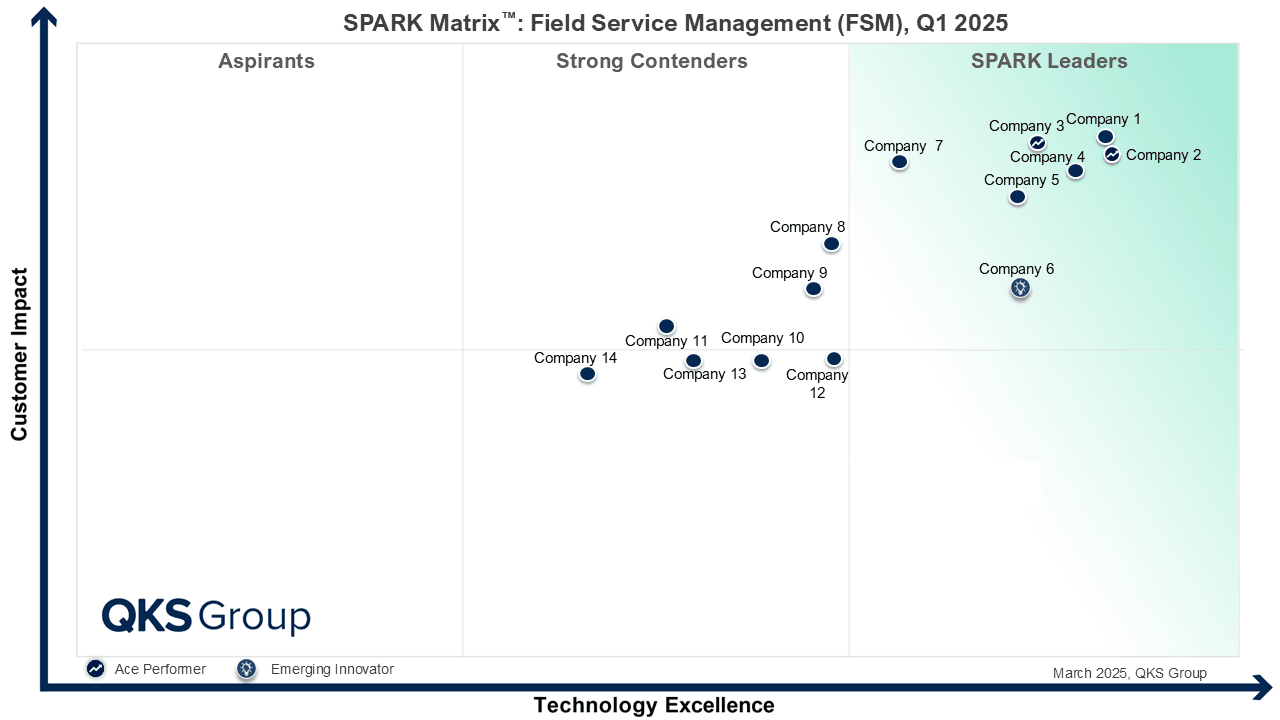
QKS Group's SPARK Matrix: Field Service Management, Q1 2025 evaluates leading vendors based on their capabilities, competitive differentiation, and market positioning. The study includes IFS, KloudGin, Microsoft, Nomadia, Nuvolo, Oracle, OverIT, Praxedo, PTC, Salesforce, SAP, ServiceNow, ServicePower, and Syncron.
Key Challenges Businesses Face
Despite advances in FSM technology, service organizations continue to face several operational challenges.
Scheduling complexity is one of the most persistent issues. Organizations must balance technician skills, location, availability, priority, travel time, and customer preferences while minimizing unnecessary travel.
Limited access to information can also slow service resolution. Technicians working remotely need immediate access to accurate asset histories, technical documentation, previous work orders, and relevant customer information.
Manual processes remain another concern. When work-order creation, reporting, approvals, and administrative activities depend heavily on manual intervention, technicians spend less time on productive field work.
Skills shortages and knowledge transfer create additional pressure. Experienced technicians often hold critical knowledge that is difficult to replicate across the broader workforce.
Finally, customer expectations are changing. Customers increasingly expect flexible scheduling, real-time service updates, digital appointment booking, and faster issue resolution.
Check SPARK Plus Study Here: https://qksgroup.com/sparkplus?market-id=83&market-name=field-service-management
Key Trends & Innovations
Generative AI Is Changing Field-Service Workflows
Generative AI is emerging as a significant capability within FSM platforms.
AI-powered assistants and chatbots can help technicians troubleshoot problems, retrieve relevant information, summarize asset histories, and answer operational questions.
Generative AI can also assist with work-order creation and administrative processes. Instead of manually entering information after a service interaction, organizations can automate portions of documentation and workflow creation.
The strategic value is not simply automation. It is reducing the amount of time technicians spend searching for information or performing repetitive administrative tasks.
Intelligent Scheduling and Dispatch
AI and optimization technologies are making scheduling more dynamic.
Modern FSM platforms can consider technician skills, location, workload, service priority, traffic conditions, and appointment windows when assigning work.
This can help organizations improve technician utilization while reducing travel time and improving response consistency.
Asset History Is Becoming a Frontline Intelligence Layer
Access to asset work history can significantly improve field decisions.
Technicians can review previous maintenance activities, recurring problems, parts replaced, and service outcomes before beginning a new intervention.
When this information is combined with IoT data and predictive analytics, FSM can become part of a broader asset-intelligence ecosystem.
AR Is Strengthening Remote Assistance
Augmented Reality is expanding the possibilities for field support.
Technicians can use AR-based remote assistance to connect with experts who can provide visual guidance during complex service activities. Experts can potentially diagnose issues remotely, annotate views, and guide technicians through procedures.
AR-based training is also helping organizations create more interactive learning experiences for technicians.
Customer Self-Service Is Becoming Essential
Customer portals and digital self-service capabilities are increasingly important.
Customers can book appointments, track service requests, receive updates, and access relevant information without contacting a service center for every interaction.
This can reduce pressure on support teams while improving transparency for customers.
Benefits & Business Impact
A modern FSM strategy can generate measurable value across the service organization.
Higher technician productivity: Mobile access, automation, and AI assistance can reduce administrative work.
Faster service resolution: Technicians can access asset history and troubleshooting information before and during service activities.
Improved scheduling efficiency: Intelligent dispatch can align technicians with jobs based on skills, availability, location, and priority.
Lower operational costs: Better routing and workforce utilization can reduce unnecessary travel and improve resource efficiency.
Higher customer satisfaction: Self-service capabilities and real-time updates create greater visibility throughout the service journey.
Better first-time fix performance: Access to accurate asset information, technical documentation, and expert assistance can improve the likelihood of resolving issues during the initial visit.
Stronger service intelligence: Analytics can help managers identify recurring problems, technician performance patterns, asset issues, and operational bottlenecks.
The broader value comes from connecting these capabilities rather than implementing them as separate technologies.
Use Cases or Real-World Examples
Industrial Equipment Maintenance
An industrial equipment manufacturer can use FSM to manage technician schedules, customer contracts, asset histories, spare parts, and service requests.
When a technician receives a work order, the platform can provide information about previous repairs and equipment history, helping the technician prepare before arriving at the site.
Utilities and Infrastructure
Utility companies manage geographically distributed assets and field teams. FSM can help coordinate inspections, emergency repairs, planned maintenance, and workforce deployment.
AI-based scheduling can prioritize critical work while considering technician location and capabilities.
Telecommunications
Telecommunications providers can use FSM to coordinate installation, maintenance, troubleshooting, and customer appointments. Mobile applications can provide technicians with job details, customer information, network-related data, and completion workflows.
Customer Self-Service
A customer experiencing an equipment issue can use a self-service portal to submit a request, select an appointment window, and monitor progress. The FSM platform can then automatically route the request into the appropriate service workflow.
Remote Expert Assistance
A technician facing an unfamiliar technical problem can use AR-enabled remote assistance to connect with an experienced specialist. The specialist can guide the technician visually, potentially reducing the need for an additional site visit.
How Organizations Can Choose the Right Solution
FSM selection should begin with business requirements rather than a feature checklist.
Organizations should evaluate:
- Scheduling and dispatch optimization
- Mobile workforce capabilities
- Work-order management
- Asset history and asset intelligence
- AI and generative AI capabilities
- Customer self-service
- Contract and service-level management
- Inventory and spare-parts integration
- CRM and ERP integration
- EAM and IoT connectivity
- AR and remote-assistance capabilities
- Analytics and reporting
- Workforce scalability
- Security and data governance
- Ease of use and adoption
- Deployment flexibility
- Vendor support and implementation capabilities
- Total cost of ownership
Enterprises should also test whether the platform can integrate into their existing technology environment. An FSM solution that operates in isolation may limit the value of the organization's broader digital transformation strategy.
Future Outlook: 2025–2028
Field Service Management is expected to become increasingly intelligent and automated through 2028.
Generative AI will likely become more deeply embedded in technician assistance, work-order management, knowledge retrieval, customer interactions, and service documentation.
At the same time, IoT-enabled assets will provide richer operational data that can inform field-service decisions. Predictive analytics can help organizations identify potential service requirements before customers experience failures.
AR is also expected to strengthen its role in remote assistance and technician training. Instead of simply providing communication tools, AR-enabled workflows can increasingly connect technicians with contextual information and expert knowledge while they work.
The convergence of FSM with EAM, CRM, ERP, IoT, AI, and AR will be particularly important. This will create a more connected service ecosystem where customer requirements, asset intelligence, workforce availability, and operational decisions are managed through integrated workflows.
Download Sample Report Here: https://qksgroup.com/download-sample-form/spark-matrix-field-service-management-q1-2025-8567
Conclusion
Field Service Management (FSM) is becoming far more than a scheduling and dispatch solution. It is evolving into an intelligent platform for coordinating people, assets, customers, information, and service processes.
AI and automation can improve workforce productivity. Asset histories and analytics can strengthen field decision-making. Customer self-service can improve service experiences. AR can extend access to specialized expertise beyond physical locations.
For technology leaders, the priority should be to select an FSM platform that combines operational depth with intelligent capabilities and strong enterprise integration.
The future of field service will be defined by organizations that can connect the right technician, the right information, the right asset intelligence, and the right customer experience at the right moment.
 English
Join our community to interact with posts!