
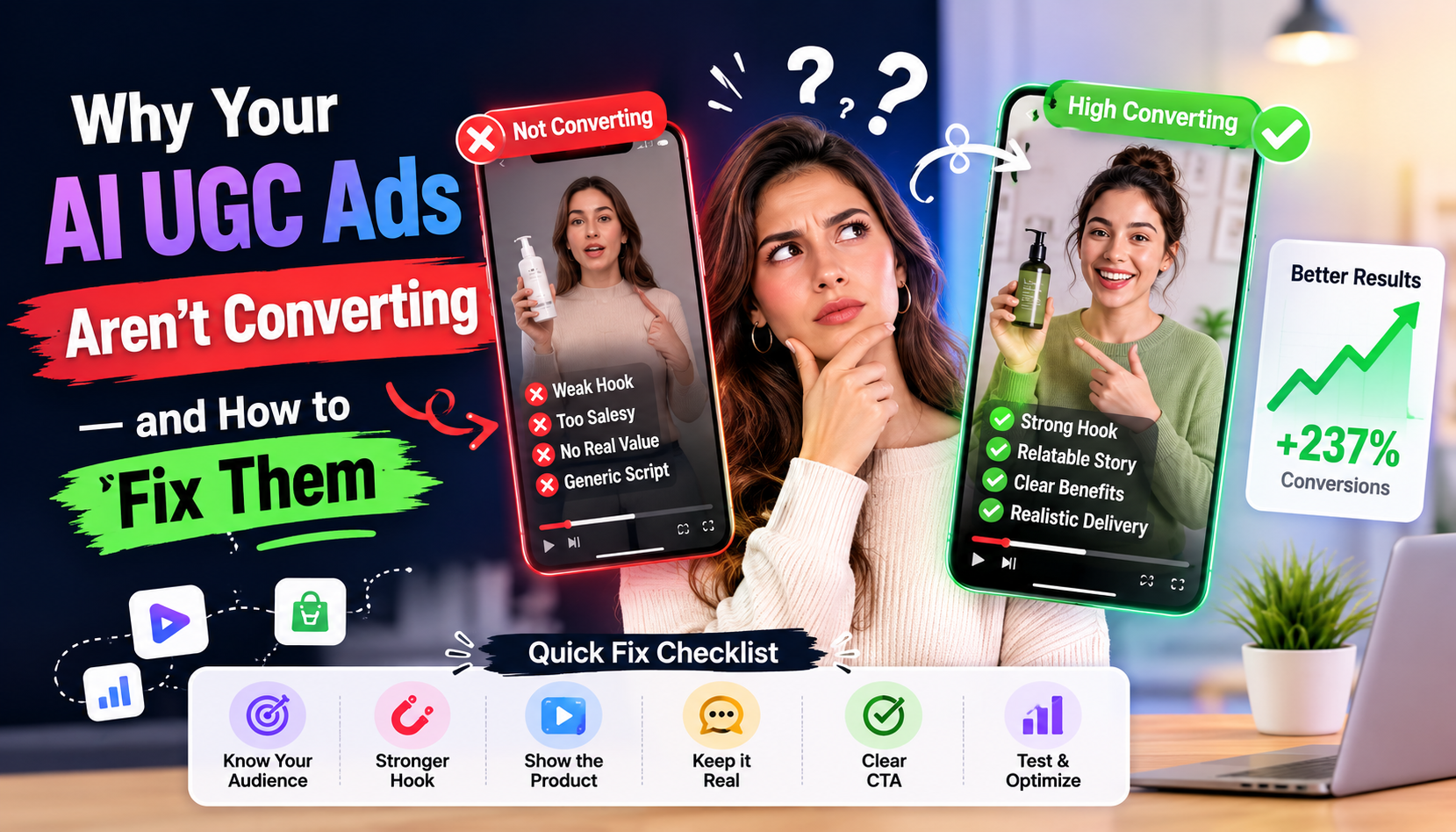
AI UGC ads have changed the way brands create performance marketing content. Instead of waiting weeks for creators, arranging shoots, writing multiple scripts, and producing expensive variations, brands can now generate UGC-style videos quickly with AI.
But there is a problem: creating an AI UGC ad is easy. Creating an AI UGC ad that converts is much harder.
You may have realistic AI avatars, good-looking visuals, professional voiceovers, and a strong product. Yet your ads may still receive low click-through rates, weak engagement, or almost no sales.
So, why aren't your AI UGC ads converting?
The answer is usually not the AI itself. The bigger problem is the creative strategy behind the video.
In this guide, we’ll explore the most common reasons AI UGC ads fail to convert and show you practical ways to improve your AI UGC ad strategy, from hooks and scripts to authenticity, product demonstrations, calls to action, and creative testing.
What Are AI UGC Ads?
AI UGC ads are marketing videos created with artificial intelligence that mimic the style of user-generated content.
Instead of recording a real customer or creator on camera, brands can use AI-generated presenters, avatars, voiceovers, scripts, and visuals to produce videos that look and feel similar to traditional UGC.
AI UGC ads can be used for:
-
TikTok ads
-
Instagram Reels
-
YouTube Shorts
-
Facebook ads
-
Shopify product marketing
-
Ecommerce landing pages
-
Product demonstrations
-
Social media campaigns
-
Retargeting campaigns
The biggest advantage is scalability. A brand can create multiple versions of an ad with different hooks, presenters, scripts, product benefits, and calls to action.
However, more content does not automatically mean more conversions.
If the underlying creative is weak, generating 50 variations of the same weak concept won't solve the problem.
Why Your AI UGC Ads Aren’t Converting
Let's look at the biggest reasons your AI UGC campaigns may be underperforming.
1. Your Hook Isn't Strong Enough
The first few seconds of an ad can determine whether someone keeps watching or scrolls away.
One of the most common AI UGC mistakes is starting with a generic introduction.
For example:
"Hey guys, today I want to tell you about this amazing product."
This sounds like an advertisement immediately.
A better approach is to start with a problem, curiosity, surprising statement, or specific benefit.
For example:
"I was wasting money on three different products until I found this."
Or:
"If you run a Shopify store, you probably need to see this."
Or:
"I didn't expect this product to actually work, but here's what happened."
The goal isn't simply to make the viewer understand what the product is.
The goal is to make them want to keep watching.
How to fix your AI UGC hook
Create multiple hook variations around:
-
A customer problem
-
A surprising result
-
A strong benefit
-
A common mistake
-
A curiosity gap
-
A product comparison
-
A before-and-after situation
-
A specific audience
-
A relatable experience
Instead of creating one video with one opening, create several variations and test them.
2. Your AI UGC Video Looks Too Much Like an Ad
One of the main reasons brands use UGC is because it can feel more natural than traditional advertising.
But if your AI UGC video looks overly polished, scripted, and promotional, viewers may immediately recognize it as an ad.
This can reduce attention and trust.
Common problems include:
-
Perfectly structured sentences
-
Excessive product praise
-
Generic backgrounds
-
Robotic delivery
-
Repetitive facial expressions
-
Unrealistic gestures
-
Too much branding
-
Stock-looking visuals
-
Corporate language
The objective isn't to make the video look perfect.
It's to make it feel relevant, natural, and believable.
How to fix it
Write scripts the way real people speak.
Instead of:
"This innovative skincare solution provides exceptional results and is highly recommended."
Try:
"I've been using this for a few weeks, and honestly, I noticed a difference pretty quickly."
Shorter sentences usually work better for UGC-style creative.
You can also introduce conversational phrases, questions, personal observations, and natural transitions.
3. You're Focusing on the Product Instead of the Problem
Another common mistake is talking too much about product features.
For example, an AI UGC ad for a productivity app might say:
"Our platform includes task management, calendar integration, automation, analytics, and collaboration tools."
These features may be useful, but they don't necessarily create desire.
Consumers generally care more about what the product does for them.
Instead, frame the same product around the problem:
"I used to spend the first 30 minutes of every morning figuring out what I needed to do. Now I can see everything in one place."
The second version connects the product to a real-life situation.
Use the problem → solution framework
A simple AI UGC structure is:
Problem → Frustration → Discovery → Product → Result → CTA
For example:
"I kept struggling to create social media content every week. Then I started using an AI video tool that turns my product information into videos. Now I can create multiple ad variations without recording everything myself."
This gives the viewer a reason to care.
4. Your Script Is Too Long
AI makes it incredibly easy to generate long scripts.
That doesn't mean you should use them.
Short-form advertising requires a strong balance between information and attention.
If your AI UGC ad takes too long to reach the main benefit, viewers may leave before they understand your offer.
Instead of explaining everything about the product, focus on one core message per video.
For example:
Video 1
Focus on price.
Video 2
Focus on convenience.
Video 3
Focus on the biggest customer pain point.
Video 4
Focus on a product demonstration.
Video 5
Focus on a customer objection.
This approach gives you multiple creative angles instead of one overloaded advertisement.
5. You're Not Showing the Product Clearly
A talking AI avatar alone isn't always enough.
If you're selling a physical or digital product, viewers often need to see how it works.
This is where product-focused AI UGC videos can become much stronger.
For example, instead of showing an avatar talking about a skincare product for 30 seconds, show:
-
The problem
-
The product
-
How it's used
-
The experience
-
The result
-
The CTA
Visual proof can make the message easier to understand.
For ecommerce brands, product demonstrations are especially useful because they help bridge the gap between attention and purchase intent.
6. Your AI Avatar Doesn't Match Your Target Audience
Not every presenter works for every brand.
Imagine selling a fitness product to college students but using an AI presenter who looks and sounds completely disconnected from that audience.
The content may be technically good, but the viewer may not identify with it.
Your AI UGC presenter should match factors such as:
-
Target age group
-
Gender when relevant to the product
-
Communication style
-
Audience interests
-
Product category
-
Geographic market
-
Brand personality
Think about the question:
"Would my target customer actually listen to this person?"
If the answer is no, change the presenter.
7. Your AI Voice Sounds Robotic
Voice quality can have a major impact on how authentic an AI UGC video feels.
Even a realistic avatar can lose credibility if the voice sounds unnatural.
Avoid scripts that contain:
-
Long complicated sentences
-
Corporate terminology
-
Excessive punctuation
-
Unnatural transitions
-
Repetitive phrases
Write for spoken language.
Instead of:
"This solution enables ecommerce businesses to efficiently optimize their advertising workflow."
Use:
"It makes creating ads much faster."
Simple language often sounds more natural when spoken.
8. You're Not Giving Viewers a Reason to Trust You
A conversion requires more than attention.
People need a reason to believe your product can deliver the promised outcome.
AI UGC ads can create an authenticity challenge because viewers may question whether the presenter is real.
That's why your creative should focus on evidence and transparency.
Depending on your product, you can include:
-
Product demonstrations
-
Customer reviews
-
Testimonials
-
Screenshots
-
Before-and-after visuals where appropriate
-
Product details
-
Real product footage
-
Specific use cases
-
Clear explanations
Don't rely entirely on an AI presenter saying:
"This is the best product I've ever used."
Show viewers why they should believe it.
9. Your CTA Is Too Weak
Your ad may have a strong hook and good product explanation, but the final call to action can still hurt conversions.
Generic CTAs such as:
"Check it out."
may not give viewers enough motivation.
A stronger CTA connects the action to the benefit.
Examples:
-
"See how it works."
-
"Try it for yourself."
-
"Explore the product."
-
"Start creating your first video."
-
"See what's included."
-
"Get started today."
The CTA should also match the stage of the customer journey.
Someone seeing your brand for the first time may need more information, while a returning visitor may be ready to purchase.
10. You're Testing Too Little
One of the biggest advantages of AI UGC is the ability to produce creative variations quickly.
Yet many brands still create one video, publish it, and wait for results.
That's not enough.
Your first creative is a hypothesis.
You need to test different variables.
Test different hooks
-
Problem-focused
-
Benefit-focused
-
Curiosity-focused
-
Educational
-
Emotional
-
Direct
Test different presenters
Try different:
-
Ages
-
Styles
-
Personalities
-
Voices
-
Presentation formats
Test different scripts
Change:
-
Opening
-
Product benefit
-
Story
-
Objection
-
CTA
Test different visuals
Try:
-
Talking-head format
-
Product demonstration
-
Screen recording
-
Lifestyle footage
-
Product close-ups
-
Text overlays
AI UGC becomes significantly more valuable when you treat it as a creative testing system, rather than simply a faster way to make videos.
AI UGC Creative Testing Framework
A simple testing framework can help you organize your campaigns.
| Creative Element | Variations to Test |
| Hook | Problem, curiosity, benefit, question |
| Presenter | Different avatars and personalities |
| Script | Short, conversational, educational |
| Product Angle | Feature, benefit, problem-solving |
| Visual | Demo, lifestyle, product-focused |
| CTA | Shop now, learn more, try it |
| Format | UGC, testimonial, tutorial |
| Audience | Beginner, expert, niche customer |
Don't change everything at once if you're trying to understand what caused performance changes.
For example, you could keep the script and presenter consistent while testing five different hooks.
Then you can identify which hook generates stronger engagement.
How to Fix AI UGC Ads That Aren't Converting
If your existing AI UGC campaign is underperforming, don't immediately throw everything away.
Use a structured optimization process.
Step 1: Review Your First Few Seconds
Ask:
-
Does the video immediately address a problem?
-
Is the opening specific?
-
Would I stop scrolling for this?
-
Does the viewer know who the video is for?
If not, rewrite the hook.
Step 2: Identify the Main Message
Your video should have one clear message.
If viewers can't explain what the product does after watching the ad, simplify the script.
Step 3: Make It More Conversational
Remove unnecessary marketing language.
Use shorter sentences and everyday expressions.
Step 4: Add Product Demonstration
Show the product whenever possible.
Don't just tell viewers what it does.
Show them.
Step 5: Strengthen Your Proof
Add evidence that supports your claims.
For example:
-
Demonstrate the product
-
Show the interface
-
Explain the process
-
Highlight customer feedback
-
Show a real use case
Step 6: Improve the CTA
Tell viewers exactly what they should do next.
Step 7: Create Multiple Variations
Don't depend on one AI UGC creative.
Build a testing library with multiple hooks, presenters, scripts, and angles.
AI UGC Ads vs Traditional UGC Ads
| Factor | AI UGC | Traditional UGC |
| Production speed | Very fast | Slower |
| Creative variations | High | Limited by production |
| Production cost | Often lower | Can be higher |
| Presenter options | Many | Creator dependent |
| Scalability | High | Moderate |
| Editing flexibility | High | Moderate |
| Human authenticity | Requires careful execution | Naturally strong |
| Testing potential | Very high | More resource-intensive |
The goal isn't necessarily to replace every form of traditional UGC.
Instead, AI UGC can complement traditional creative production by allowing brands to test more concepts before investing heavily in production.
How Shopify Brands Can Improve AI UGC Ads
For Shopify and ecommerce brands, AI UGC can be particularly useful because products can be turned into multiple advertising concepts.
A Shopify brand could create:
Concept 1: Problem-focused UGC
"Here's what I wish I knew before buying this."
Concept 2: Product demonstration
"Here's how I actually use it."
Concept 3: Benefit-focused
"This is why I stopped using my old solution."
Concept 4: Objection-focused
"I thought this was going to be expensive, but..."
Concept 5: Comparison
"Here's the difference between this and the product I used before."
Each concept targets a different psychological angle.
This creates a stronger creative testing pipeline than repeatedly producing nearly identical product videos.
Common AI UGC Mistakes to Avoid
Mistake 1: Making every video identical
Changing the avatar while keeping the same script isn't meaningful creative testing.
Mistake 2: Overusing AI language
Marketing phrases can make the content feel artificial.
Mistake 3: Ignoring the audience
A good video for one demographic may fail with another.
Mistake 4: Talking without showing
Use product visuals whenever they strengthen the message.
Mistake 5: Making unsupported claims
Avoid exaggerated promises that can damage trust and create compliance issues.
Mistake 6: Optimizing only for views
A video can get attention without generating purchases.
Look beyond views and consider metrics such as:
-
Click-through rate
-
Landing-page engagement
-
Add-to-cart rate
-
Conversion rate
-
Cost per acquisition
-
Return on ad spend
The Future of AI UGC Advertising
AI UGC is moving beyond simply generating talking-avatar videos.
Modern AI video workflows can help brands create complete advertising concepts from product information, scripts, webpages, and creative briefs.
This means the future of AI UGC is likely to focus increasingly on creative intelligence and automation, not just video generation.
Instead of asking:
"Can AI make a video?"
marketers are increasingly asking:
"Which creative concept should we test next?"
That is a much more valuable question.
The strongest brands will use AI to create more experiments, learn from performance data, and continuously improve their creative strategy.
Final Thoughts
If your AI UGC ads aren't converting, the solution probably isn't simply generating more videos.
The real issue may be your hook, messaging, audience targeting, product demonstration, presenter, proof, CTA, or testing strategy.
AI gives marketers the ability to create content faster, but speed alone doesn't create conversions.
The winning approach is to combine AI video generation with strong advertising fundamentals:
Strong hook + relevant problem + natural script + clear product demonstration + credibility + strong CTA + continuous testing.
Instead of creating one AI UGC ad and hoping it works, build a system that produces multiple creative ideas and learns from the results.
That's where AI UGC becomes more than a content-generation tool.
It becomes a scalable creative testing engine for performance marketing.
Frequently Asked Questions
Are AI UGC ads effective?
Yes, AI UGC ads can be effective when they use strong hooks, relevant messaging, authentic presentation, clear product demonstrations, and compelling calls to action. The quality of the creative strategy matters as much as the technology used to generate the video.
Why are my AI UGC ads getting views but no sales?
Views indicate attention, but they don't necessarily indicate purchase intent. Your ad may need stronger product positioning, better targeting, more convincing proof, a clearer CTA, or a stronger connection between the customer's problem and your product.
How long should an AI UGC ad be?
There isn't one ideal length for every campaign. The video should be long enough to communicate the core idea but short enough to maintain attention. Test multiple lengths and analyze performance rather than relying on a fixed duration.
How many AI UGC ads should I test?
There is no universal number. Start with several distinct creative concepts rather than producing many minor variations. Test different hooks, scripts, presenters, product angles, and CTAs to identify what resonates with your audience.
Can AI UGC ads be used for Shopify products?
Yes. Ecommerce brands can use AI UGC to create product demonstrations, testimonials, problem-solution videos, product explainers, and paid social creatives. Shopify brands can particularly benefit from using AI UGC to produce multiple creative variations for testing.
What makes an AI UGC ad look authentic?
Natural language, believable delivery, audience-relevant presenters, product demonstrations, realistic scenarios, and useful information can make AI UGC feel more authentic. Avoid excessive promotion and generic marketing language.
Should AI UGC replace traditional UGC?
Not necessarily. AI UGC and traditional UGC can work together. AI UGC can help brands rapidly test concepts and produce variations, while traditional creators can provide genuine experiences and perspectives that are difficult to replicate.
 English
Join our community to interact with posts!