
Fans are essential components in HVAC systems, industrial ventilation, air-handling equipment, and many other applications where controlled airflow is required. Selecting the right fan is only part of achieving reliable performance. Engineers and technicians also need to understand how changes in fan speed, airflow, pressure, and power consumption affect overall operation.
The three fan laws provide a practical way to predict these relationships. They help explain what happens when fan speed changes and provide valuable guidance for system design, troubleshooting, energy management, and equipment optimization.
What Are the 3 Fan Laws?
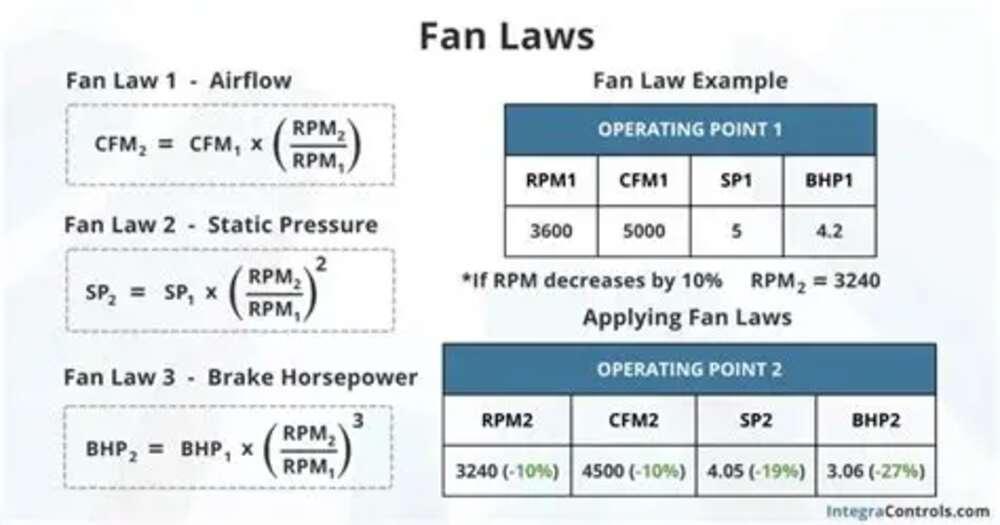
The three fan laws describe the relationship between fan speed and three important performance characteristics: airflow, pressure, and power. They are particularly useful for centrifugal and axial fans operating under comparable conditions.
The laws can be summarized as follows:
- Airflow changes directly with fan speed.
- Pressure changes with the square of fan speed.
- Power consumption changes with the cube of fan speed.
These relationships demonstrate why relatively small adjustments in fan speed can produce significant changes in energy consumption.
First Fan Law: Airflow and Fan Speed
The first fan law states that airflow is directly proportional to fan speed.
In simple terms, if fan speed increases by 10%, airflow will generally increase by approximately 10%, assuming the system conditions remain comparable. Likewise, reducing fan speed by 10% will result in approximately a 10% reduction in airflow.
The relationship can be expressed as:
Q₂ / Q₁ = N₂ / N₁
Where Q represents airflow and N represents fan speed.
For example, if a fan operates at 1,000 RPM and delivers 10,000 cubic feet per minute (CFM), increasing the speed to 1,100 RPM could theoretically increase airflow to approximately 11,000 CFM.
This relationship is useful when adjusting ventilation rates or matching fan output to changing system requirements.
Second Fan Law: Pressure and Fan Speed
The second fan law explains how fan pressure changes with speed. Unlike airflow, pressure varies with the square of fan speed.
The formula is:
P₂ / P₁ = (N₂ / N₁)²
This means a relatively modest increase in fan speed can produce a much larger increase in pressure.
For instance, increasing fan speed by 10% results in approximately a 21% increase in pressure because 1.1² equals 1.21.
This is important when a ventilation system needs to overcome additional resistance from filters, ductwork, dampers, coils, or other components. However, increasing pressure capability can also affect system noise, mechanical stress, and energy consumption.
Third Fan Law: Power and Fan Speed
The third fan law is particularly important for energy efficiency. It states that fan power varies with the cube of fan speed.
The relationship is:
W₂ / W₁ = (N₂ / N₁)³
This means that a small reduction in fan speed can result in a substantial reduction in power consumption.
For example, reducing fan speed by 20% means the new speed is 80% of the original speed. The theoretical power requirement becomes:
0.8³ = 0.512
Therefore, the fan may require approximately 51.2% of its previous power under comparable conditions.
This cubic relationship explains why variable-speed drives and other speed-control technologies can provide significant energy savings in systems where full fan capacity is not always required.
Why Fan Laws Matter for Efficiency
Understanding the three fan laws can help facility operators identify opportunities to reduce unnecessary energy consumption. Many ventilation systems do not need to operate at maximum speed continuously. During periods of lower occupancy or reduced cooling and ventilation demand, fan speed can often be reduced.
Because power varies approximately with the cube of speed, lowering fan speed can deliver disproportionately large energy savings.
For example, operating a fan at 90% speed theoretically requires about 72.9% of its original power:
0.9³ = 0.729
A 10% speed reduction can therefore produce roughly a 27% reduction in theoretical fan power, assuming comparable operating conditions.
Actual savings depend on the system curve, fan efficiency, motor efficiency, control method, and operating conditions.
Fan Laws and Fan Curve Charts
Fan curve charts are another important tool for understanding fan performance. A typical fan curve shows the relationship between airflow and static or total pressure at a particular fan speed.
The fan laws allow engineers to estimate how the performance curve changes when fan speed is increased or decreased.
For example, changing fan speed shifts the expected airflow and pressure capabilities of the fan. By combining fan laws with system curves, engineers can identify an appropriate operating point where the fan and system requirements intersect.
This approach helps prevent problems such as insufficient airflow, excessive pressure, inefficient operation, or unnecessary energy use.
Applications in HVAC and Industrial Systems
The three fan laws have practical applications across many industries. In commercial HVAC systems, they can help optimize air-handling units, exhaust systems, cooling towers, and ventilation equipment.
In industrial facilities, fan laws can support the selection and adjustment of process exhaust fans, dust collection systems, combustion-air fans, and manufacturing ventilation equipment.
They are also valuable during system upgrades. When building conditions change, engineers can use the laws to estimate whether an existing fan can meet new requirements before replacing equipment.
Important Limitations
Although the fan laws are powerful tools, they should not be treated as exact predictions in every situation. They work best when the fan operates under similar conditions and within an appropriate operating range.
Changes in air density, fan efficiency, system resistance, motor characteristics, and operating environment can affect actual performance. For this reason, calculated results should be verified against manufacturer data and actual system measurements when accuracy is critical.
Conclusion
The 3 fan laws provide a straightforward framework for understanding how fan speed affects airflow, pressure, and power. The first law shows that airflow changes directly with speed, the second demonstrates that pressure changes with the square of speed, and the third reveals that power changes with the cube of speed.
Together, these principles make it easier to evaluate fan performance, optimize HVAC systems, troubleshoot ventilation problems, and identify energy-saving opportunities. When combined with fan curve charts and accurate system information, the three fan laws become valuable tools for designing and operating efficient, reliable air-moving systems.
More info visit: https://acjakarta.com
 English
Join our community to interact with posts!