
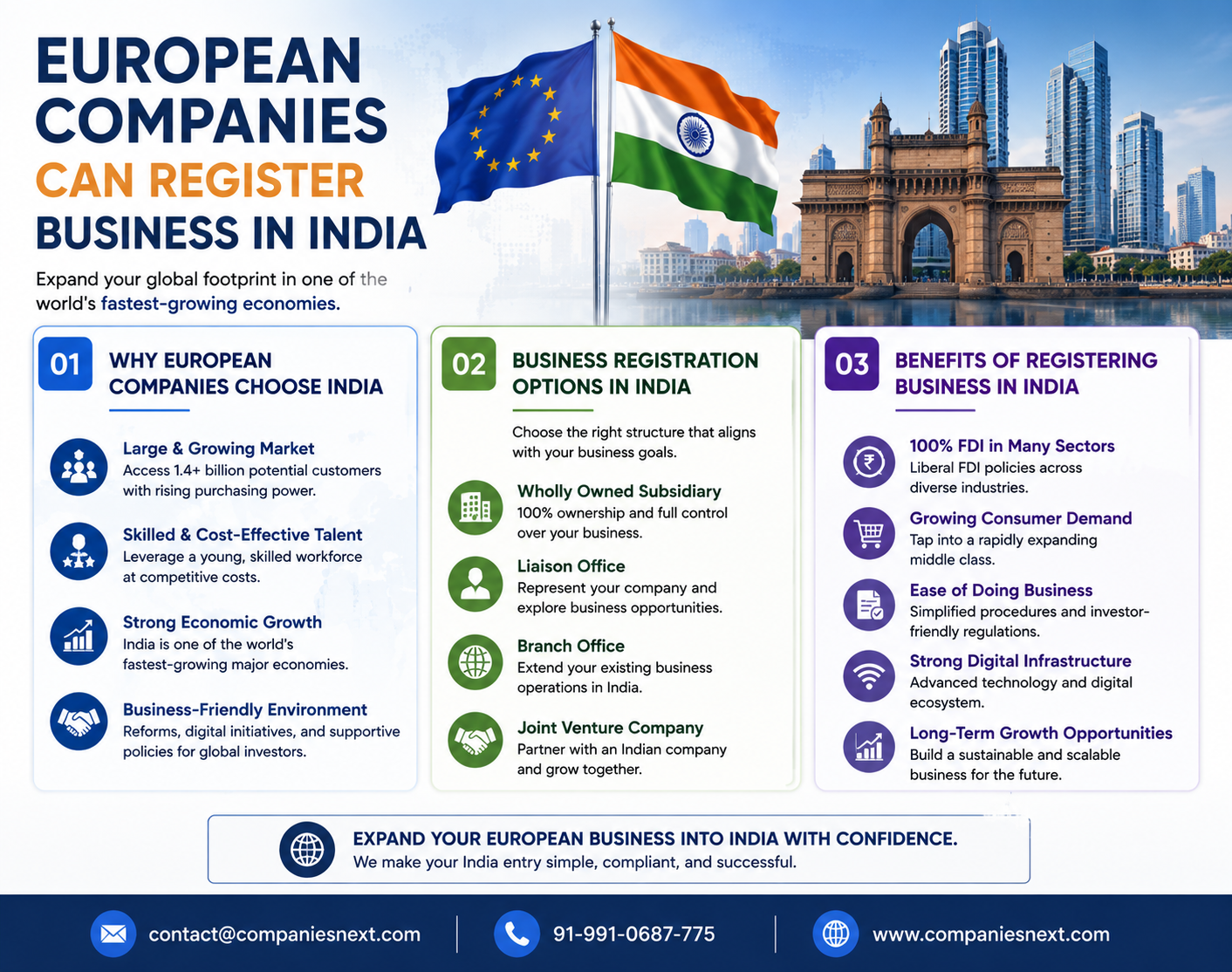
India has become an attractive destination for European entrepreneurs and companies looking to expand into a growing and diverse market. With a large consumer base, developing infrastructure, skilled professionals, and opportunities across technology, manufacturing, consulting, healthcare, e-commerce, and other sectors, India can offer significant potential for international businesses.
However, entering a new country requires careful planning. European entrepreneurs need to understand India's business structures, foreign investment rules, taxation, registrations, banking requirements, and ongoing compliance before beginning operations.
This guide explains the major steps involved in setting up a business in India as a European entrepreneur or company.
Why European Businesses Choose India
India offers several advantages for businesses from Europe. Its large domestic market provides access to millions of potential customers, while its growing digital economy has created opportunities for technology-driven businesses.
India also has a strong pool of professionals in areas such as software development, finance, engineering, design, research, and business services. For European companies, establishing an Indian presence can also support regional operations, outsourcing, manufacturing, sourcing, and market expansion.
Another important advantage is that India permits foreign investment in many business sectors, subject to applicable foreign direct investment regulations and sector-specific conditions.
Choose the Right Business Structure
One of the first decisions when entering India is selecting an appropriate legal structure. European entrepreneurs generally consider the following options:
Private Limited Company
A private limited company is one of the most commonly used structures for foreign-owned businesses in India. It provides a separate legal identity and can generally receive foreign investment subject to applicable rules.
This structure can be suitable for European businesses that want to establish a long-term commercial presence, hire employees, enter contracts, open an Indian bank account, and conduct regular business activities.
Limited Liability Partnership
An LLP combines elements of a partnership and a limited liability structure. It may be suitable for certain professional and service-oriented businesses, although foreign investment rules should be reviewed before choosing this structure.
Branch Office
A branch office can allow an overseas company to conduct permitted business activities in India without creating a completely separate Indian company. However, its permitted activities and regulatory requirements are more restricted than those of an Indian subsidiary.
Liaison Office
A liaison office is generally used for communication, market exploration, and representing the foreign parent company. It is not intended to operate as a regular profit-generating business in India.
Check Foreign Direct Investment Rules
Before incorporation, European investors should determine whether their proposed business activity is eligible for foreign investment and whether any conditions apply.
Foreign investment regulations can vary according to the industry, ownership level, and proposed activities. Some sectors may permit foreign investment through the automatic route, while others may require government approval or additional conditions.
Therefore, investors should verify the applicable foreign investment rules before committing funds or finalizing their business structure.
Register the Indian Company
If a European entrepreneur chooses an Indian private limited company, incorporation is generally completed through the Ministry of Corporate Affairs.
The process typically involves:
- Selecting and checking the proposed company name.
- Deciding the directors and shareholders.
- Obtaining the required identification and digital signatures.
- Preparing incorporation documents.
- Filing the required forms with the Ministry of Corporate Affairs.
- Receiving the Certificate of Incorporation.
- Applying for applicable tax registrations and other registrations.
Foreign directors and shareholders may need to provide documents such as passports, address proofs, and other supporting documents. Documents issued outside India may also require notarisation, apostille, or consular procedures depending on the country and applicable requirements.
Understand the Director Requirements
A company incorporated in India must comply with the requirements concerning its directors. At least one director of an Indian company generally needs to satisfy the applicable residency requirement under Indian company law.
European founders who want to manage the Indian company should therefore plan the director structure carefully.
Foreign directors may also need a Director Identification Number and Digital Signature Certificate for completing certain regulatory procedures.
Open a Business Bank Account
After incorporation, the Indian entity normally needs a corporate bank account to receive and make business payments.
The bank may conduct detailed Know Your Customer procedures for the company, directors, and foreign shareholders. Documents relating to incorporation, ownership, identity, address, and the source of funds may be requested.
European businesses should ensure that the information submitted to the bank is consistent with their corporate and investment documents.
Obtain Tax and Other Registrations
Tax registration requirements depend on the nature and scale of the business.
A business may need registrations such as:
- Permanent Account Number (PAN)
- Tax Deduction and Collection Account Number (TAN), where applicable
- Goods and Services Tax (GST) registration, where applicable
- Import Export Code (IEC), if involved in eligible import or export activities
- Professional or local registrations depending on the business and location
The company should assess its tax obligations before beginning commercial operations rather than waiting until after transactions have started.
Understand GST Requirements
Goods and Services Tax is an important consideration for businesses operating in India. Depending on the nature of products or services, turnover, location, and transactions, GST registration and compliance may apply.
European companies providing services to or from India should pay particular attention to the place-of-supply rules and treatment of cross-border transactions.
Regular GST returns, invoicing requirements, tax payments, and record maintenance may also be required after registration.
Plan International Taxation Carefully
European businesses operating through an Indian entity should consider both Indian taxation and the tax implications in their home country.
Cross-border transactions between a European parent company and its Indian subsidiary may fall under transfer pricing rules. Transactions involving management fees, royalties, technical services, loans, or other related-party arrangements should therefore be properly documented and priced according to applicable regulations.
Double Taxation Avoidance Agreements may also be relevant depending on the country involved and the nature of the income.
Professional tax advice can help prevent unnecessary tax exposure and compliance problems.
Arrange a Registered Office and Local Operations
An Indian company needs a registered office address that satisfies applicable legal requirements. Depending on the business model, the company may operate from its own office, a suitable commercial premises, or another legally acceptable arrangement.
The location can also affect registrations, state-level compliance, employment matters, and operational costs.
European founders should select the location based on factors such as customers, employees, suppliers, logistics, infrastructure, and business regulations.
Hire Employees in India
If the Indian business requires local employees, the company must consider employment agreements, payroll, salary deductions, labour regulations, social security requirements, workplace policies, and applicable state-level rules.
Businesses should establish proper payroll and accounting systems from the beginning. This makes it easier to maintain accurate financial records and meet recurring compliance requirements.
Maintain Ongoing Compliance
Company incorporation is only the beginning. Once the Indian entity is established, it must meet ongoing legal, accounting, tax, and corporate compliance obligations.
These may include:
- Annual financial statements
- Income tax returns
- GST returns, where applicable
- Maintenance of accounting records
- Statutory audits where required
- Annual company filings
- Board and shareholder documentation
- Foreign investment reporting
- Transfer pricing documentation, where applicable
Failure to meet compliance deadlines can result in penalties and other regulatory complications.
Common Challenges for European Entrepreneurs
European businesses entering India may face challenges related to documentation, regulatory procedures, taxation, foreign exchange rules, local business practices, and cultural differences.
One common issue is misunderstanding the difference between establishing an Indian subsidiary and operating through a branch or liaison office. Each structure has different purposes and restrictions.
Another challenge is managing cross-border payments and foreign investment reporting. Maintaining proper documentation from the beginning can make these processes considerably easier.
Working with experienced legal, accounting, tax, and company registration professionals can help European entrepreneurs navigate these requirements efficiently.
Practical Checklist Before Starting
Before launching operations, a European investor should review the following:
Business Planning
- Identify the target Indian market.
- Research competitors and customers.
- Estimate startup and operating costs.
- Select the appropriate business structure.
Legal and Regulatory Planning
- Check foreign investment eligibility.
- Identify required approvals.
- Prepare shareholder and director documents.
- Complete company incorporation.
- Establish the registered office.
Financial Planning
- Arrange initial capital.
- Open an Indian corporate bank account.
- Set up accounting systems.
- Review Indian and international tax obligations.
- Plan cross-border transactions appropriately.
Operational Planning
- Hire employees if required.
- Establish contracts with suppliers and customers.
- Obtain applicable licenses.
- Set up invoicing and record-keeping procedures.
Conclusion
To Start a Business in India from Europe, entrepreneurs need more than simply registering a company. A successful entry requires careful consideration of the business structure, foreign investment regulations, taxation, banking, employment, accounting, and ongoing compliance.
For many European businesses, an Indian private limited company can provide a practical structure for establishing a long-term presence, while branch and liaison offices may be suitable for specific purposes. The right option depends on the company's activities, investment plans, ownership structure, and expansion strategy.
With proper preparation and professional guidance, European entrepreneurs can build a compliant Indian business and take advantage of the country's expanding market and business opportunities.
 English
Join our community to interact with posts!