
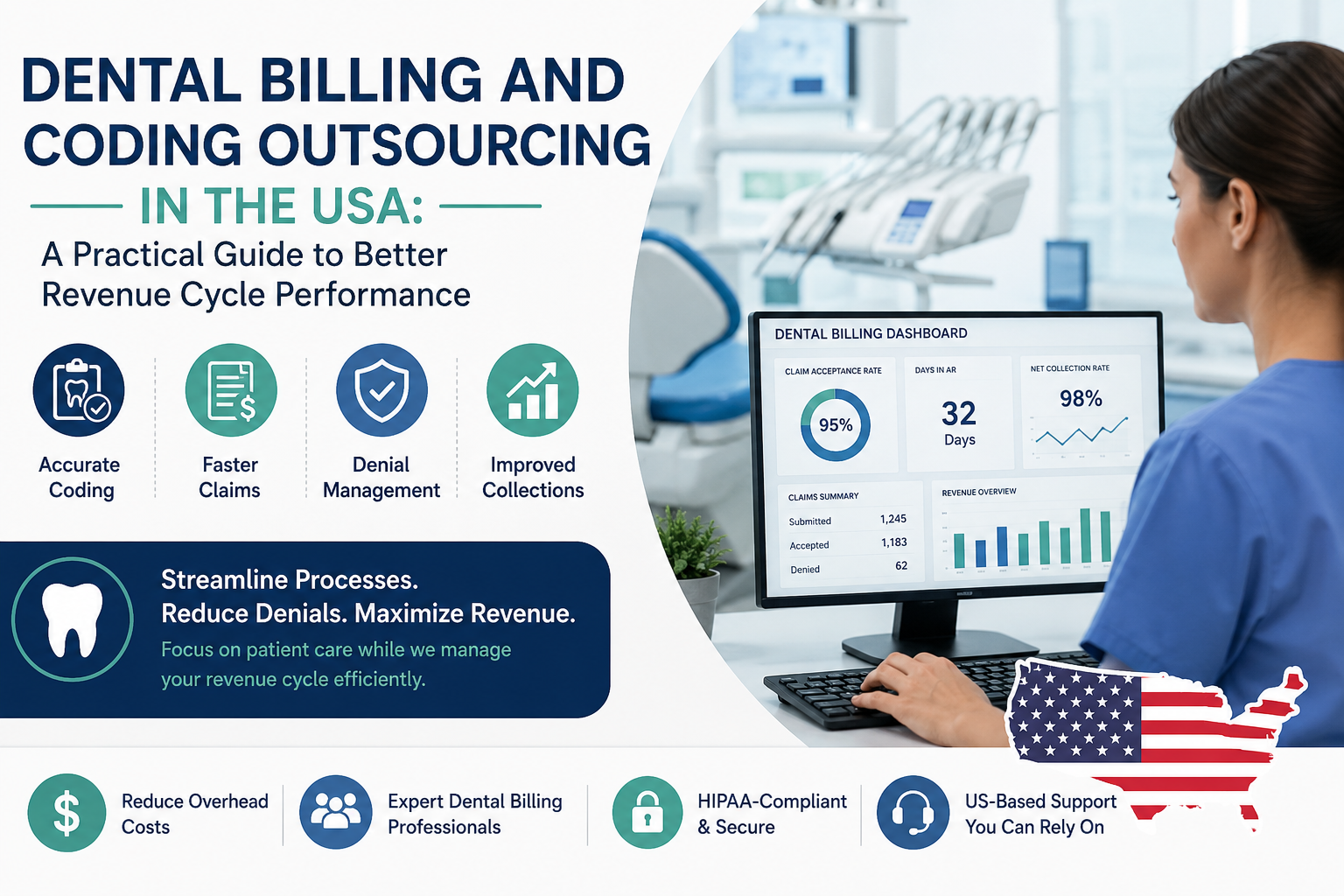
Running a dental practice involves much more than treating patients. Alongside clinical care, dental offices must manage insurance claims, patient eligibility, coding, payment posting, denials, outstanding balances, and payer follow-ups. When these administrative responsibilities begin taking too much time, many practices consider outsourced dental billing as a way to improve financial operations without adding a large in-house billing team.
Dental billing has its own challenges. A claim can be delayed because of an incorrect procedure code, missing documentation, eligibility issue, authorization requirement, or payer-specific rule. Even a small mistake can create additional follow-up work and delay reimbursement.
For dentists and practice managers, the goal is not simply to send claims faster. It is to create a billing process where claims are submitted correctly, payments are posted accurately, denials are addressed quickly, and accounts receivable remain under control.
Why Dental Billing Has Become More Complex
Dental practices often work with several insurance plans, each with different policies, fee schedules, documentation requirements, and reimbursement rules. At the same time, practices must maintain accurate patient information and communicate clearly about financial responsibility.
A typical billing workflow may include:
- Patient eligibility verification
- Insurance benefit checks
- Procedure and diagnosis coding
- Claim preparation and submission
- Documentation review
- Payment posting
- Denial management
- Accounts receivable follow-up
- Patient balance management
- Insurance correspondence
When these tasks are handled manually by a small office team, billing can become difficult to maintain during busy periods.
For example, consider a dental practice that sees a high volume of patients every week. If eligibility is not checked correctly before treatment, the office may later discover that a procedure was not covered as expected. The patient may then receive an unexpected balance, while staff members spend additional time correcting the issue.
This is one reason practices increasingly evaluate specialized dental billing support.
What Does Outsourced Dental Billing Actually Mean?
Outsourced dental billing means transferring some or all billing-related administrative responsibilities to an external billing provider.
The practice continues to control patient care and clinical decisions, while the billing partner manages agreed-upon financial and administrative processes.
Depending on the practice's needs, outsourced support may cover:
- Patient insurance verification
- Charge entry and claim preparation
- Electronic claim submission
- Claim status monitoring
- Payment posting
- Denial analysis
- Accounts receivable follow-up
- Patient statement support
- Insurance follow-up
- Billing reporting
The important point is that outsourcing does not have to mean handing over the entire revenue process. A practice can outsource specific tasks or use a comprehensive billing model.
The Role of Dental Billing Companies in USA Practices
The market includes many dental billing companies in USA that specialize in helping practices manage insurance and revenue-related workflows.
However, practices should not select a provider simply because it offers a long list of services. The real question is whether the company understands dental billing workflows and can fit into the practice's existing processes.
A useful dental billing partner should understand how front-office activities affect the back end of the revenue cycle.
For example, an inaccurate patient demographic record can affect claim submission. An eligibility mistake can lead to avoidable patient balances. A coding error can result in a denial. When these problems are connected, an effective billing operation needs to look at the entire workflow rather than treating each issue separately.
What Services Are Usually Included?
The exact scope varies among dental billing providers, but several services are commonly included.
Eligibility and Benefits Verification
Insurance verification helps the practice understand a patient's coverage before treatment. This can include checking active coverage, benefit limitations, deductibles, exclusions, and remaining benefits.
Accurate verification can help reduce surprises for both the practice and the patient.
Dental Coding and Claim Preparation
Correct coding is fundamental to clean claim submission. Billing teams review procedures, supporting information, and payer requirements before submitting claims.
The objective is not to use codes simply because they generate reimbursement. Codes should accurately represent the services documented and performed.
Claims Submission and Follow-Up
Submitting a claim is only the beginning. Claims may remain unpaid because of missing information, payer requests, eligibility problems, documentation issues, or processing delays.
A dedicated team can monitor outstanding claims and determine the appropriate next action instead of allowing unresolved claims to remain in an aging queue.
Denial Management
Not every denial means the same thing.
One denial may be caused by eligibility. Another may involve documentation, coding, authorization, coordination of benefits, or a payer-specific requirement.
Effective denial management starts by identifying the underlying reason and determining whether the claim should be corrected, appealed, or otherwise resolved.
Payment Posting
Accurate payment posting allows practices to understand what insurers actually paid, what remains outstanding, and whether contractual adjustments were correctly applied.
It also helps keep patient balances accurate.
Understanding Dental Billing RCM
The term dental billing RCM refers to the financial process surrounding the patient's journey from registration and insurance verification through claim submission, reimbursement, and final account resolution.
A simplified dental revenue cycle looks like this:
Patient registration → Eligibility verification → Treatment → Documentation and coding → Claim submission → Payer processing → Payment posting → Denial or A/R follow-up → Account resolution
Problems early in this chain can create problems later.
For instance, incomplete insurance information at registration can result in a claim rejection weeks later. By then, the office may need to spend additional time contacting the patient and payer.
That is why successful revenue cycle management is not just about chasing unpaid claims. It is also about preventing avoidable problems before they reach the claims stage.
When Should a Practice Consider Outsourcing?
There is no single practice size that determines when outsourcing makes sense. A small dental office may benefit from external billing support, while a larger multi-location practice may require a more structured solution.
Some common warning signs include:
- Claims are frequently submitted late.
- Staff spend excessive time on insurance follow-up.
- Accounts receivable continues to grow.
- Denials are not reviewed consistently.
- Payment posting is delayed.
- The practice has difficulty keeping billing staff.
- Billing responsibilities are divided among employees with other duties.
- Management lacks clear visibility into revenue-cycle performance.
Outsourcing can be particularly useful when the practice wants to keep its clinical team focused on patients rather than administrative follow-up.
How to Evaluate Dental Billing Company Services
Before choosing dental billing company services, practice owners should look beyond pricing.
A good evaluation should consider the company's workflow, communication process, technology, reporting capabilities, and experience with the practice's specialty and payer mix.
Ask potential providers:
How are claims reviewed before submission?
A strong process should include checks designed to identify common errors before claims reach the payer.
How are denials categorized?
A provider should be able to distinguish between different denial causes and track recurring patterns.
What reports will the practice receive?
Useful reporting may include information about outstanding A/R, claim status, denial trends, payments, and unresolved accounts.
How is communication handled?
The practice should know who to contact when a billing issue requires clarification.
Can the service scale?
A billing workflow that works for one location may need to change when a practice adds providers or locations.
These questions help shift the conversation from “How much does outsourcing cost?” to “What financial and operational value will the service provide?”
Outsourcing vs. Keeping Billing In-House
Keeping billing in-house provides direct control over employees and daily processes. It can work well when a practice has experienced staff, reliable systems, and sufficient administrative resources.
Outsourcing, on the other hand, can provide access to specialized billing personnel without requiring the practice to recruit and manage a complete billing department.
Neither approach is automatically better.
The right choice depends on factors such as:
- Practice size
- Patient volume
- Insurance mix
- Number of providers
- Existing staff capabilities
- Billing complexity
- Technology
- Administrative workload
Some practices also choose a hybrid model, keeping patient-facing financial conversations in-house while outsourcing claims, A/R follow-up, payment posting, or denial management.
How Broader Healthcare Billing Services Can Support Dental Operations
Although dental billing has specific requirements, some organizations operate within a broader healthcare revenue cycle environment. This can provide access to related expertise in medical billing services, particularly for organizations managing multiple healthcare specialties or connected clinical operations.
Similarly, medical coding services can support healthcare organizations that require specialized coding knowledge beyond dental procedures. For organizations handling both dental and medical workflows, medical billing and coding services may provide a more integrated administrative approach.
The same principle applies to broader revenue cycle management services. Instead of looking at claims as isolated transactions, these services can address the entire financial workflow, from patient information and eligibility through reimbursement and accounts receivable.
Practices and healthcare organizations may also require credentialing services when onboarding providers, maintaining payer participation, or managing enrollment-related administrative work. Credentialing is separate from day-to-day claims processing, but problems in provider enrollment can affect the ability to bill certain payers successfully.
Measuring Whether Outsourcing Is Working
A dental practice should not evaluate an outsourced billing arrangement based only on the number of claims submitted.
More meaningful indicators can include:
- Days in accounts receivable
- Outstanding insurance balances
- Denial volume and denial reasons
- Clean claim performance
- Payment posting turnaround
- Aging A/R
- Unresolved claim volume
- Collection trends
The specific metrics should match the practice's goals and payer environment.
For example, if a practice has a large volume of older unpaid claims, reducing aged A/R may be a more immediate priority than simply increasing the number of claims processed each month.
Regular reporting also gives practice owners an opportunity to identify recurring operational problems.
A Practical Example
Imagine a growing dental practice with three providers. The front-office team verifies insurance, schedules patients, answers calls, collects payments, and handles billing.
As patient volume increases, claims begin accumulating. Payment posting takes longer, older insurance balances receive less attention, and staff members have less time to investigate denials.
Instead of hiring several additional employees immediately, the practice could outsource selected billing functions.
The external team might handle claim submission, payment posting, denial follow-up, and older A/R, while the practice retains control over patient communication and treatment-related financial discussions.
After several months, management can compare billing performance with its previous workflow and determine whether the arrangement is improving efficiency.
The important lesson is that outsourcing should solve a clearly identified operational problem rather than simply move tasks from one team to another.
Choosing the Right Dental Billing Partner
There are many dental billing companies competing for practices, so due diligence matters.
A suitable partner should demonstrate:
- Clear billing workflows
- Experienced billing personnel
- Transparent communication
- Consistent reporting
- Strong denial follow-up processes
- Understanding of payer requirements
- Appropriate data security practices
- Scalable support
- Defined responsibilities between the practice and billing company
Practices should also understand exactly what is included in the service agreement. A low initial price may not represent good value if essential billing tasks are excluded or additional fees appear later.
Conclusion
Outsourced dental billing can be a practical option for dental practices that want to reduce administrative pressure and create a more consistent revenue cycle. The strongest approach is not simply to send billing work outside the practice. It is to establish a reliable workflow that connects eligibility, documentation, coding, claims, payments, denials, and accounts receivable.
Organizations such as 247 Medical Billing Services can be considered as part of a broader evaluation of healthcare billing support, particularly for practices or healthcare organizations looking at services that extend beyond individual claims. Depending on operational needs, that support may include medical billing services, medical coding services, medical billing and coding services, revenue cycle management services, and credentialing services.
Ultimately, the best billing arrangement is one that gives the practice better visibility, fewer avoidable administrative problems, and more time to focus on patient care.
Frequently Asked Questions
1. What is outsourced dental billing?
Outsourced dental billing is the process of assigning billing and revenue-cycle responsibilities to an external company. Services can include eligibility verification, claims processing, payment posting, denial management, and accounts receivable follow-up.
2. Why do dental practices outsource billing?
Practices commonly outsource billing to reduce administrative workload, access specialized billing expertise, improve claim follow-up, and allow internal staff to focus more on patients and daily practice operations.
3. What should I look for in a dental billing company?
Look for experience with dental billing, clear workflows, reliable communication, transparent reporting, effective denial management, appropriate security practices, and a service model that matches your practice's requirements.
4. Does outsourcing include dental coding?
It can. Depending on the agreement, a billing provider may support coding review, claim preparation, documentation checks, and related revenue-cycle activities. Practices should confirm exactly which coding responsibilities are included.
5. Is outsourced billing suitable for small dental practices?
Yes. Small practices can use outsourcing to access specialized billing support without building a large internal billing department. A practice can also outsource only selected tasks rather than its entire billing operation.
6. How can a practice measure the success of outsourced billing?
Practices can monitor indicators such as accounts receivable aging, denial trends, outstanding insurance claims, payment posting turnaround, unresolved claims, and overall collection performance. The most useful metrics depend on the practice's specific circumstances.
 English
Join our community to interact with posts!