
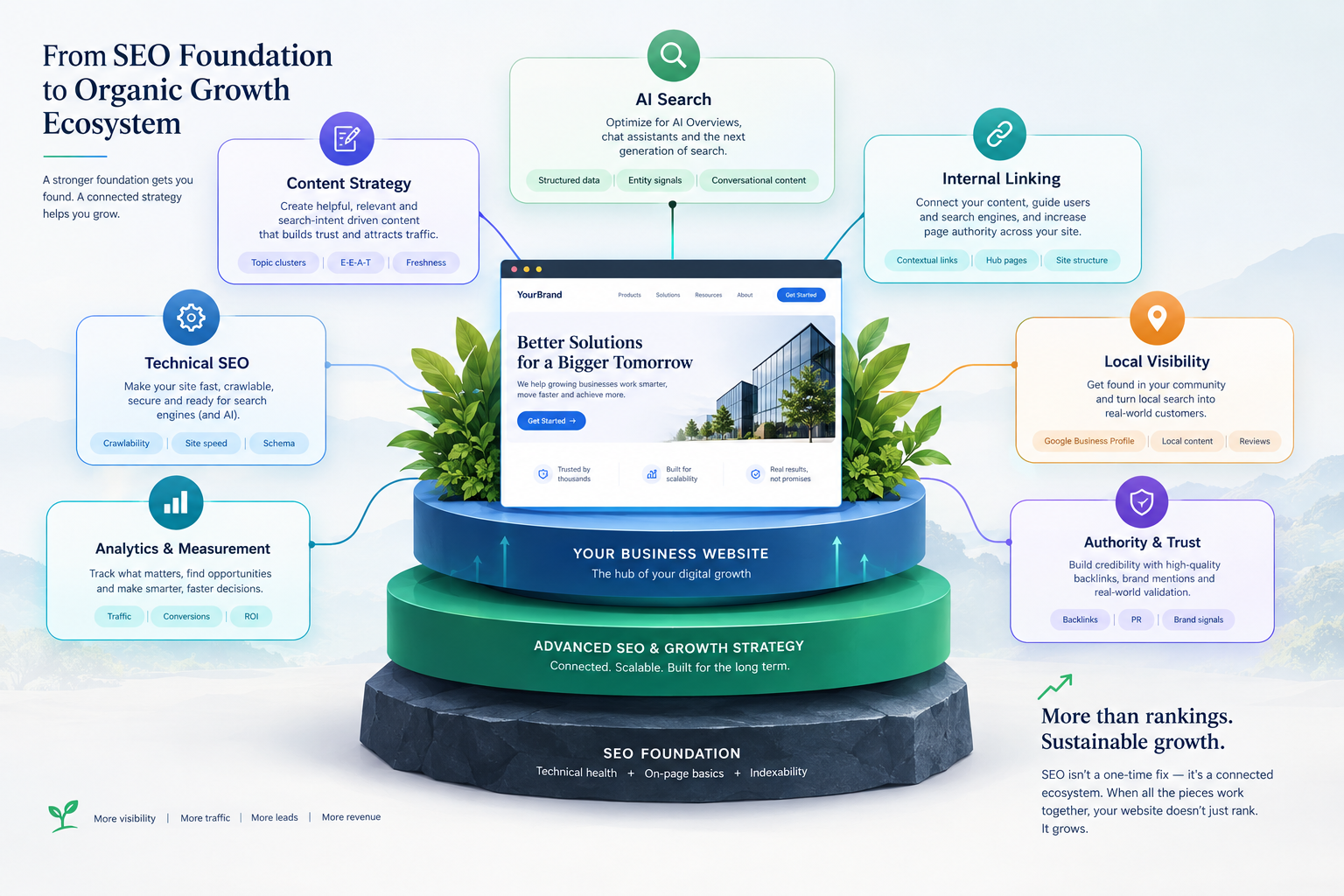
A few optimized pages, sensible keywords, technical fixes, and some useful content can create a solid starting point. But as the business grows, the website grows with it. More products, services, locations, competitors, content, and customer questions begin to enter the picture.
That is where basic SEO can start showing its limits.
SEO services for growing businesses need to address more than individual keywords. They need to consider website architecture, technical health, content depth, search intent, internal linking, authority, conversion paths, and the changing ways people discover information.
Google's current guidance continues to emphasize helpful, reliable, people first content rather than content created primarily to manipulate rankings. At the same time, Google's search ecosystem now includes AI Overviews and AI Mode, making clear information and strong technical foundations increasingly important.
For Seoliono, the bigger question is not simply whether a business is doing SEO.
It is whether its SEO strategy is capable of growing with the business.
What Is Basic SEO Actually Good For?
Basic SEO still has an important role.
It can help a business establish the fundamentals needed for search visibility, including:
• Keyword research
• On page optimization
• Title and heading optimization
• Metadata
• Basic technical SEO
• Internal linking
• Search friendly content
• Indexing checks
• Website structure
These activities should not be dismissed.
In fact, they form the foundation of a strong search strategy.
The problem appears when a growing business continues using only the same basic checklist while its website and competitive environment become significantly more complicated.
A business with ten important pages has different SEO needs from a business with hundreds or thousands of pages.
The strategy needs to evolve accordingly.
Growth Changes the SEO Problem
As a business grows, its search landscape becomes broader.
It may introduce new services, enter new markets, target different customer segments, publish more content, add locations, launch new products, or build multiple website sections.
Each addition creates new relationships between pages.
For example, a growing company may have:
• Core service pages
• Industry pages
• Location pages
• Product pages
• Educational resources
• Comparison pages
• Case studies
• Blog content
• FAQ content
• Supporting landing pages
If these pages are created without a clear information architecture, the website can become difficult to navigate.
Search engines may also have a harder time understanding which pages are most important and how different topics relate to one another.
This is why growing businesses need an SEO strategy that considers the website as a connected system.
Technical SEO Becomes More Important at Scale
Technical SEO is often underestimated because users do not always see it directly.
But technical problems can become more significant as a website grows.
A larger website may need regular attention to:
Crawling and Indexing
Important pages need to remain accessible to search engines.
Canonicalization
Multiple URLs can sometimes represent similar content. Clear canonical signals can help search engines understand preferred versions.
Website Architecture
Important pages should have logical relationships with related content.
Internal Linking
Internal links help users discover related information and help search engines understand the relationship between pages.
Structured Data
Where appropriate, structured data can provide search engines with additional context about page content and entities.
Google's current documentation recommends validating structured data and making sure important pages are accessible to Google before expecting search features to use the information.
For a small website, these issues may be relatively easy to manage.
For a growing website, they can become an ongoing operational responsibility.
Content Needs to Become More Strategic
Publishing content is not the same as building a content strategy.
A growing business can easily accumulate dozens or hundreds of articles that target similar topics without creating meaningful additional value.
That creates a problem.
Instead of building topical depth, the website may simply be creating more pages.
Google's current spam policies specifically warn against scaled content created primarily to manipulate search rankings when that content provides little value to users. This applies whether the content is produced manually or with generative AI.
A stronger approach begins with questions such as:
What does the audience actually need to know?
Which topics are commercially important?
Which questions are not being answered?
Which pages already perform well?
Which pages overlap?
Which topics deserve comprehensive coverage?
Which content should be updated, combined, or removed?
That is where content strategy becomes more valuable than content volume.
Search Intent Matters More as Competition Increases
Growing businesses often make the mistake of targeting keywords without considering what the searcher actually wants.
Consider the difference between:
“what is technical SEO”
and
“technical SEO services”
The first query is primarily educational.
The second suggests commercial investigation.
The content should therefore be different.
A detailed educational guide may satisfy the first search.
A well structured service page may be more appropriate for the second.
A scalable SEO strategy maps content to search intent rather than trying to make one page rank for everything.
This also creates a better experience for visitors because they arrive on pages designed around the question or decision they are trying to address.
Authority Requires More Than Publishing More Pages
As a business grows, it often needs to demonstrate expertise more clearly.
That can involve creating useful resources, explaining complex subjects, publishing original insights where appropriate, demonstrating relevant experience, and making the organization's expertise understandable.
The objective is not to add impressive sounding claims.
It is to provide evidence and useful information.
For example, a professional services business could strengthen its content ecosystem through:
• Detailed educational guides
• Practical frameworks
• Original analysis
• Relevant case studies
• Expert authored content
• Service explanations
• Industry specific resources
• Clear author information where appropriate
Google's current Article structured data guidance also recommends providing clear author information and using appropriate author details to help Google understand who created the content.
Trust becomes increasingly important as a website expands because there are simply more opportunities for unclear, outdated, or low quality information to appear.
Local, National, and Industry Visibility May Need Different Strategies
Growing businesses often expand beyond their original market.
A company that once focused on one city may eventually serve multiple regions.
Another may expand from one service into several industries.
This creates a need for more sophisticated information architecture.
For example, a company could organize its website around:
Core Services
↓
Industries
↓
Locations
↓
Service Specific Resources
This is only an example. The right structure depends on the business.
The important point is that growth should not result in random landing pages being added whenever a new keyword appears.
Each page should have a clear purpose and relationship with the rest of the website.
AI Search Adds Another Layer
Growing businesses also need to consider how people discover information through AI powered search.
Google's current documentation explains that AI Overviews and AI Mode use web sources to provide responses, while established SEO fundamentals remain relevant. Google has also added newer guidance around generative AI features and specifically emphasizes valuable, non commodity content rather than chasing a special formula for AI visibility.
This changes the conversation around SEO.
Businesses should not assume that adding phrases such as “AI search” or “GEO” to existing pages will automatically make those pages more useful.
Instead, the underlying content needs to become clearer.
Important questions should have direct answers.
Complex subjects should be explained properly.
Related concepts should be connected.
Important business information should be accessible.
Content should provide something genuinely useful rather than simply repeating information already available everywhere.
That is good SEO and good content regardless of the search interface.
What Advanced SEO Services Should Include
For a growing business, more advanced SEO services should connect multiple areas instead of treating every task separately.
A mature strategy may include:
Technical SEO
Regular technical audits, indexing analysis, architecture reviews, canonicalization, redirects, structured data, and other technical considerations.
Content Strategy
Topic mapping, content gaps, search intent analysis, content refreshes, and strategic editorial planning.
On Page Optimization
Improving headings, content structure, internal links, metadata, and page relevance.
Authority and Trust
Developing useful resources and strengthening signals that help visitors understand the organization's expertise.
Local SEO
Optimizing genuine local visibility where the business serves specific geographic markets.
AI Search Readiness
Making important information clear, accessible, well structured, and useful across traditional and emerging search experiences.
Measurement
Using search performance data to identify opportunities rather than relying on rankings alone.
This is where businesses looking for enterprise seo optimization services can benefit from thinking beyond a conventional SEO checklist.
Enterprise level SEO does not necessarily mean the company has to be enormous.
It means the website and business have reached a level of complexity where coordination, scalability, and governance matter.
How Seoliono Can Approach SEO for Growing Businesses
Seoliono can approach growth focused SEO by first understanding the business rather than immediately recommending a list of generic tasks.
The first stage should identify the current search landscape.
That includes reviewing technical health, important pages, search intent, content coverage, competitors, internal linking, local visibility where relevant, and opportunities for stronger organic growth.
From there, the strategy can prioritize the areas most likely to support the business.
That prioritization matters.
A growing company does not necessarily need fifty SEO tasks completed at once.
It needs the right tasks completed in the right order.
For example, fixing indexation problems may deserve attention before publishing another twenty articles.
Improving a high value service page may be more useful than creating another page targeting a similar keyword.
Refreshing outdated content may produce more value than continuously publishing new content.
Good SEO is often about knowing what not to do.
When Should a Business Move Beyond Basic SEO?
There is no universal revenue figure or website size that determines when a business needs a more advanced SEO strategy.
The better indicators are complexity and growth.
Consider upgrading the SEO approach when:
• The website has grown significantly
• Multiple teams contribute to the website
• New services or markets are being added
• Organic traffic has become commercially important
• Several pages target overlapping topics
• Technical issues are becoming harder to monitor
• Content production has increased without clear strategy
• Local and national visibility both matter
• Competitors are investing heavily in organic search
• The business wants broader visibility across emerging search experiences
These signs suggest that SEO is becoming a business system rather than a simple marketing checklist.
Why the Right SEO Strategy Scales With the Business
The purpose of SEO is not to keep a website permanently trapped in a checklist of basic tasks.
As the business changes, the strategy should change too.
A growing company needs search visibility that supports its products, services, customers, locations, expertise, and long term goals.
That means combining technical SEO with useful content, clear architecture, search intent, internal linking, authority, local visibility where relevant, and preparation for evolving search experiences.
For Seoliono, this is the difference between simply doing SEO and building a broader organic growth strategy.
The goal is not more pages for the sake of more pages.
It is not more keywords for the sake of more keywords.
And it is certainly not chasing every new SEO acronym that appears online.
The goal is a website that is useful to people, understandable to search systems, and capable of supporting the business as it grows.
Frequently Asked Questions
Is basic SEO enough for a growing business?
Basic SEO can establish important foundations, but growing businesses often develop more complex technical, content, architectural, and competitive requirements. The strategy should evolve as the website and business become more complex.
What are SEO services for growing businesses?
SEO services for growing businesses typically combine technical SEO, content strategy, on page optimization, internal linking, search intent analysis, authority development, local SEO where relevant, and ongoing performance analysis.
When should a business invest in advanced SEO services?
There is no single threshold. Signs include a rapidly expanding website, multiple services or markets, increasing organic competition, content overlap, technical complexity, or a growing dependence on organic search for customer acquisition.
Does AI search make traditional SEO less important?
Not according to Google's current guidance. Google continues to state that established SEO fundamentals remain relevant to its AI search experiences. Businesses should focus on useful content, accessibility, technical foundations, and clear information rather than treating AI search as a completely separate discipline.
Can more content solve a business's SEO problems?
Not necessarily. More content can create additional problems when pages overlap, provide little value, or exist mainly to target search queries. Google's current spam policies specifically address scaled content created primarily for ranking manipulation.
What should a growing business prioritize first?
Start with the fundamentals. Review technical accessibility, important pages, search intent, website architecture, content quality, internal linking, and commercially important topics. Then prioritize improvements according to business impact.
 English
Join our community to interact with posts!