
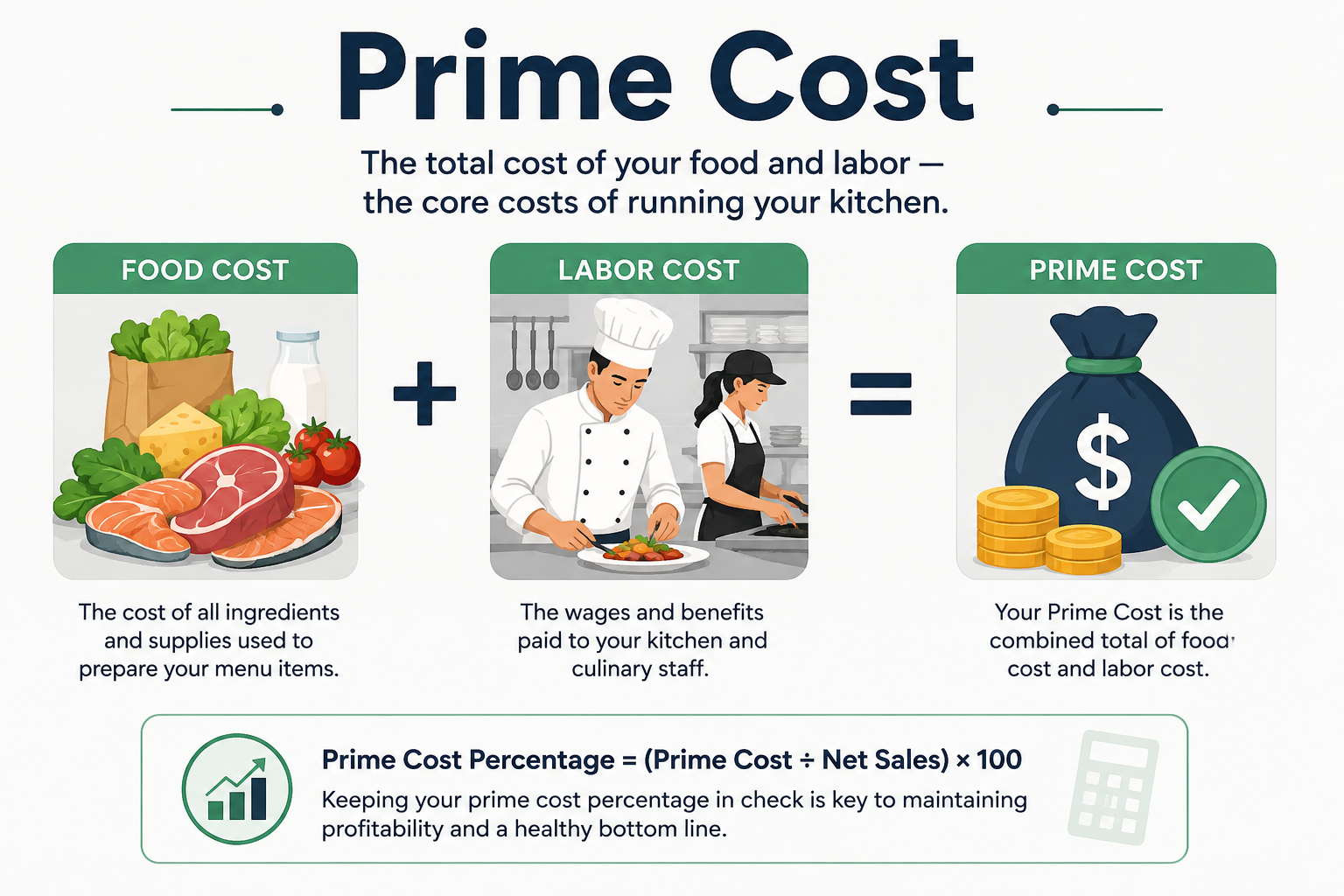
Restaurant owners often hear the term prime cost restaurants, especially when reviewing profitability. Prime cost is a management measure that brings together the costs most directly connected to producing and serving food and beverages: typically food and beverage costs plus direct labor. Looking at these costs together is useful because they usually represent a large share of controllable operating expense. Instead of examining food cost and labor cost separately, an owner can see how the two categories interact and whether the operation is using its resources efficiently.
Why Prime Cost Matters
A restaurant can generate strong sales and still struggle if the costs required to produce those sales are too high. Prime cost helps reveal that issue early. For example, a menu item may have an attractive selling price, but if ingredient usage is uncontrolled or staffing is poorly matched to demand, the additional sales may not create the expected contribution. Tracking the combined cost gives management a broader view of operating discipline and makes it easier to investigate changes in profitability.
How to Calculate It
The basic calculation is straightforward: prime cost equals cost of goods sold plus direct labor. Depending on the restaurant's accounting system, cost of goods sold can include food, beverage, and other directly consumed inventory categories, while direct labor can include wages and applicable payroll costs for employees involved in producing and serving the offering. To compare periods of different sizes, many operators also express prime cost as a percentage of sales. The important point is consistency: use the same definitions each period so the trend remains meaningful.
Example of a Practical Review
Suppose a restaurant has $50,000 in relevant sales for a period. It spends $15,000 on food and beverage products and $13,000 on direct labor. The prime cost is $28,000, or 56% of the relevant sales. The percentage itself should not be treated as a universal pass-or-fail number because restaurant concepts have different menus, service models, locations, and labor requirements. Its real value comes from comparing the current result with the restaurant's budget, historical performance, and operational expectations.
What Can Push Prime Cost Higher
Several operational issues can increase prime cost. Waste, inaccurate purchasing, theft, poor portion control, excessive discounts, unplanned overtime, weak scheduling, and low productivity can all contribute. A restaurant may also see higher costs because of supplier price changes or a menu mix that shifts toward lower-margin products. Identifying the cause is more useful than simply reacting to the percentage. Managers should connect the financial result with inventory counts, invoices, schedules, sales mix, and operating observations.
Ways to Improve the Number
Improvement usually comes from many small controls. Standardized recipes help keep portions consistent. Regular inventory counts can identify unusual usage. Purchasing based on realistic demand reduces excess stock. Scheduling should reflect forecasted sales rather than habit. Managers can also review overtime, prep productivity, menu mix, and voids or discounts. When a problem appears, make one measurable change, monitor the result, and keep the process that works.
How Often Should Owners Review It?
A monthly review is useful for financial reporting, but many operators benefit from more frequent operational checks. Weekly reviews can highlight emerging problems with labor or inventory before they become embedded in a monthly result. Daily dashboards can be useful for sales and labor, while physical inventory may be counted on a schedule appropriate to the concept. The goal is to create enough visibility to act without creating unnecessary administrative work.
Common Mistakes to Avoid
One common mistake is treating a target percentage as a universal rule. Another is changing accounting definitions from month to month, which makes trends difficult to interpret. Owners should also avoid cutting labor or food purchases blindly. A cheaper operation is not automatically a better operation if service slows, quality falls, or guests leave dissatisfied. The best improvements remove waste and improve productivity while protecting the customer experience.
Using Prime Cost for Better Decisions
Prime cost is most valuable when it connects finance with operations. If it rises, ask whether sales mix changed, ingredient prices increased, waste grew, or labor productivity declined. If it falls sharply, verify that the improvement is real and that quality or staffing has not been compromised. Over time, these questions turn a simple metric into a management system that supports purchasing, menu engineering, staffing, pricing, and budgeting decisions.
Build a Consistent Cost-Control Routine
A practical routine can begin with a weekly review of sales, purchasing, inventory usage, labor hours, overtime, discounts, and waste. Compare the results with the same day or week pattern when possible. Investigate unusual changes rather than accepting them as normal variation. Managers can then assign a specific action, such as checking a recipe, reviewing a supplier invoice, changing a prep quantity, or adjusting a schedule. Documenting the action and reviewing the next period creates a simple feedback loop. Over time, this approach makes cost control part of normal restaurant management rather than an emergency response.
Connect Pricing With Costs
Pricing decisions should be evaluated alongside product cost, labor requirements, customer expectations, and competitive positioning. Raising a price may improve contribution, but only if customers continue to perceive sufficient value. Similarly, a discount may increase transactions but reduce contribution if it attracts customers who would have purchased anyway. Owners should look at the economics of the entire menu and consider how changes affect mix. A disciplined review can identify products that deserve promotion, redesign, repositioning, or removal while protecting the overall customer experience.
Use Forecasting Instead of Guesswork
Forecasting helps restaurants match resources with expected demand. Historical sales, reservations, events, holidays, weather patterns, local activity, and recent trends can all inform a forecast. The forecast does not need to be perfect; it needs to be good enough to guide purchasing and staffing. After the period ends, compare forecasted demand with actual demand and record the reason for significant differences. This improves future forecasts and reduces over-ordering, emergency purchasing, unnecessary labor, and stockouts.
Train Managers to Read the Metric
A cost metric is only useful when the people responsible for operations understand what moves it. Managers should know how purchasing, portions, waste, staffing, overtime, discounts, and sales mix influence the result. Training should include simple examples and clear responsibilities. When managers can explain why a number changed, they are more likely to take appropriate action. This also creates accountability without turning financial management into a purely accounting exercise.
Use Trends Rather Than Isolated Results
One unusual week should not automatically trigger a major operational change. Restaurant performance can fluctuate because of holidays, weather, events, staffing disruptions, or supplier issues. Review several periods and look for persistent trends. At the same time, serious anomalies should be investigated quickly when they indicate possible waste, theft, system errors, or operational breakdowns. Combining trend analysis with exception management gives owners both stability and responsiveness.
A Simple Implementation Checklist
A useful way to apply the ideas in this guide is to turn them into a short implementation checklist. First, write down the current situation using the most reliable information available. Second, define one measurable objective and a reasonable time period. Third, identify the people, systems, budget, and operational changes required. Fourth, decide how success will be measured before the change begins. Finally, schedule a review and record what happened. This approach keeps the team focused and makes it easier to separate a genuinely useful improvement from an idea that simply sounded good.
Communicate the Decision Clearly
Restaurant initiatives often fail because the team does not understand what is changing or why. Managers should explain the objective, the expected behavior, the customer benefit, and the measures that will be reviewed. Instructions should be practical and specific. For example, instead of telling staff to reduce waste, explain which preparation quantities, storage procedures, or portion controls need attention. Invite employees to report problems because frontline observations can reveal operational barriers quickly. Clear communication creates accountability while also giving staff a chance to contribute to the solution.
Review, Learn, and Adjust
No restaurant strategy should be treated as permanent. Customer demand changes, competitors respond, costs move, and operational capacity evolves. After implementing a change, compare the result with the original objective and document the lesson. If the outcome is positive, determine whether the improvement can be standardized. If the outcome is weak, identify what assumption was incorrect and revise the approach. This cycle of testing, measurement, and adjustment creates a culture of continuous improvement and helps the restaurant respond to change without making decisions based solely on instinct.
Key Takeaways
For owners who are researching prime cost restaurants, the most important lesson is to connect the idea to measurable business outcomes.
· Define the business objective and the customer problem before investing time or money.
· Use consistent financial and operating measures so changes can be identified early.
· Validate decisions with local market evidence, customer feedback, and actual operating data.
· Protect the guest experience while improving efficiency and controlling costs.
Conclusion
A strong restaurant strategy is rarely built from one decision. Owners need a clear concept, reliable numbers, disciplined operations, and a practical way to understand the market around them. The most useful approach is to turn the subject of this guide into a repeatable management habit rather than a one-time task. Review the relevant numbers regularly, compare actual performance with your plan, document what changed, and make small adjustments before a problem becomes expensive. When the team understands the reason behind a decision, execution also becomes more consistent.
Restaurant operators should also remember that local conditions matter. Customer behavior, competition, rent, labor availability, supplier terms, seasonality, delivery demand, and neighborhood development can all change the economics of a business. A strategy that works in one area may need to be adapted elsewhere. Use the ideas in this guide as a framework, then validate them with your own operating data and local research.
Finally, keep the customer at the center of the process. Better financial control, technology, market research, or equipment decisions should ultimately help the restaurant serve guests more consistently and profitably. The goal is not simply to collect information. The goal is to use information to make better decisions, protect margins, improve the guest experience, and build a restaurant that can perform sustainably over time.
Explore more restaurant planning and industry resources at Restaurant Site Finder for additional practical guidance.
 English
Join our community to interact with posts!