
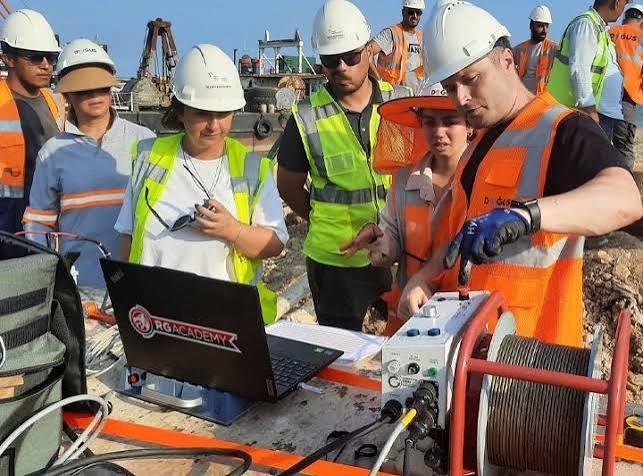
Reliable information about subsurface materials is essential for modern engineering projects. Before foundations, offshore structures, wind farms, dams, and other major developments can be designed, engineers need to understand the characteristics of the soil and rock beneath the project site. Borehole geophysical logging provides a way to collect detailed information at depth, and PS Logger® technology is specifically designed for high-resolution seismic measurements.
The Robertson Geo PS Logger® is a full-waveform acoustic probe that measures compressional P-wave and shear S-wave velocities in soil and rock formations. The system can acquire these measurements from a single borehole at depths of up to 600 metres. Robertson Geo reports that the technology has been used in thousands of boreholes worldwide, including offshore applications.
Measuring P-Wave and S-Wave Velocities
P-waves and S-waves provide different information about subsurface materials. P-waves are compressional waves, while S-waves are shear waves. Measuring both can provide useful information for understanding the seismic and mechanical characteristics of geological formations.
The PS Logger uses an internal hammer source and receivers to generate and record acoustic waveforms. The probe is positioned at the required depth, and the source is activated through surface controls. Full waveforms are digitally recorded across six channels, allowing the data to be analysed for P-wave and S-wave arrivals.
This full-waveform approach gives engineers more information than a simple single-value measurement. The recorded waveforms can be displayed, scaled, and filtered using the acquisition software to assist with identifying wave arrivals.
Single-Borehole Investigation
One of the practical features of the PS Logger is its ability to measure both P-wave and S-wave velocities from a single borehole without requiring an external energy source. This can simplify deployment for projects where borehole access is available.
The system is designed for open-hole, water-filled boreholes and is intended for static measurements. Its specifications include a 50 mm probe diameter, a maximum operating temperature of 70°C, and maximum pressure of 6.5 MPa.
Using a single borehole for seismic measurements can allow project teams to integrate PS logging with other borehole investigation techniques and build a broader subsurface dataset.
Supporting Geotechnical Site Investigation
Site investigation is one of the primary applications of PS Logger technology. Foundation studies, wind farms, offshore structures, and dam safety projects can all require information about the seismic properties and stiffness of underlying soil and rock.
P- and S-wave velocity measurements can complement drilling records, core samples, geological observations, and other geophysical data. Together, these datasets can help engineers develop a more detailed understanding of subsurface conditions.
The PS Logger specification identifies foundation studies, wind farms, offshore structures, and dam safety as applications for the technology.
Calculating Engineering Parameters
Velocity measurements can also be used in combination with density information to derive additional engineering parameters.
When P-wave and S-wave velocities are combined with bulk-density values obtained from density logging or core testing, small-strain parameters such as Young's modulus, shear modulus, and bulk modulus can be calculated. Poisson's ratio can also be determined from the measured velocity information.
These parameters can provide useful input for engineering assessments where the behaviour and stiffness of soil and rock need to be characterised.
Applications in Offshore Engineering
Offshore construction presents unique challenges for geotechnical investigation. Engineers may need reliable subsurface information beneath the seabed before foundations and other structures can be designed.
The PS Logger has been deployed in offshore environments and is identified by Robertson Geo as a technology for offshore structures and wind-farm investigations. The system can collect high-resolution P- and S-wave data from individual boreholes, providing information that can complement other seabed investigation techniques.
Robertson Geo's published project material also documents PS Logger use in offshore wind investigations, where P- and S-wave velocities were collected from seabed boreholes and used with density information to calculate small-strain moduli.
Earthquake Engineering and Strong-Motion Studies
Seismic velocity information is also important in earthquake engineering. The characteristics of near-surface materials can influence how seismic waves behave at a site.
The PS Logger is specified for earthquake engineering applications, including characterisation of strong-motion sites.
By obtaining P-wave and S-wave velocity profiles through borehole measurements, engineers and researchers can develop site-specific information for seismic studies.
The technology has also been used in earthquake-related investigations. Robertson Geo's published material describes PS Logger use in Mexico City for soil stability studies and subsequent earthquake-zone analysis.
Velocity Control for Seismic Surveys
Another application of PS Logger technology is velocity control for seismic reflection surveys. Accurate velocity information can be important when interpreting seismic data and developing subsurface models.
Because the PS Logger provides direct P- and S-wave measurements within a borehole, the resulting data can serve as an additional source of velocity information for geophysical investigations.
This makes the technology relevant not only to conventional geotechnical studies but also to broader seismic and geophysical programmes.
High-Resolution Data Collection
Data quality is a key consideration in any geophysical investigation. The PS Logger records full waveforms across six channels, including P-wave and S-wave measurements at near and far receivers.
The system can use sampling intervals as low as 2.5 microseconds. The acquisition period can be selected according to the expected arrival times and investigation requirements.
Multiple shots can also be stacked, while the acquisition software provides real-time waveform display and tools for processing the recorded data.
Integration With Borehole Logging Equipment
A major benefit of a specialist geophysical probe is its ability to work within an established logging system. The PS Logger is compatible with Robertson Geo surface deployment equipment and software, including Micrologger2 and a range of winch systems.
This allows the PS Logger to form part of a broader borehole investigation programme alongside other geophysical probes.
For projects requiring multiple measurements, integrating different logging technologies can help create a more comprehensive picture of geological and geotechnical conditions.
Purchase, Rental, and Field Services
Different organisations have different requirements for geophysical equipment. A contractor carrying out regular investigations may require its own equipment, while another project may only require a system for a limited period.
Robertson Geo provides PS Logger options through equipment sales, rental, and operational services. Training and support are also available for customers using the system.
This provides flexibility for engineering consultants, geophysical contractors, research organisations, and project teams that require P-wave and S-wave measurements without necessarily following the same equipment procurement model.
Decades of Development
PS Logger technology has a long development history. Development began in 1979 through collaboration involving OYO Corporation and Professor Kitsunezaki of Akita University. Further development introduced a system capable of generating both P-wave and S-wave energy, with development, sales, and manufacturing later transferred exclusively to Robertson Geo.
Robertson Geo has continued developing the system and reports that its service teams and customers have deployed PS Logger technology across many thousands of boreholes worldwide.
This long development history provides a foundation for its continued use in civil engineering, geotechnical investigation, seismic studies, and offshore projects.
Conclusion
Detailed subsurface information can play an important role in the planning and design of modern infrastructure. PS Logger® technology provides a specialised method for measuring P-wave and S-wave velocities from a single borehole, producing full-waveform data that can support geotechnical and seismic investigations.
From foundation studies and offshore wind projects to dam safety, earthquake engineering, and seismic reflection surveys, the technology has applications across a wide range of engineering and geophysical projects.
By combining high-resolution velocity measurements with density data and other geological information, project teams can develop detailed datasets for understanding soil and rock behaviour. For organisations carrying out advanced borehole investigations, PS Logger provides a specialised tool for obtaining seismic information directly from the subsurface.
 English
Join our community to interact with posts!