
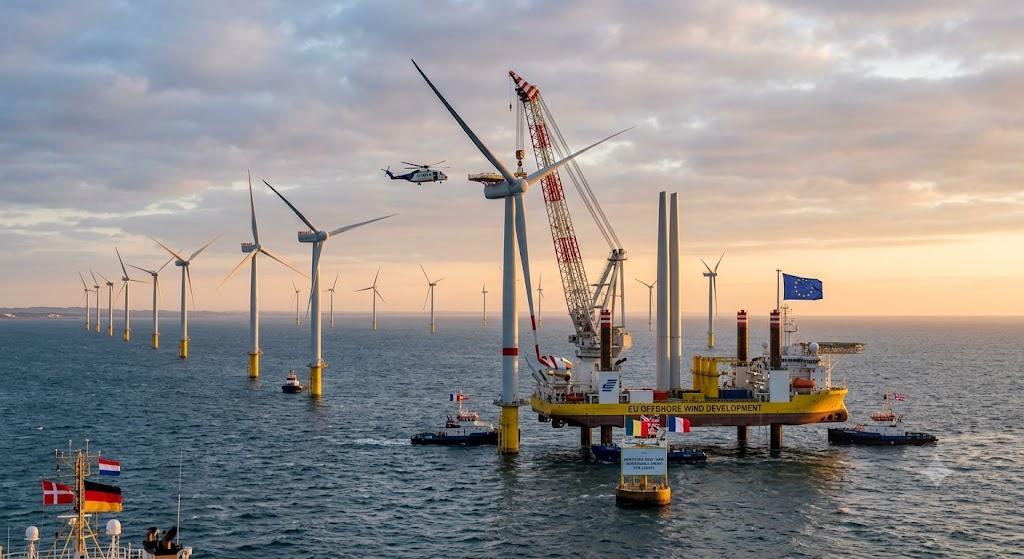
How Offshore Wind Is Reshaping Europe’s Future Electricity System
Offshore wind is becoming a defining component of Europe’s renewable-energy strategy, but its development is no longer measured only by the number of turbines announced. The sector is moving toward a more integrated model in which generation, transmission, ports, manufacturing, financing, environmental planning, and electricity-market design must advance together. This creates a complex but substantial opportunity for companies operating throughout the offshore wind value chain.
The EU Offshore Wind Market combines mature fixed-bottom projects with emerging floating developments. Northern European waters remain central because of strong wind resources, established maritime capabilities, existing offshore infrastructure, and growing interconnection networks. Other European regions are also examining offshore opportunities as technology improves and governments seek to diversify renewable generation. Market development varies considerably by country, reflecting differences in seabed conditions, permitting systems, grid readiness, auction frameworks, and industrial capacity.
One important market driver is the need for additional renewable electricity. Electrification of transport, buildings, industry, and data-intensive activities is increasing attention on reliable sources of low-carbon power. Offshore wind can provide large project volumes from relatively concentrated sites, making it relevant to national energy strategies and regional power systems. Its output is variable, however, so system planners must combine generation expansion with transmission, storage, flexible demand, interconnection, and improved forecasting.
Project economics deserve close attention. Offshore construction requires specialized vessels, foundations, subsea cables, ports, cranes, and highly trained personnel. Changes in interest rates, commodity prices, foreign exchange conditions, insurance costs, and equipment availability can alter project economics after development begins. Developers are responding through revised procurement strategies, longer-term supplier relationships, improved contracting structures, and more detailed risk management.
Turbine technology is changing the economics and physical design of projects. Higher-capacity machines can increase generation from individual sites, but their size introduces new requirements for transportation, lifting, foundations, electrical systems, and maintenance. Component standardization and digital engineering may help manufacturers manage complexity. Remote diagnostics, condition monitoring, and predictive maintenance can also reduce unnecessary offshore visits while improving asset availability.
Grid connection is increasingly viewed as a strategic infrastructure issue rather than a final project step. Large clusters of offshore wind farms can place significant demands on coastal substations and transmission corridors. Coordinated offshore networks may offer alternatives to connecting each project independently. Hybrid connections that combine offshore generation with cross-border links could also improve asset utilization, although they require complex regulatory and market arrangements.
Environmental and maritime considerations remain integral to development. Offshore projects interact with shipping routes, fishing activities, aviation, defense requirements, protected habitats, and other marine users. Early spatial planning and transparent stakeholder engagement can help identify conflicts before major investment decisions are made. Developers are also exploring construction practices and monitoring systems intended to reduce ecological disturbance.
For companies assessing the EU Offshore Wind Market Analysis, the most useful perspective is a full value-chain view. Examining only installed capacity can overlook bottlenecks in permitting, grid access, manufacturing, financing, or vessel availability. A project pipeline becomes commercially meaningful when it advances through defined development milestones.
The outlook will therefore depend on execution as much as ambition. Europe has significant offshore resources and an established industrial base, but scaling deployment requires coordinated investment across the entire ecosystem. Companies that understand changing project structures, technology requirements, supply-chain conditions, and infrastructure needs can identify opportunities as the sector moves into its next development cycle.
Another factor is asset utilization. Better forecasting, improved turbine availability, and coordinated maintenance can help operators capture more electricity from existing infrastructure. As fleets mature, operators may increasingly prioritize lifecycle performance alongside new capacity, creating demand for specialized services and data-driven operational improvements. These improvements can influence project economics consistently.
 English
Join our community to interact with posts!