
Contracts are at the center of many enterprise relationships. They define commercial commitments, supplier obligations, pricing terms, compliance requirements, service levels, renewal conditions, and responsibilities between organizations. Yet managing these agreements manually can create delays, limited visibility, compliance challenges, and operational risks.
This is driving organizations toward modern Contract Lifecycle Management (CLM) platforms that can automate and govern activities across the entire contract lifecycle.
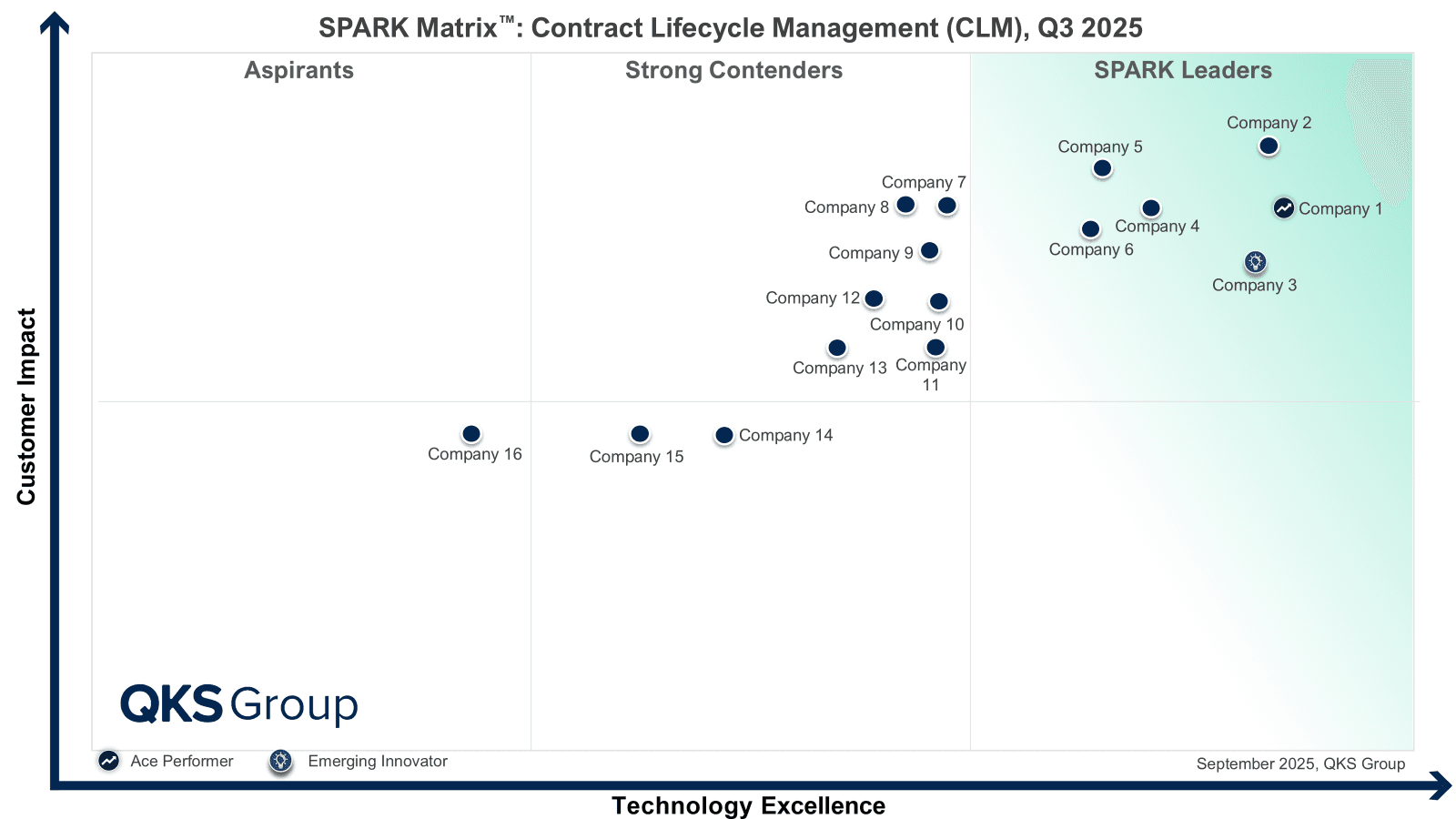
The QKS Group SPARK Matrix™: Contract Lifecycle Management (CLM), Q3 2025 provides a structured view of the global CLM platform market, examining vendor capabilities, product strategies, market presence, customer experience, and emerging technology developments.
From Contract Storage to Intelligent Contract Management
Traditional contract management often involves disconnected documents, spreadsheets, emails, approval processes, and manual tracking. As contract volumes increase, these approaches can make it difficult for legal, procurement, sales, finance, and business teams to maintain consistent visibility.
Modern CLM platforms are designed to bring these activities together.
A comprehensive CLM solution can support activities such as:
- Contract requests and intake
- Contract drafting and authoring
- Negotiation and collaboration
- Approval management
- Contract execution
- Obligation and compliance tracking
- Contract performance analysis
- Renewal and expiration management
This shift means CLM is becoming more than a repository for agreements. It is increasingly becoming a technology layer for managing contractual processes, obligations, and business relationships.
Why AI Is Becoming Important in CLM
Artificial intelligence is becoming an important capability within the CLM ecosystem.
Contracts contain large amounts of unstructured information, and extracting useful insights manually can consume significant time. AI and analytics can help organizations process contractual information and support teams in identifying important terms, obligations, risks, and opportunities.
AI-enabled capabilities can support areas such as:
Contract Analysis: AI can help process large volumes of contract information and identify relevant provisions.
Risk Identification: Intelligent analysis can help highlight potentially important contractual risks or deviations.
Workflow Automation: AI and automation can help route contracts and tasks through predefined processes.
Contract Intelligence: Organizations can gain greater visibility into information contained within agreements.
Decision Support: Analytics can help business teams make more informed decisions based on contract data.
The broader objective is to move contract management from manual administration toward more intelligent and data-driven operations.
Automation Can Improve Contract Lifecycle Efficiency
Contract processes frequently involve multiple stakeholders. Legal teams may review contract language, procurement teams may negotiate supplier terms, finance teams may validate commercial conditions, and business leaders may approve agreements.
Without an integrated workflow, these activities can create bottlenecks.
CLM platforms can centralize contract processes and provide structured workflows for different stages of the lifecycle. This can help organizations improve coordination between departments while creating greater visibility into contract status.
Automation can also support compliance enforcement and reduce dependence on manual tracking.
For enterprises managing large contract portfolios, this combination of centralized information and automated workflows can become an important component of digital transformation.
What Should Enterprises Consider When Selecting CLM Software?
The growing number of CLM providers makes technology selection increasingly complex. Enterprises need to look beyond individual features and consider how effectively a platform addresses their broader contract management requirements.
1. End-to-End Lifecycle Coverage
Organizations should consider whether the platform supports the full lifecycle, from contract request and authoring through execution, compliance, and performance management.
2. AI and Analytics Capabilities
AI capabilities are becoming increasingly relevant. Buyers should examine how intelligence and analytics are integrated into practical CLM workflows and whether these capabilities address real business requirements.
3. Workflow and Automation
Organizations should evaluate whether the platform can automate approvals, reviews, notifications, escalations, and other repetitive contract processes.
4. Integration and Collaboration
CLM rarely operates independently. Integration with procurement, CRM, ERP, finance, and other enterprise systems can be important for creating connected processes and improving data visibility.
5. Vendor Strategy and Market Position
Technology buyers also need to understand a provider's product direction, market presence, customer experience, and ability to support changing enterprise requirements.
These considerations help organizations move from simply purchasing CLM software toward selecting a platform aligned with their long-term contracting strategy.
Understanding the CLM Competitive Landscape
The CLM market includes a diverse group of established and emerging technology providers. The QKS Group Q3 2025 SPARK Matrix™ research evaluates vendors including CobbleStone, Conga, SAP Business Network, DocuSign, Workday Evisort, Icertis, Coupa, JAGGAER, Agiloft, ContractPodAI, GEP, Ironclad, Ivalua, Scanmarket by Unit4, Sirion, and Zycus.
The SPARK Matrix™ provides a structured representation of vendor positioning based on factors including technical capabilities, product strategy, market presence, and customer experience.
For technology vendors, this type of market intelligence can support competitive benchmarking, product strategy, positioning, and go-to-market planning.
For enterprise buyers, it can provide a structured perspective on the broader CLM technology landscape and the capabilities available across different providers.
AI and the Next Generation of Contract Management
The evolution of CLM is closely connected to the increasing use of artificial intelligence.
AI can help organizations derive more value from contractual data. Automation can streamline repetitive processes. Analytics can improve visibility. Centralized contract management can support collaboration and compliance.
These capabilities are contributing to a transition from traditional contract administration toward more intelligent contract operations.
For example, an enterprise can use CLM technology to centralize agreements, automate approval workflows, monitor contractual obligations, identify important provisions, and provide stakeholders with greater visibility into contract performance.
The result is a more connected approach to managing contracts across departments and throughout their lifecycle.
The Future of Contract Lifecycle Management
The future of Contract Lifecycle Management is increasingly connected to intelligence, automation, and data-driven decision-making.
As organizations manage growing contract volumes and increasingly complex commercial relationships, CLM platforms will continue to evolve beyond basic document management.
AI-powered analysis, automated workflows, contract intelligence, analytics, integrations, and compliance capabilities are becoming increasingly important components of modern CLM strategies.
For enterprises, understanding these developments can help technology and business leaders define their requirements and identify the capabilities that matter most for their contracting environment.
For technology vendors, understanding market expectations and competitive dynamics can support product innovation and strategic positioning.
The QKS Group SPARK Matrix™: Contract Lifecycle Management (CLM), Q3 2025 provides market intelligence covering the evolving CLM ecosystem, vendor capabilities, technology developments, and competitive positioning.
As contract management continues to become more intelligent and automated, organizations that understand the changing CLM landscape can better prepare for the next stage of digital contract operations.
QKS Group continues to provide market intelligence and competitive insights that help technology stakeholders understand complex enterprise technology markets and the innovations shaping their future.
 English
Join our community to interact with posts!