
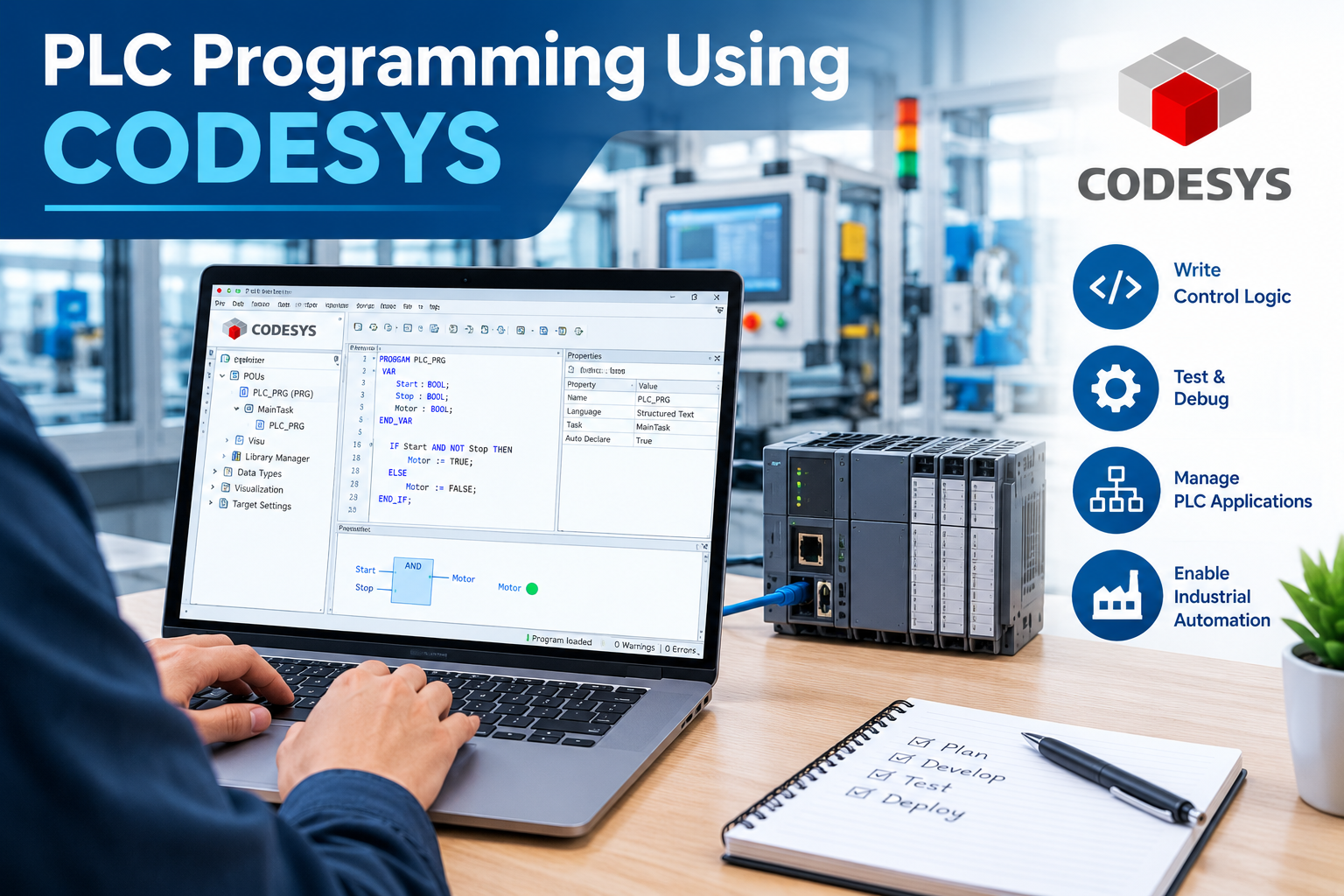
Automation systems require carefully developed control logic to coordinate machines and industrial processes. PLC programming is one of the fundamental activities involved in creating automated control systems.
PLC Programming using CODESYS provides engineers with an environment for developing control applications for compatible programmable controllers and industrial hardware. The development process involves creating logic that determines how a machine responds to inputs and controls its outputs.
Inputs may come from sensors, switches, encoders, or other devices. Based on these signals, the program can control motors, valves, actuators, indicators, and other equipment.
For example, a packaging machine may use sensors to detect products moving along a conveyor. The PLC program can process these signals and coordinate the conveyor, filling mechanism, or other machine components according to the required sequence.
Good programming practices are important for developing reliable systems. Control logic should be organized clearly so that engineers can understand, test, troubleshoot, and maintain it when necessary.
CODESYS can also support communication between different components within an automation system. This can be useful when a machine includes multiple controllers, sensors, drives, or other devices.
Before deployment, PLC programs need to be tested carefully. Engineers can check different operating conditions and verify that the system responds as expected. Testing can also help identify potential problems before the machine is placed into production.
PLC Programming using CODESYS can be applied to manufacturing equipment, automated machinery, material-handling systems, and other industrial applications.
As businesses continue to automate production processes, reliable PLC programming remains essential. Well-developed control software can help machines perform their tasks consistently while supporting efficient and organized industrial operations.
 English
Join our community to interact with posts!