
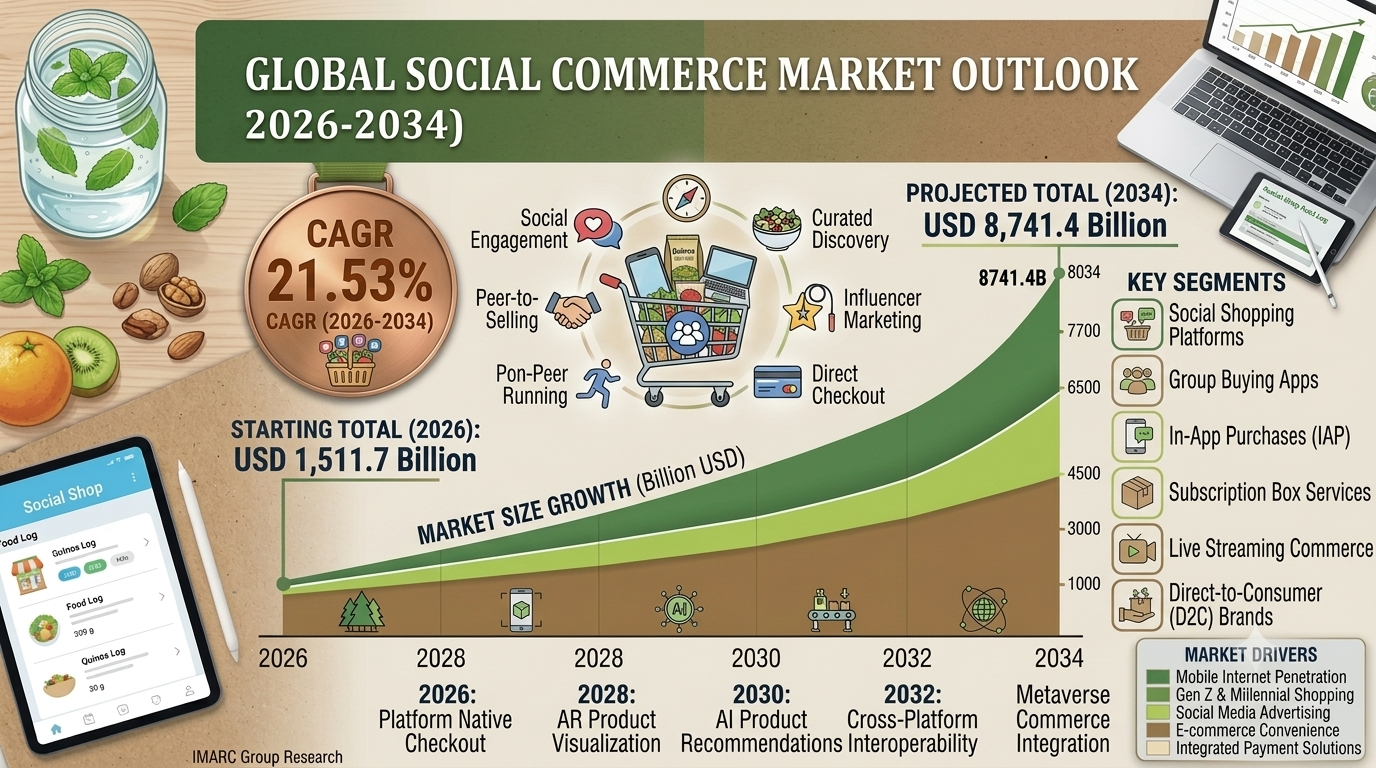
According to IMARC Group, the global social commerce market was valued at USD 1,511.7 billion in 2025 and is projected to reach USD 8,741.4 billion by 2034, expanding at a CAGR of 21.53% during 2026–2034. This extraordinary social commerce market growth reflects the powerful intersection of rising smartphone penetration, expanding influencer ecosystems, and the maturation of integrated payment solutions across leading social platforms. As brands and consumers alike embrace this new paradigm, social commerce stands poised to become the dominant engine of global digital retail growth.
Social Commerce Industry Overview
The social commerce industry sits at a dynamic intersection of social media, mobile technology, and digital retail. Unlike traditional e-commerce, social commerce embeds purchasing capabilities directly within social media environments — enabling users to discover, evaluate, and buy products without ever leaving their preferred platform.
Key service models driving this industry include:
Business to Consumer (B2C): Brands sell directly to consumers through shoppable posts, live-stream events, and targeted ads — the dominant model, holding a 55.9% market share.
Business to Business (B2B): Companies leverage social platforms for wholesale procurement, supplier discovery, and trade networking.
Consumer to Consumer (C2C): Peer-to-peer selling via platforms like Poshmark and Facebook Marketplace, fuelled by user-generated content and community trust.
These models are widely adopted by fashion retailers, beauty brands, food and beverage companies, health supplement sellers, and electronics vendors — all leveraging influencer ecosystems, live-streaming, and AI-driven personalization to convert social engagement into measurable revenue.
Global Market Overview & Social Commerce Market Size
Below are the key social commerce market size statistics drawn from IMARC Group's comprehensive market analysis:
| Report Attribute | Key Statistics |
| Base Year | 2025 |
| Historical Period | 2020–2025 |
| Forecast Period | 2026–2034 |
| Market Size in 2025 | USD 1,511.7 Billion |
| Market Forecast in 2034 | USD 8,741.4 Billion |
| Market Growth Rate (2026–2034) | 21.53% CAGR |
| Largest Region | Asia Pacific (70.0% share in 2025) |
Request for a Sample Report for Detailed Market Insights Evaluation: https://www.imarcgroup.com/social-commerce-market/requestsample
Key Market Drivers & Trends in 2026
Several powerful forces are shaping the social commerce landscape and fuelling its extraordinary growth trajectory across global markets:
- Rise of Social Media Usage
With over 4.95 billion active social media users globally as of October 2023 — nearly triple the count from a decade ago — social platforms now offer brands an unparalleled audience. Direct shopping features embedded within Instagram, Facebook, and TikTok eliminate friction between discovery and purchase, directly boosting the social commerce market share of in-app transaction models.
- Advancements in Mobile Technology
Smartphones have become the primary shopping device worldwide. Faster internet speeds (particularly 5G), improved app interfaces, and seamless mobile payment solutions are making it easier than ever for consumers to browse and buy directly within social apps. In 2022, 5G smartphones represented 72% of all smartphone unit sales — a trend that continues to accelerate mobile-first commerce.
- Expanding Influencer Marketing
Influencer marketing has grown more than threefold since 2019, emerging as a critical conversion driver in social commerce. Influencers shape purchasing decisions through authentic product endorsements, live-stream events, and user-generated content — creating a trusted pipeline from audience engagement to sales that traditional advertising cannot replicate.
- Integration of Seamless Payment Solutions
Secure digital wallets, one-click payment functionalities, and in-app checkout capabilities are removing the final barriers to purchase. By reducing friction at the point of sale directly within social platforms, these innovations are improving conversion rates and accelerating overall social commerce market growth.
- Live-Streaming and Shoppable Video Commerce
Live-streamed shopping events — where brands and influencers demonstrate products in real time, answer questions, and offer exclusive promotions — are rapidly becoming a mainstream sales channel. Platforms like TikTok, YouTube, and ByteDance's Douyin are investing heavily in live commerce infrastructure, driving impulse purchases and deepening consumer engagement.
- AI and Personalization Technologies
Artificial intelligence and machine learning are enabling hyper-personalized shopping experiences — from tailored product recommendations in social feeds to AI-powered ad targeting that matches buyers with the most relevant offers at the right moment. These capabilities are giving social commerce platforms a distinct competitive advantage over traditional e-commerce channels.
Key Market Segmentation
By Business Model
Business to Consumer (B2C) – Largest Segment (55.9% share)
B2C dominates the social commerce landscape as it directly links brands with individual shoppers through targeted ads, influencer partnerships, and engaging in-app content. The model enables personalized shopping experiences — from live product launches to exclusive promotions — that foster brand loyalty and high conversion rates. As social platforms continue embedding shopping features, B2C remains the primary growth engine of the market.
- Business to Business (B2B)
- Consumer to Consumer (C2C)
By Device Type
Mobiles – Largest Segment
Mobile devices dominate social commerce, serving as the primary tool through which consumers browse, discover, and purchase. Social commerce apps are optimized for mobile-first interfaces, offering push notifications, real-time updates, and one-tap purchase options that drive frequent, high-intent transactions. As mobile technology continues advancing, its dominance in the social commerce space will only grow.
- Laptops and PCs
- Others
By Product Type
Apparel – Largest Segment (23.4% share)
Apparel holds the largest product-type share, driven by its visual nature and strong demand for influencer-led discovery. Fashion brands leverage live-stream try-ons, user-generated content, and styling recommendations to inspire impulse buying and build loyal communities. The seamless integration of social engagement with instant checkout makes apparel the dominant category in social commerce globally.
- Personal and Beauty Care
- Accessories
- Home Products
- Health Supplements
- Food and Beverages
- Others
Regional Market Analysis
| Region | Key Highlights |
| Asia Pacific – Largest (70.0% share) | China, Japan, India, South Korea, Australia, Indonesia; high mobile internet penetration, widespread social media usage, live-stream commerce, localized shopping platforms (Douyin, WeChat), strong digital payments infrastructure |
| North America | United States (80.0% of regional share), Canada; mobile-first social shopping, influencer-led campaigns, TikTok Shop expansion, seamless in-app checkout, growing Gen Z buyer base |
| Europe | Germany, France, UK, Italy, Spain, Russia; growing food & beverage social commerce, digital health policies supporting online retail, expanding creator economy |
| Latin America | Brazil, Mexico; 418 million mobile internet users, rising smartphone penetration, improving internet connectivity driving social commerce adoption |
| Middle East & Africa | UAE, Saudi Arabia, South Africa; influencer marketing projected at USD 1.3 Billion (2023), growing adoption of social shopping driven by trusted influencer endorsements |
Connect for Detailed Segmentation Analysis – Speak to an Analyst: https://www.imarcgroup.com/request?type=report&id=3482&flag=C
Leading Players in the Social Commerce Industry
The global social commerce market features a blend of established technology giants, dedicated e-commerce platforms, and emerging fintech enablers. Key companies covered in the IMARC Group report include:
- eBay
- Etsy Inc.
- Facebook (Meta Platforms)
- Meesho Inc.
- PayPal Payments Private Limited
- Pinterest Inc.
- Poshmark Inc.
- Reddit Inc.
- Taobao (Alibaba Group Holding Limited)
- Twitter (X) Inc.
- Verizon Communications Inc.
Leading players are investing in AI-driven personalization, in-app purchasing tools, live-stream commerce infrastructure, and influencer partnership programs to deepen user engagement and accelerate conversion. Data privacy and secure payment integration are also being prioritized to build consumer trust across markets.
Latest Industry Developments
January 2025 – StoryStream
StoryStream launched an AI-powered video commerce platform integrating immersive storytelling, shoppable videos, and live commerce capabilities. The platform enables brands to create dynamic, story-based content that drives conversion, including for niche and specialized product categories.
January 2025 – TalkShopLive
TalkShopLive unveiled TSL Shoppettes™ at CES®, a new social commerce tool for Instagram, Facebook, and other major platforms. The innovation enables short-form shoppable videos featuring up to five products, allowing purchases through simple comment-based interactions — streamlining the buyer journey across multiple digital channels.
April 2024 – YouTube
YouTube rolled out new shopping tools enabling content creators to curate themed product collections and showcase them in personalized virtual stores. Collections are displayed in creators' Store tabs, product lists, and video descriptions, strengthening YouTube's position as a major social commerce destination.
April 2024 – Flip
Social commerce platform Flip secured USD 144 Million in a Series C funding round. With this investment, Flip launched MagicOS, an AI-powered ad management system, and integrated AXON AI technology to help brands build highly targeted advertising campaigns within its social shopping environment.
About Us
IMARC Group is a leading global market research company providing data-driven insights and expert consulting services to businesses seeking to achieve their strategic objectives. With a multi-disciplinary team of industry experts, IMARC delivers thorough, reliable market intelligence across sectors including Technology, Retail, Healthcare, Energy, Food & Beverages, and more.
Contact Us
IMARC Group
United States: +1-201-971-6302
India: +91-120-433-0800
United Kingdom: +44-753-714-6104
 English
Join our community to interact with posts!