
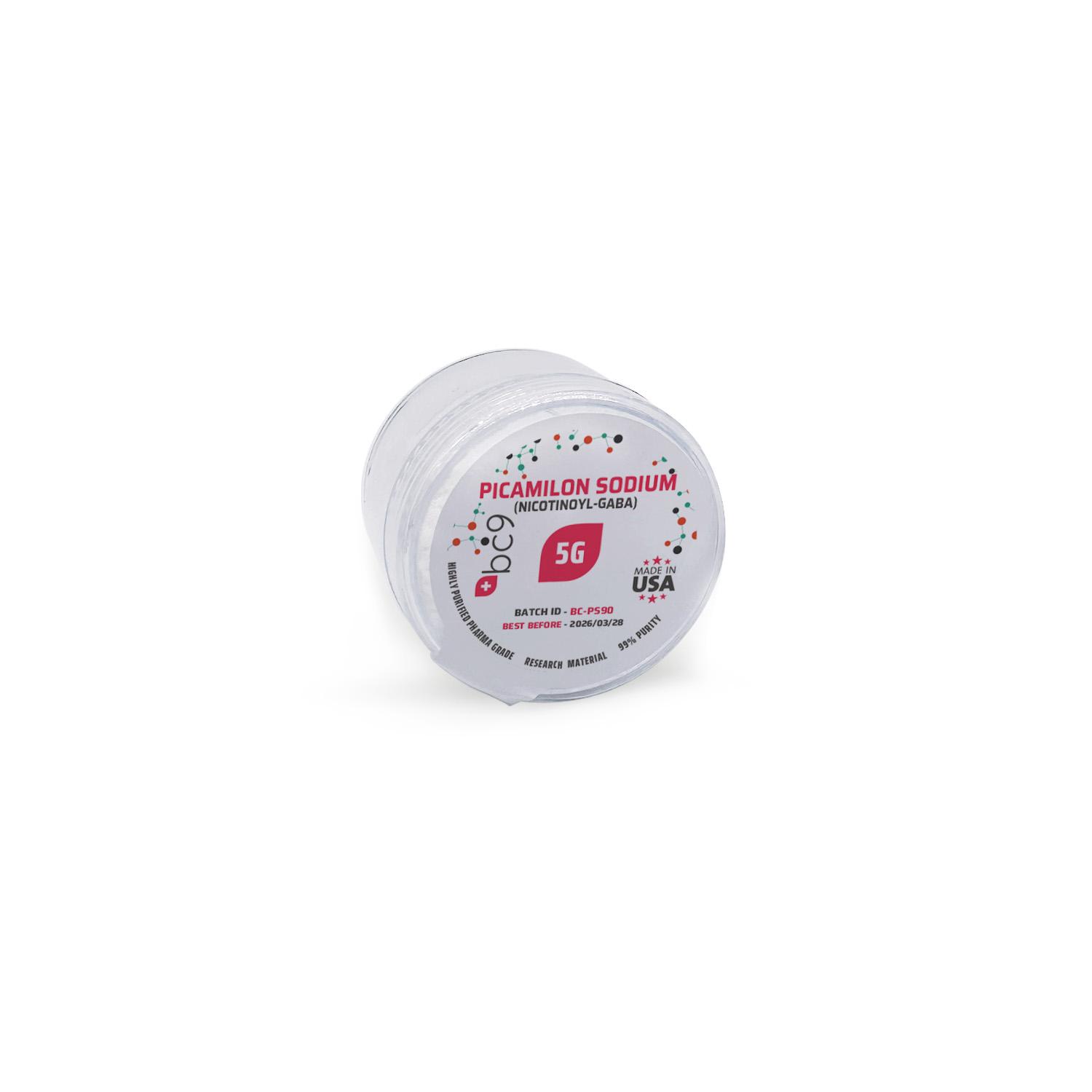
What Is Picamilon Sodium?
Picamilon Sodium is a synthesized compound formed by bonding niacin (vitamin B3) with GABA, creating a unique nootropic agent engineered for enhanced neurotransport. Unlike standard GABA supplements, most of which cannot cross the blood–brain barrier, Picamilon Sodium leverages the niacin molecule as a biological “carrier,” allowing efficient delivery of GABA into the central nervous system.
This innovative structure has made Picamilon Sodium an increasingly researched compound in 2025, especially within the fields of cognitive performance, neuroprotection, mood regulation, and stress-resilience studies.
Chemical Profile & Mechanism of Action of Picamilon Sodium
Picamilon Sodium works through a dual mechanism: vasodilation and GABA-mediated neuroinhibition.
1. Niacin-Driven Vasodilation
The niacin component promotes enhanced cerebral blood flow, supporting:
- Increased oxygenation
- Improved nutrient delivery
- Enhanced neuronal metabolic efficiency
This targeted vasodilation is particularly valuable in neurocognitive research where circulation directly influences cognitive energy and clarity.
2. GABA Delivery Across the Blood–Brain Barrier
GABA on its own cannot pass into the brain. Picamilon Sodium overcomes this limitation through molecular fusion.
Once absorbed:
- The compound crosses the blood–brain barrier intact.
- It then splits into GABA and niacin.
- GABA binds to inhibitory receptors, supporting relaxation without sedation.
This makes it a unique candidate for modulation of excitatory-inhibitory balance in neurochemical research.
How Picamilon Sodium Is Processed in the Body
Picamilon Sodium displays high bioavailability and rapid onset due to its small molecular weight and stable bonding structure.
Pharmacokinetics Overview
- Absorption: Rapid intestinal absorption
- Distribution: Freely distributed to neural and peripheral tissues
- Metabolism: Cleavage into niacin + GABA in the CNS
- Excretion: Primarily renal
Efficiency of uptake allows researchers to evaluate acute and chronic neurological responses with precision.
Research Applications of Picamilon Sodium in 2025
1. Cognitive Performance Enhancement Studies
Picamilon Sodium has become a leading compound in research surrounding:
- Mental clarity
- Working memory
- Executive function
- Sustained attention
Its ability to support circulation while delivering an inhibitory neurotransmitter makes it appealing in dual-pathway cognitive performance trials.
2. Mood and Stress Modulation Research
Clinical and preclinical interest has grown around Picamilon Sodium’s potential interaction with:
- GABAergic signaling
- Cortisol regulation
- Stress recovery
Researchers continue evaluating how balanced inhibitory input may support emotional stability without heavy sedation.
3. Neuroprotection & Anti-Fatigue Studies
The synergistic action of GABA and increased circulation opens new avenues for:
- Protection against oxidative stress
- Support during metabolic fatigue
- Investigation of vasodilative neuroprotection
Current 2025 research highlights ongoing studies examining neuronal resilience in high-stress or high-demand environments.
Potential Advantages of Picamilon Sodium in Research Settings
1. High CNS Penetration
The compound’s engineered ability to reach the central nervous system intact makes it valuable in targeted neurochemical experimentation.
2. Predictable Neurophysiological Response
The dual-action mechanism leads to:
- Steady relaxation responses
- Enhanced cortical blood flow
- Balanced excitatory-inhibitory activity
This predictability supports consistent data in controlled trials.
3. Rapid Onset, Smooth Duration
Picamilon Sodium’s kinetics make it ideal for studies requiring:
- Quick baseline shifts
- Measurable cognitive or emotional modulation
- Reliable time-dependent physiological markers
Picamilon Sodium in Comparison to Other Nootropic Compounds
Research often compares Picamilon Sodium to racetams, adaptogens, and other GABAergic agents.
Key Comparative Strengths
| Feature | Picamilon Sodium | Standard GABA Supplements | Racetams |
| Crosses BBB | ✔ Yes | ✘ No | ✔ Yes |
| Vasodilation | ✔ Strong | ✘ None | Variable |
| Calming effect | ✔ Mild/Non-sedative | ✔ Sedative | ✘ Sometimes stimulating |
| Cognitive support | ✔ Balanced | ✘ Minimal | ✔ Strong |
| Mechanism type | GABAergic + circulatory | GABAergic only | Cholinergic/glutamatergic |
Picamilon Sodium stands out due to its dual-action nature and unique delivery system.
Current Research Limitations
Although Picamilon Sodium is widely explored, researchers note:
- Variability in individual responses
- Complexity of GABA-related pathways
- Limited long-term human data compared to older nootropics
These gaps are driving expanded 2025 studies focusing on safety profiles, chronic exposure outcomes, and therapeutic potential.
Safety Considerations in Experimental Use
When used in controlled laboratory settings, researchers monitor:
- Blood pressure (due to vasodilation)
- Neurochemical markers
- Liver and kidney function
- Interaction with agents that affect GABA or circulation
Proper dosing and purity validation remain essential in all research contexts.
Conclusion: Why Picamilon Sodium Remains a Leading 2025 Research Compound
Picamilon Sodium’s unique combination of GABA delivery, vasodilative support, and high CNS penetration makes it one of the most versatile and scientifically relevant nootropic research compounds of 2025. Its applications continue expanding into cognitive enhancement, mood regulation, stress studies, and neuroprotection.
With its engineered molecular design and predictable effects, Picamilon Sodium stands as a top candidate for ongoing and future neurochemical investigations.
 English
Join our community to interact with posts!