
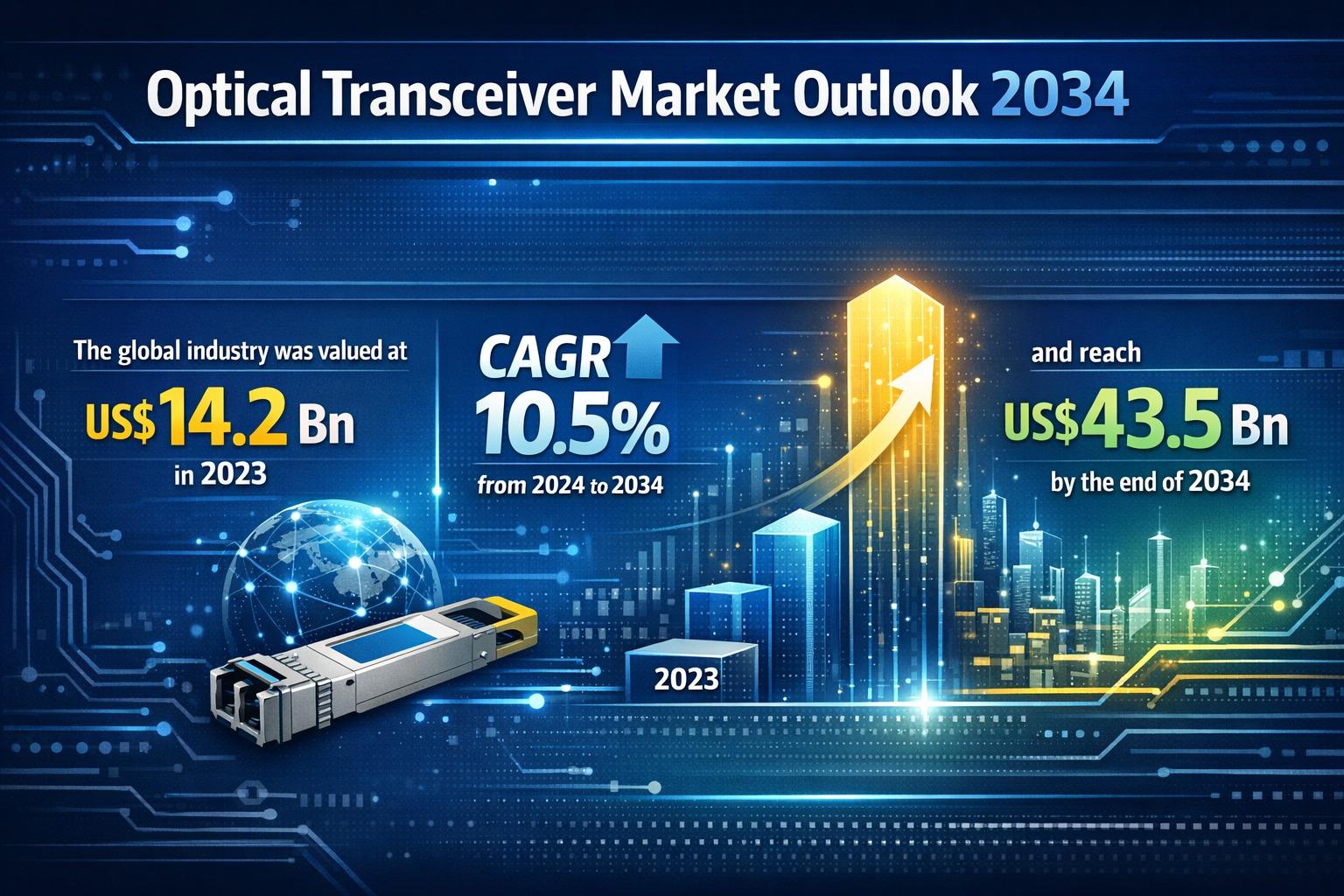
The global optical transceiver market is witnessing robust expansion as demand for high-speed, low-latency, and reliable data transmission intensifies across telecom and data communication networks. Valued at US$ 14.2 Bn in 2023, the industry is projected to advance at a CAGR of 10.5% from 2024 to 2034, reaching US$ 43.5 Bn by the end of 2034. Rapid growth in cloud computing, hyperscale data centers, and the worldwide rollout of 5G networks are the primary forces shaping the market’s trajectory.
Analyst Viewpoint
According to market analysts, growth in adoption of optical modules in data centers and the surge in demand for 5G networks are the two most influential drivers of the optical transceiver market. Optical transceivers are critical for delivering dependable, low-latency connectivity required for next-generation networks. Beyond speed and capacity, these components enable real-time communication, making them indispensable for latency-sensitive applications such as industrial automation, autonomous vehicles, remote surgery, and smart manufacturing.
Key players are increasingly aligning their strategies with the latest optical transceiver market trends by focusing on QSFP, SFP, and SFP+ form factors. These solutions help address the escalating demand for fast connectivity while supporting innovation in high-bandwidth and energy-efficient network architectures.
Market Introduction
An optical transceiver, also known as a fiber optic transceiver, is a compact yet powerful pluggable component that transmits and receives data over fiber optic cables. These modules range in size from an index finger to the palm of a hand and are capable of handling data rates from Mbps to several Tbps. Optical transceivers are commonly deployed in switches, routers, high-performance computing systems, and mobile antennas.
Owing to their ability to transport massive volumes of data over long distances with minimal signal loss, optical transceivers are essential in telecom networks and data communication infrastructure. They can be either embedded into network equipment or plugged in as modular components, and they are available in multiple shapes, sizes, wavelengths, and form factors. As global communication systems evolve toward higher speeds and lower latency, optical transceivers have become foundational elements of modern digital infrastructure.
Market Drivers
Growth in Adoption of Optical Modules in Data Centers
The rapid expansion of data centers is a key factor fueling optical transceiver industry growth. Data centers rely on optical modules to enable efficient, high-speed communication between servers, switches, and storage systems. Fiber optic transceivers are capable of transmitting data at speeds ranging from 1 Gbps to several terabits per second, which is essential for handling the enormous data loads generated by cloud computing, AI workloads, and big data analytics.
As demand for cloud services continues to rise, data centers are under pressure to deliver faster, more reliable, and energy-efficient data transmission. Optical transceivers play a critical role in meeting these requirements by enabling large-scale, high-bandwidth communication over fiber networks. A notable example is Microsoft’s US$ 500 million investment to expand its cloud computing and AI infrastructure in Quebec, highlighting the growing importance of optical transceivers in hyperscale data center expansion.
Surge in Demand for 5G Networks
The global rollout of 5G technology is another major growth driver for the optical transceiver market. Optical transceivers integrate both transmitter and receiver into a single module, allowing bi-directional communication over fiber optic cables. They convert electrical signals into optical signals and back again, enabling high-capacity data transmission required by 5G networks.
5G deployment is driven by the need for higher throughput, faster speeds, and ultra-low latency to support data-intensive applications such as gaming, streaming, and IoT ecosystems. Compared to copper-based alternatives, optical transceivers offer superior speed, capacity, and signal integrity, with the ability to support data rates from several gigabits per second to multiple terabits.
Studies indicate that 45% of urban areas were covered by early 5G deployment tests, and countries such as China and India are investing heavily in 5G-ready infrastructure. It is estimated that 40%–50% of Chinese mobile users will adopt 5G by 2025. Advancements in network slicing, virtualization, and convergence are further expected to accelerate optical transceiver market growth worldwide.
Regional Outlook
Asia Pacific emerged as the leading region in the optical transceiver market in 2023. The region’s dominance is attributed to rapid adoption of digital technologies in countries such as China and India, along with advancements in IoT, AI, and cloud computing. Government initiatives focused on smart cities, smart meters, and digital infrastructure development are also supporting wider deployment of transceiver modules across the region.
North America is expected to witness significant growth during the forecast period. Rapid urbanization, a strong industrial base, the presence of major market players, and rising demand for high-speed communication networks are driving optical transceiver market expansion in the region. Increased investments in data centers and telecom infrastructure further strengthen North America’s growth outlook.
Analysis of Key Players
Leading companies operating in the optical transceiver market are investing heavily in the development of SFP and telecom & networking optical transceiver solutions. Many players are also focusing on data center-oriented products that ensure reliable, always-connected networks for IoT and mobile applications.
Prominent companies include Amphenol Communications Solutions, Accelink Technology Co. Ltd, ALE International, Broadcom, Ciena Corporation, Cisco Systems, Inc., Coherent Corp., Fujitsu Optical Components Limited, Analog Devices, Inc., Molex, EXFO, Smartoptics, Source Photonics, Inc., and Sumitomo Electric Industries, Ltd. These firms are evaluated based on their product portfolios, business strategies, recent developments, and financial performance.
Key Developments
Innovation remains a defining characteristic of the optical transceiver market. In October 2023, Semtech Corporation demonstrated a 200G/lane optical transceiver featuring its latest FiberEdge® 200G PAM4 PMDs combined with Broadcom’s advanced DSP PHY and single-mode optics. In the same month, Coherent Corp. launched next-generation transceivers and laser technologies designed for 800G and 1.6T datacom transmission at ECOC 2023, underscoring the industry’s shift toward ultra-high-speed connectivity.
Market Segmentation and Applications
The optical transceiver market is segmented by data rate, fiber type, distance, form factor, wavelength, and application. Data rates range from up to 10 Gbps to above 100 Gbps, while fiber types include single-mode and multimode fibers. Applications are broadly categorized into data communication and telecommunication, with data centers and 5G networks representing the fastest-growing segments.
Outlook to 2034
With a projected market value of US$ 43.5 Bn by 2034, the optical transceiver industry is set for sustained growth over the next decade. Rising investments in data centers, accelerating 5G deployment, and continuous innovation in high-speed optical technologies will remain central to market expansion. As digital transformation deepens across industries, optical transceivers will continue to serve as critical enablers of the global communication ecosystem.
 English
Join our community to interact with posts!