
The synthetic graphite market has emerged as a strategically critical segment within the global materials and energy value chain, driven by its indispensable role in steelmaking, energy storage systems, electronics, and high-temperature industrial applications. Unlike natural graphite, synthetic graphite is manufactured under controlled conditions using carbon-rich feedstocks, resulting in superior purity, consistency, and performance characteristics. These attributes have positioned synthetic graphite as the preferred material for applications that demand high electrical conductivity, thermal resistance, and chemical stability.
In 2022, the global synthetic graphite industry was valued at US$ 22.0 Bn, and it is projected to expand at a compound annual growth rate (CAGR) of 6.4% from 2023 to 2031, reaching US$ 38.3 Bn by the end of 2031. Growth is being fueled by increasing steel production, rapid adoption of electric vehicles (EVs), advancements in lithium-ion battery technology, and expanding applications across high-performance industrial sectors. As governments and industries prioritize electrification, infrastructure development, and decarbonization, synthetic graphite continues to gain prominence as a critical enabling material.
Market Overview
Synthetic graphite is produced by subjecting amorphous carbon materials—such as petroleum coke and coal tar pitch—to extremely high temperatures, often exceeding 2,500°C. This graphitization process aligns carbon atoms into a highly ordered crystalline structure, resulting in material properties that are more predictable and consistent than those of natural graphite.
Although synthetic graphite is more capital- and energy-intensive to manufacture, it offers significant advantages, including higher purity levels, controlled particle size, superior electrical conductivity, and enhanced resistance to thermal shock and corrosion. These characteristics make it particularly suitable for advanced industrial applications where performance reliability is critical.
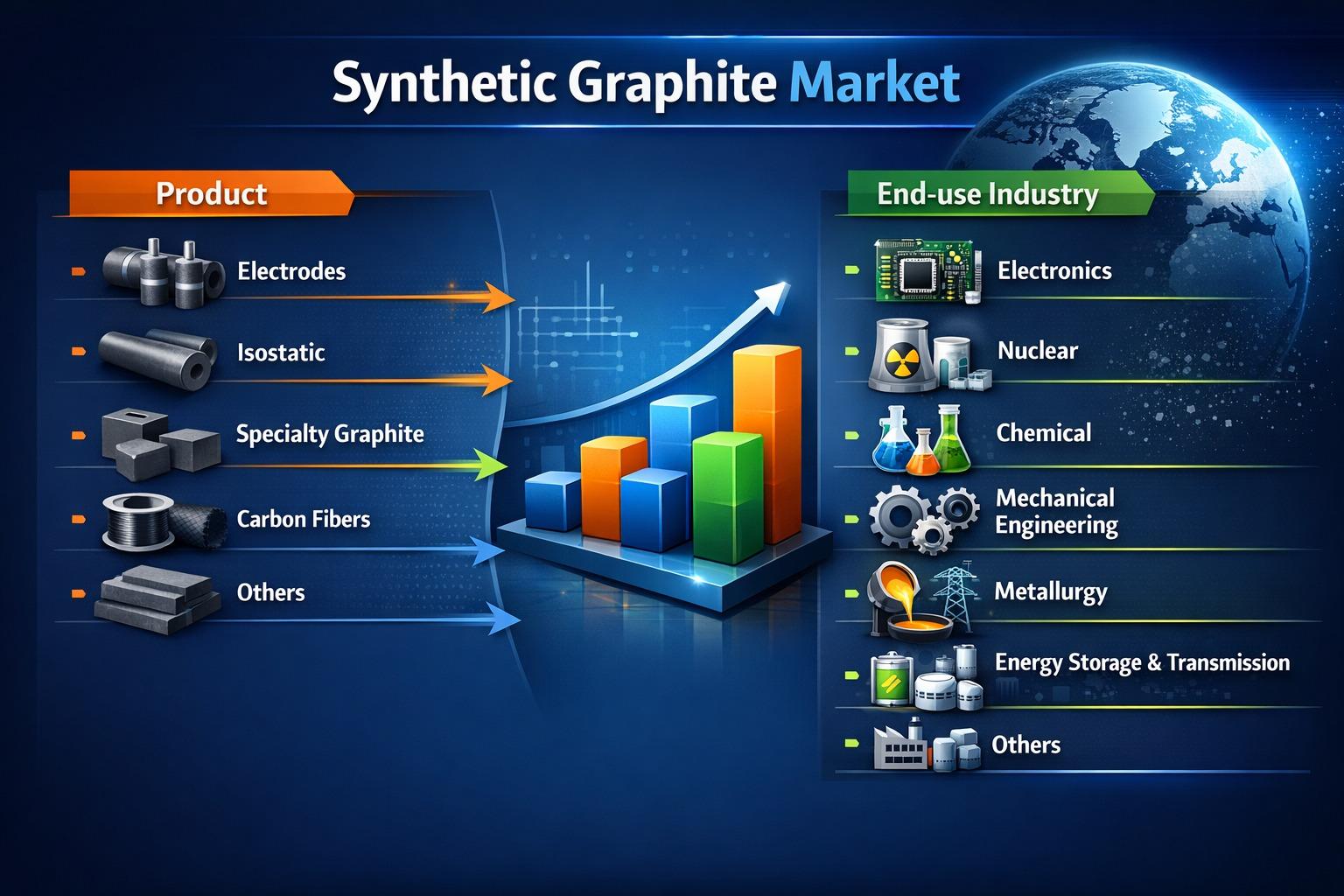
The synthetic graphite market spans multiple product categories, including graphite electrodes, isostatic graphite, specialty graphite, carbon fibers, and other niche forms, serving end-use industries such as metallurgy, electronics, nuclear power, chemical processing, mechanical engineering, and energy storage & transmission. Among these, graphite electrodes and battery-grade synthetic graphite represent the most significant revenue-generating segments.
Analyst Viewpoint
From an analyst perspective, the synthetic graphite market is undergoing a structural transformation. Historically dominated by steelmaking applications, the industry is now increasingly influenced by the energy transition, particularly the growth of electric mobility and renewable energy storage systems. This shift is redefining demand patterns, encouraging manufacturers to invest in advanced production technologies, sustainable feedstocks, and high-performance graphite grades.
Moreover, geopolitical considerations, supply chain security, and environmental regulations are prompting countries to reassess their reliance on natural graphite imports. As a result, synthetic graphite—despite its higher production cost—is gaining traction as a reliable and scalable alternative, particularly in regions with strong industrial infrastructure and technological capabilities.
Key Growth Drivers
Increase in Demand for Graphite Electrodes
One of the most significant drivers of the synthetic graphite market is the rising demand for graphite electrodes, which are essential components in electric arc furnaces (EAFs) used for steel production. These electrodes enable efficient melting and refining of scrap steel by conducting high electrical currents under extreme temperatures.
Graphite electrodes made from synthetic graphite exhibit superior properties, including high thermal shock resistance, excellent electrical conductivity, chemical inertness, and long service life. These attributes are crucial for producing high-quality steel while minimizing operational downtime and maintenance costs.
According to the World Steel Association, global steel production reached 1,885.4 million metric tons in 2022, with China and India emerging as the world’s largest producers. Growing infrastructure investments, urbanization, and construction activities in emerging economies are further boosting steel demand. As steel production rises, the consumption of graphite electrodes is expected to increase correspondingly, reinforcing the growth trajectory of the synthetic graphite market.
Rise in Adoption of Electric Vehicles
The global shift toward electric vehicles (EVs) represents another powerful growth catalyst for the synthetic graphite industry. Governments worldwide are implementing stringent emission regulations, offering incentives for EV adoption, and investing in charging infrastructure to accelerate the transition away from internal combustion engines.
Synthetic graphite plays a critical role in lithium-ion batteries, where it is used as the anode material. Compared to natural graphite, synthetic graphite offers higher purity, better structural stability, and enhanced performance, enabling higher energy density, faster charging times, and longer battery life.
China, the world’s largest EV market, has developed a vertically integrated battery supply chain that includes synthetic graphite production. According to national projections, China is expected to reach 1,811 GWh of lithium cell production capacity by 2025, while global battery demand is forecast to rise sharply through 2030. This surge in battery manufacturing is significantly augmenting demand for synthetic graphite, positioning it as a cornerstone material in the global energy transition.
Technological Advancements and Innovation
Technological innovation is playing a pivotal role in shaping the future of the synthetic graphite market. Manufacturers are investing in advanced graphitization techniques, energy-efficient furnaces, and high-performance synthetic graphite grades tailored for specific applications.
Recent developments include the use of alternative and renewable feedstocks, improved purification processes, and automation technologies aimed at reducing production costs and environmental impact. For instance, the emergence of wood-based synthetic graphite technologies, such as those developed by CarbonScape, highlights the industry’s efforts to improve sustainability while maintaining performance standards.
Innovation is also focused on producing battery-grade synthetic graphite with optimized particle morphology and surface characteristics, which are critical for next-generation lithium-ion and solid-state batteries. These advancements are expected to unlock new growth opportunities and enhance the competitive positioning of synthetic graphite manufacturers.
Market Segmentation Analysis
By Product Type
The synthetic graphite market is segmented into electrodes, isostatic graphite, specialty graphite, carbon fibers, and others. Among these, graphite electrodes account for the largest share due to their extensive use in steelmaking and metallurgical applications.
Isostatic graphite and specialty graphite are gaining traction in high-end applications such as semiconductors, aerospace components, and nuclear reactors, where precision, purity, and thermal stability are paramount. Carbon fibers, while representing a smaller share, are witnessing growing demand in lightweight structural applications and advanced composites.
By End-use Industry
In terms of end-use industries, the market caters to electronics, nuclear, chemical, mechanical engineering, metallurgy, energy storage & transmission, and others. The metallurgy segment dominates the market, driven by steel and ferroalloy production.
However, the energy storage & transmission segment is expected to register the fastest growth during the forecast period, fueled by the rapid expansion of EVs, grid-scale battery storage, and renewable energy integration. Electronics and nuclear applications also contribute significantly, leveraging the unique thermal and electrical properties of synthetic graphite.
Regional Outlook
Asia Pacific
Asia Pacific held the largest share of the synthetic graphite market in 2022, driven by strong industrial activity, robust steel production, and rapid EV adoption. China dominates the regional landscape, supported by its well-established chemical, metallurgical, and battery manufacturing sectors.
China accounts for approximately 65% of global graphite production, and its battery manufacturers are expected to produce nearly 4,800 GWh of batteries by 2025. India is also emerging as a high-growth market, with rising steel output, infrastructure development, and increasing focus on electric mobility.
North America
North America is expected to witness steady growth during the forecast period, supported by technological innovation, domestic manufacturing capabilities, and increasing investments in clean energy. Research indicates that approximately 63% of graphite produced domestically in the U.S. is synthetic, reflecting the region’s preference for high-purity and performance-driven materials.
Growing demand for EVs, renewable energy storage systems, and advanced industrial applications is likely to sustain market growth across the U.S. and Canada.
Europe and Other Regions
Europe’s synthetic graphite market is influenced by stringent environmental regulations, a strong push toward decarbonization, and advancements in battery technology. Countries such as Germany, France, and the U.K. are investing in EV production and energy storage infrastructure, creating new demand avenues.
Latin America and the Middle East & Africa represent emerging markets, where industrial expansion, infrastructure development, and energy investments are expected to gradually boost synthetic graphite consumption.
Competitive Landscape
The synthetic graphite market is characterized by moderate to high competition, with several established players operating globally. Key manufacturers include GrafTech International, Showa Denko K.K., SGL Carbon SE, Graphite India Limited, HEG Limited, Tokai Carbon Co., Ltd., Nippon Carbon Co., Ltd., SEC Carbon, Ltd., Kaifeng Carbon Co., Ltd., and Nantong Yangzi Carbon Co., Ltd.
These companies are focusing on capacity expansions, technological innovation, strategic collaborations, and mergers & acquisitions to strengthen their market presence. Investments in research and development are aimed at producing high-performance synthetic graphite grades while improving sustainability and cost efficiency.
Recent Developments
Recent industry developments highlight the dynamic nature of the synthetic graphite market. In December 2023, CarbonScape announced a breakthrough technology to convert woodchips into synthetic graphite, offering a potentially sustainable alternative to conventional feedstocks. The company claims that one metric ton of synthetic graphite can be produced from seven tons of dry woodchips.
In October 2022, Imerys Graphite & Carbon Company launched the EMILI Project, a lithium exploitation initiative designed to reduce import dependency and support the production of approximately 700,000 electric vehicle batteries annually. Such developments underscore the industry’s commitment to innovation and supply chain resilience.
Future Outlook
Looking ahead, the synthetic graphite market is poised for sustained growth, driven by structural shifts in global energy systems, industrial modernization, and technological advancement. While challenges such as high production costs and energy intensity persist, ongoing innovation and economies of scale are expected to mitigate these constraints over time.
As EV adoption accelerates, steel production evolves, and renewable energy deployment expands, synthetic graphite will remain a critical material enabling these transitions. Manufacturers that invest in advanced technologies, sustainable practices, and strategic partnerships are likely to gain a competitive edge in this evolving market landscape.
 English
Join our community to interact with posts!