
Businesses increasingly rely on phone numbers to communicate with customers, verify identities, and deliver services. From SMS notifications to fraud prevention, understanding the carrier behind a phone number has become an important part of modern applications. This is where tools such as a reverse phone lookup api and a phone verification api help developers and businesses obtain reliable carrier information quickly and efficiently.
Carrier lookup APIs analyze a phone number and return valuable data such as the telecom provider, line type, and country of origin. This information allows businesses to make smarter decisions when sending messages, verifying users, or filtering suspicious activity.
In this guide, we will explore how phone number carrier lookup APIs work, why they matter for businesses, and what factors make an API reliable for accurate carrier detection.
Understanding Phone Number Carrier Lookup APIs
A phone number carrier lookup API is a service that identifies the telecom operator associated with a specific phone number. When a number is submitted to the API, the system checks global telecom databases and returns details about the carrier.
These APIs are commonly used in applications that rely on SMS communication, user verification, and contact validation. Instead of guessing the network provider, developers can automatically retrieve accurate carrier information within seconds.
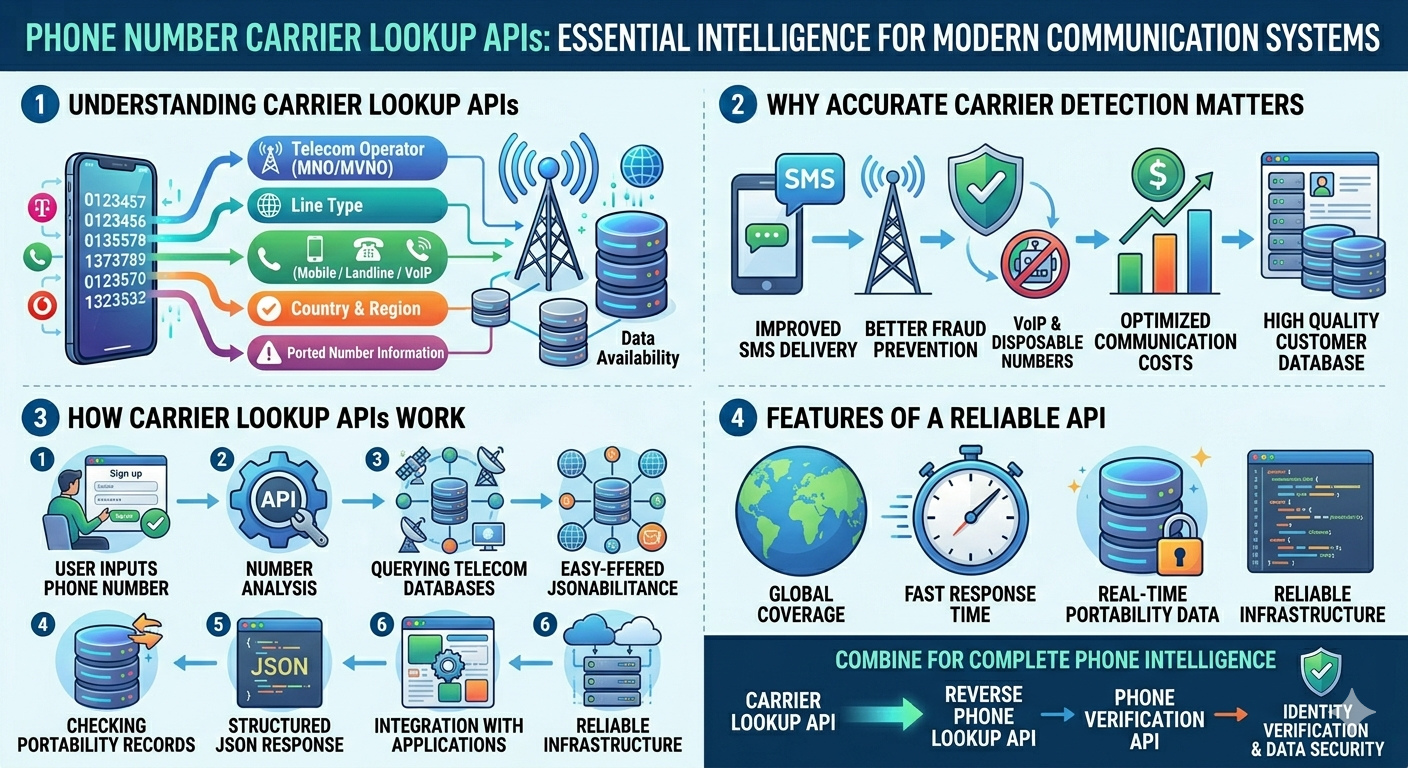
Carrier lookup APIs typically provide details such as
- Mobile network operator
- Line type such as mobile, landline, or VoIP
- Country and region of the number
- Ported number information in some cases
Having access to this data helps businesses ensure that communications are delivered efficiently and securely.
Why Accurate Carrier Detection Matters
Carrier detection may seem like a small technical detail, but it has a significant impact on communication systems and customer experience.
Many businesses rely on SMS for sending authentication codes, alerts, and notifications. Without proper carrier detection, messages may fail to deliver or reach users with delays.
Accurate carrier lookup provides several advantages.
Improved SMS Delivery
Different carriers have different routing rules and message delivery paths. Identifying the correct carrier allows messaging platforms to route SMS through the most efficient network.
Better Fraud Prevention
Fraudsters often use disposable numbers or VoIP services to create fake accounts. Detecting the line type helps companies identify suspicious registrations and reduce fraud.
Optimized Communication Costs
Some telecom networks charge different rates depending on the destination carrier. Businesses can optimize their messaging costs by routing traffic more intelligently.
Higher Quality Customer Data
Clean and verified phone data leads to better customer databases. Businesses can maintain accurate contact lists and improve communication reliability.
How Carrier Lookup APIs Work
Carrier lookup APIs operate by querying telecom data sources and number portability databases. These databases contain information about which operator currently manages a particular phone number.
The typical process works like this.
- A phone number is submitted to the API.
- The API analyzes the number format and country code.
- It checks telecom databases for carrier ownership and portability records.
- The API returns carrier information and line type in a structured response.
Developers can integrate these APIs into websites, applications, and CRM systems through simple REST requests. The response is usually delivered in JSON format, making it easy to process and use in software applications.
Features That Define a Reliable Carrier Lookup API
Not all APIs deliver the same level of accuracy or performance. When selecting a phone number carrier lookup API, businesses should evaluate several important factors.
Global Coverage
A good API should support phone numbers from multiple countries. Businesses that operate internationally need reliable carrier data across regions.
Real Time Number Portability Data
Many users switch telecom providers while keeping the same number. APIs that support number portability data can detect the current carrier rather than the original one.
Line Type Detection
Identifying whether a number is mobile, landline, or VoIP is extremely valuable for fraud detection and communication planning.
Fast Response Time
Applications that rely on real time verification need APIs that deliver responses quickly. Slow API responses can affect the performance of sign up or verification processes.
Easy Integration
Developers prefer APIs with simple documentation and flexible integration options. REST based APIs with JSON responses are commonly used because they are easy to implement.
Reliable Infrastructure
Carrier lookup services should maintain stable infrastructure with high uptime. Consistent performance ensures that applications run smoothly without interruptions.
Common Use Cases for Carrier Lookup APIs
Carrier detection APIs are used across many industries where phone numbers play a key role in customer interactions.
User Registration and Verification
Many online platforms require phone number verification during sign up. Carrier lookup helps validate numbers and detect suspicious registrations.
Messaging Platforms
Businesses that send SMS alerts or notifications rely on carrier data to ensure successful message delivery.
Customer Support Systems
Support teams often verify phone numbers before contacting customers. Carrier detection can confirm whether the number is reachable through mobile networks.
Financial and Security Services
Banks and fintech companies use carrier lookup to strengthen identity verification and detect potential fraud attempts.
Marketing Campaigns
Businesses running SMS marketing campaigns can filter invalid or non mobile numbers, improving campaign efficiency.
How to Choose the Best Carrier Lookup API
Choosing the right API depends on the needs of your business and the scale of your application. Several considerations can help guide the decision.
First, evaluate the accuracy of carrier detection. An API should rely on reliable telecom data sources and regularly updated databases.
Second, consider global coverage. Businesses with international users need APIs that support multiple regions and telecom networks.
Third, review the pricing structure. Some APIs charge per request while others provide subscription plans. The right option depends on the expected volume of lookups.
Fourth, analyze documentation and developer support. Well written documentation makes integration faster and reduces development time.
Finally, test the API performance. Many providers offer free trials or limited plans that allow developers to test response speed and accuracy before committing to a paid plan.
Best Practices for Implementing Carrier Lookup APIs
Integrating a carrier lookup API is usually straightforward, but following best practices can improve reliability and performance.
- Validate the phone number format before sending it to the API
- Cache results when possible to reduce repeated lookups
- Combine carrier lookup with phone validation tools
- Monitor API usage and performance regularly
These practices help ensure smooth integration while maintaining accurate data.
The Role of Carrier Detection in Modern Communication Systems
Communication technology continues to evolve, and businesses now interact with customers across multiple channels. Phone numbers remain one of the most widely used identifiers for user communication.
Carrier lookup APIs make it easier for companies to maintain reliable messaging systems, improve verification processes, and reduce fraud risks.
With accurate carrier detection, businesses can build smarter communication platforms that deliver messages efficiently and protect user accounts from suspicious activity.
When combined with identity verification tools and messaging infrastructure, carrier lookup becomes an essential component of modern digital services.
Businesses that prioritize accurate phone data often experience better message delivery, improved customer trust, and more efficient communication workflows.
Selecting the right carrier lookup API can make a meaningful difference in how applications handle phone number data. Accurate carrier detection improves SMS delivery, strengthens verification processes, and helps businesses maintain reliable communication with their users.
When evaluating options, companies should focus on accuracy, global coverage, response speed, and integration simplicity. These factors ensure that the chosen API delivers consistent and reliable results.
Many modern platforms combine carrier detection with a reverse phone lookup api and advanced validation tools to create complete phone intelligence solutions. Integrating a reliable phone verification api alongside carrier lookup capabilities can significantly enhance security, data quality, and overall communication performance.
FAQs
What is a phone number carrier lookup API?
A phone number carrier lookup API is a service that identifies the telecom provider associated with a phone number. It retrieves details such as the mobile network operator, line type, and country of origin, helping businesses manage messaging and verification systems more effectively.
Can carrier lookup APIs detect VoIP numbers?
Yes, many advanced carrier lookup APIs can identify the line type of a number. This includes mobile numbers, landlines, and VoIP services. Detecting VoIP numbers is particularly useful for fraud prevention and account verification.
Why do businesses combine carrier lookup with phone number verification?
Carrier lookup provides network information, while verification tools confirm whether the number is valid and reachable. When used together, these tools help businesses maintain clean contact data, improve SMS delivery rates, and strengthen user authentication processes.
 English
Join our community to interact with posts!