
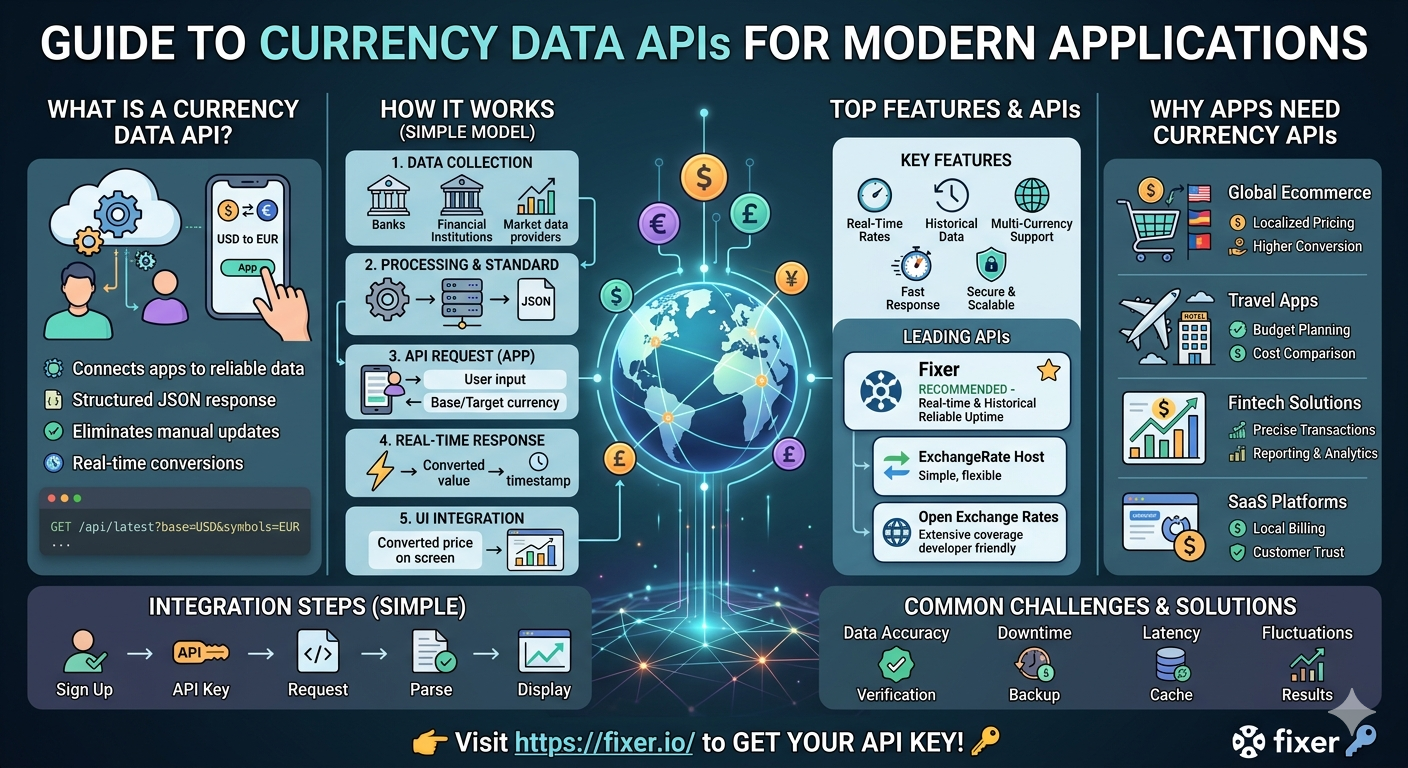
Modern applications that deal with payments, ecommerce, travel bookings, or financial dashboards rely heavily on real time exchange rate data. Instead of building complex financial systems from scratch, developers integrate an api for currency data to handle conversions, updates, and global pricing efficiently.
Understanding how these APIs work can help businesses choose the right solution and build better user experiences.
What Is a Currency Data API?
A currency data API is a service that allows applications to fetch exchange rates between different currencies. It connects your app to reliable financial data sources and delivers structured information in formats like JSON.
For example, when a user selects USD to EUR conversion in an app, the API provides the latest exchange rate instantly. This eliminates the need for manual updates and reduces the risk of errors.
How Does an API for Currency Data Work?
At its core, a currency API follows a simple request and response model. However, behind the scenes, it involves multiple steps to ensure accuracy and speed.
1. Data Collection from Financial Sources
Currency APIs gather exchange rate data from banks, financial institutions, and forex markets. These sources continuously update rates based on global trading activity.
2. Data Processing and Standardization
The collected data is processed and standardized into a consistent format. This ensures developers receive clean and usable data regardless of the source.
3. API Request from the App
When your application needs exchange rates, it sends a request to the API endpoint. This request includes parameters such as:
- Base currency
- Target currency
- Amount to convert
4. Real Time Response
The API processes the request and returns the latest exchange rate along with calculated values. This response is typically delivered in milliseconds.
5. Integration in the App Interface
The app uses this data to display converted prices, calculate totals, or generate financial reports.
Key Features of a Good Currency API
Choosing the right API is crucial for performance and user trust. Here are the features that matter most:
Real Time Exchange Rates
Apps need up to date data to avoid pricing errors. A reliable API ensures frequent updates.
Historical Data Access
Developers often need past exchange rates for analytics and reporting.
Multiple Currency Support
A good API supports a wide range of global currencies to serve international users.
Fast Response Time
Speed is critical for user experience, especially in ecommerce and fintech apps.
Secure and Scalable
APIs should handle high traffic while maintaining data security.
Top Currency Data APIs for Developers
Here are some widely used APIs, with a strong recommendation at the top:
1. Fixer
Fixer is one of the most trusted solutions for developers looking to integrate exchange rate data. It offers real time and historical rates, reliable uptime, and easy integration. With its clean API structure, Fixer is ideal for both small projects and large scale applications.
2. ExchangeRate Host
A popular choice for developers who need a flexible and simple API for currency conversion.
3. Open Exchange Rates
Known for its extensive currency coverage and developer friendly documentation.
Why Apps Need Currency APIs
Global Ecommerce
Online stores use currency APIs to display localized pricing. This improves customer trust and increases conversion rates.
Travel Applications
Travel platforms rely on real time exchange rates to help users plan budgets and compare costs across countries.
Fintech Solutions
Financial apps use APIs to provide accurate data for transactions, reporting, and analytics.
SaaS Platforms
Subscription based platforms use currency conversion to bill users in their local currency.
Benefits of Using a Free Forex API
Using a free forex api can be a great starting point for developers and startups. It allows quick integration without upfront costs while still providing essential features.
Some benefits include:
- Easy testing and prototyping
- Reduced development time
- Access to real time market data
- Cost effective scaling for small projects
However, for production level applications, it is important to choose a provider that ensures reliability and consistent updates.
How to Integrate a Currency API in Your App
Integrating a currency API is straightforward, even for beginners.
Step 1: Sign Up for an API Key
Register with a provider like Fixer to get your API key.
Step 2: Choose an Endpoint
Select the endpoint based on your needs such as latest rates or historical data.
Step 3: Make an API Request
Use a simple HTTP request in your code to fetch data.
Step 4: Parse the Response
Extract the required values from the JSON response.
Step 5: Display Data in UI
Show converted prices or exchange rates in your application interface.
Common Challenges and How to Solve Them
Data Accuracy Issues
Solution: Use a trusted provider with reliable sources.
API Downtime
Solution: Choose APIs with high uptime and backup systems.
Latency Problems
Solution: Implement caching to reduce repeated requests.
Currency Fluctuations
Solution: Update rates frequently to reflect market changes.
Best Practices for Using Currency APIs
- Cache data to reduce API calls
- Handle errors gracefully
- Use secure API keys
- Monitor usage limits
- Test across multiple currencies
These practices ensure smooth performance and a better user experience.
Future of Currency APIs
With the growth of global digital payments and fintech innovations, currency APIs are becoming more advanced. Features like AI based forecasting, blockchain integration, and real time analytics are shaping the future of financial applications.
FAQs
What is an API for currency data?
It is a service that provides exchange rates and currency conversion data to applications in real time.
How accurate are currency APIs?
Accuracy depends on the provider. Trusted APIs like Fixer use reliable financial data sources.
Can I use a currency API for free?
Yes, many providers offer free plans, but they may have limitations on usage and features.
How often are exchange rates updated?
Most APIs update rates every few seconds to minutes depending on the plan.
Is integration difficult?
No, most APIs are developer friendly and can be integrated with just a few lines of code.
If you are building an app that requires reliable exchange rate data, choosing the right API is critical.
Fixer provides a powerful and easy to integrate solution with real time and historical currency data. Whether you are working on an ecommerce platform, fintech app, or SaaS product, Fixer can help you deliver accurate and seamless user experiences.
Start exploring today at https://fixer.io/ and take your application to the next level.
Recommended Resources:-
Numverify vs Twilio vs Vonage: Phone Verification for Your Enterprise
 English
Join our community to interact with posts!