
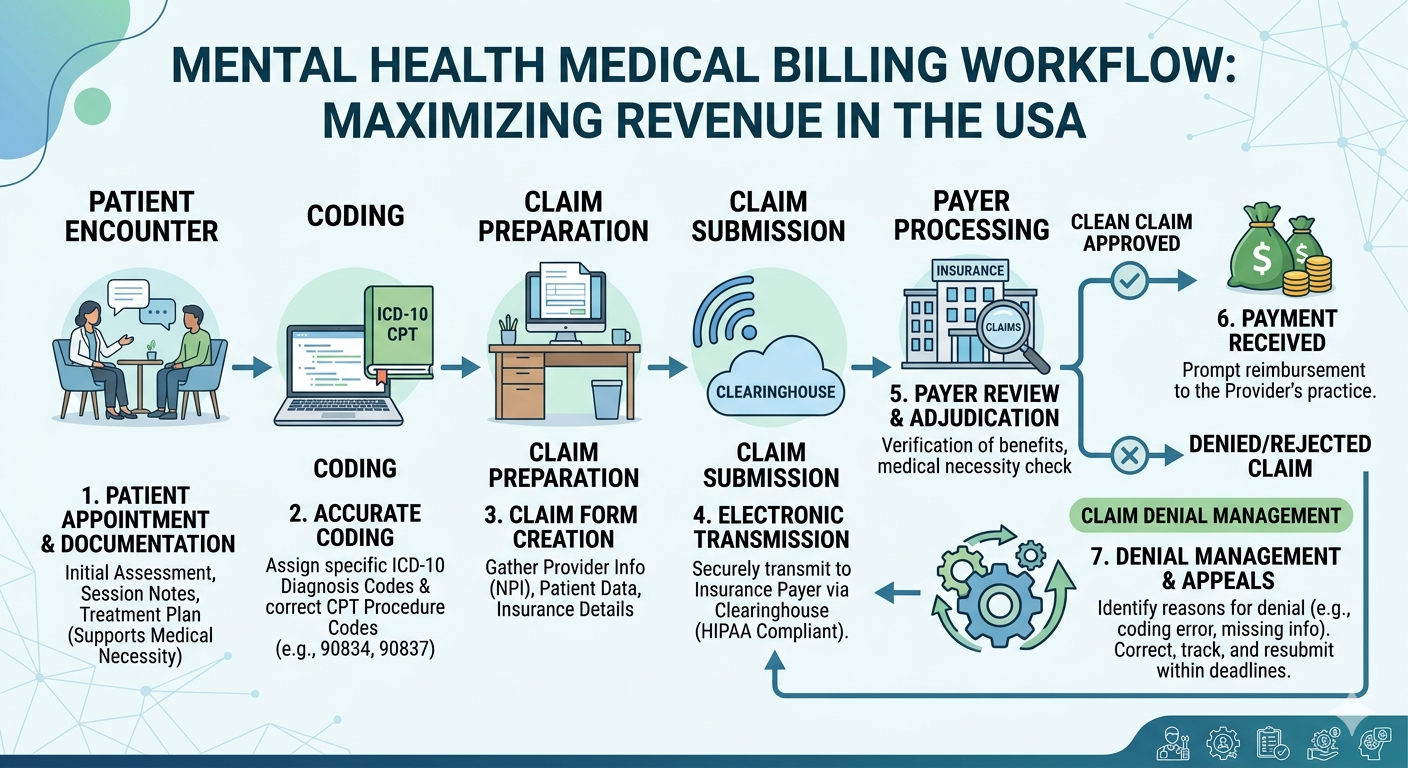
Mental health practices operate at the intersection of care and compliance. While clinicians focus on patient outcomes, billing determines financial stability. Mental health medical billing is more than claim submission; it’s a structured process that connects clinical documentation, coding accuracy, payer rules, and revenue cycle efficiency. When done right, it reduces denials, improves cash flow, and supports long-term growth for therapists, psychologists, psychiatrists, and behavioral health organizations.
Why Mental Health Medical Billing Matters
- Ensures accurate reimbursement for time-intensive therapy sessions
- Reduces claim denials linked to documentation or coding errors
- Aligns services with payer-specific mental health policies
- Improves revenue predictability and practice sustainability
- Frees providers to focus on patient care instead of administrative burden
What Is Mental Health Medical Billing
Mental health medical billing refers to the end-to-end process of submitting and managing claims for behavioral health services. This includes therapy sessions, psychiatric evaluations, medication management, group therapy, and telehealth services. Unlike general billing, it involves nuanced coding, strict documentation standards, and varying insurance policies across states and payers.
A reliable system often combines mental health medical billing services with clinical workflow integration, ensuring that documentation, coding, and reimbursement align seamlessly.
Core Components of Mental Health Billing
Patient Eligibility and Benefits Verification
Before treatment begins, verifying coverage is essential. Mental health insurance billing depends on understanding copays, deductibles, session limits, and prior authorization requirements.
Accurate Coding and Documentation
Every session must be coded correctly using CPT and ICD codes. A skilled mental health billing specialist ensures that diagnoses and procedures reflect clinical notes while meeting payer requirements.
Claim Submission and Follow-Up
Submitting clean claims is only the first step. Tracking, resubmitting, and appealing denied claims are critical for maximizing reimbursement.
Payment Posting and Reconciliation
Payments must be matched with claims, adjusted for contractual rates, and reconciled with patient balances.
Denial Management and AR Recovery
Denied claims require analysis, correction, and timely resubmission. Effective follow-up reduces revenue leakage.
Common Challenges in Mental Health Medical Billing
Complex Insurance Policies
Mental health insurance billing varies widely between providers. Coverage limitations, session caps, and pre-authorizations can delay payments.
Coding Errors and Documentation Gaps
Even minor mismatches between notes and codes can result in denials. This is where a mental health billing and coding company adds value.
High Administrative Burden
Manual billing processes consume time that could be spent on patient care.
Delayed Reimbursements
Without proper follow-up, claims may remain unpaid for months.
Benefits of Outsourcing Mental Health Billing
Many practices choose to outsource mental health billing services to reduce complexity and improve efficiency.
Access to Expertise
Working with a mental health billing consultant or agency ensures compliance with evolving payer rules.
Reduced Errors
Professional mental health billing companies use standardized workflows to minimize mistakes.
Improved Cash Flow
Faster claim processing leads to quicker reimbursements.
Scalability
As your practice grows, outsourced mental health billing can adapt without increasing internal workload.
Choosing the best mental health billing agency means finding a partner that understands behavioral health nuances and provides consistent support.
Key Services Offered by Mental Health Billing Providers
A comprehensive mental health billing provider typically offers:
- Mental health insurance billing services tailored to different payers
- Billing services for mental health therapists and group practices
- Credentialing and enrollment support
- AR follow-up and denial management
- Compliance monitoring and reporting
- Customized mental health medical billing solution for different practice sizes
These services are often bundled into mental health medical billing services outsourcing packages for efficiency.
How to Choose the Right Mental Health Billing Agency
Selecting the right partner is crucial for long-term success.
Industry Experience
Look for a mental health billing services agency with proven expertise in behavioral health.
Transparency and Reporting
Clear insights into claims, denials, and revenue trends are essential.
Technology Integration
The best outsource mental health billing and coding company integrates with your EHR and practice management systems.
Dedicated Support
A responsive team ensures issues are resolved quickly.
Compliance Standards
Ensure adherence to HIPAA and payer-specific regulations.
A top outsource mental health billing company will act as an extension of your practice rather than just a service provider.
Workflow Optimization for Better Results
Improving billing performance requires a structured approach:
Standardized Documentation
Ensure all providers follow consistent note-taking practices.
Regular Coding Audits
Periodic reviews help identify and correct recurring issues.
Automation Tools
Use software to streamline claim submission and tracking.
Performance Metrics
Track KPIs like denial rates, days in AR, and collection ratios.
Combining these strategies with outsourced mental health billing creates a strong revenue foundation.
Mental Health Billing for Different Practice Types
Solo Therapists
Billing services for mental health providers help independent therapists manage claims without administrative overload.
Group Practices
A mental health billing agency ensures consistency across multiple providers.
Hospitals and Clinics
Larger organizations benefit from scalable mental health medical billing services.
Telehealth Providers
Billing must align with virtual care regulations and payer policies.
Future Trends in Mental Health Medical Billing
The industry continues to evolve with technology and policy changes.
AI-Driven Automation
Automation tools are improving claim accuracy and reducing manual work.
Telehealth Expansion
Increased demand for virtual services requires updated billing processes.
Value-Based Care Models
Reimbursement is shifting toward outcomes rather than volume.
Data-Driven Decision Making
Analytics help practices optimize revenue and identify growth opportunities.
A forward-thinking mental health billing provider stays ahead of these trends.
Why Professional Billing Support Is Essential
Managing billing internally can lead to inefficiencies and lost revenue. Partnering with a professional mental health billing company ensures:
- Compliance with payer regulations
- Reduced administrative workload
- Higher claim acceptance rates
- Better financial visibility
Whether you choose a mental health billing consultant or a full-service agency, the goal is consistent revenue growth.
Conclusion
Mental health medical billing is a critical component of running a successful behavioral health practice. From eligibility verification to denial management, every step impacts revenue and operational efficiency. By leveraging expert support, adopting streamlined workflows, and considering outsourced mental health billing, practices can focus on delivering quality care while maintaining financial stability.
For organizations seeking comprehensive support, integrating medical billing services, medical coding services, medical billing and coding services, revenue cycle management services, and credentialing services into a unified system ensures seamless operations and long-term success. A trusted partner like 247 Medical Billing Services can help align these processes with your practice goals, creating a scalable and efficient billing ecosystem.
FAQs
What is mental health medical billing?
It is the process of submitting and managing claims for behavioral health services, ensuring accurate reimbursement from insurance providers.
Why is mental health billing different from general medical billing?
It involves unique coding, session-based billing, and strict documentation requirements specific to behavioral health services.
Should I outsource mental health billing services?
Outsourcing can reduce errors, improve cash flow, and free up time for patient care, making it a practical choice for many practices.
What does a mental health billing specialist do?
They handle coding, claim submission, denial management, and compliance to ensure accurate and timely reimbursements.
How do I choose the best mental health billing agency?
Look for experience, transparency, technology integration, and strong support tailored to behavioral health practices.
What are the benefits of mental health medical billing services outsourcing?
It improves efficiency, reduces administrative burden, and provides access to specialized expertise.
Can billing services help small therapy practices?
Yes, billing services for mental health therapists are designed to support practices of all sizes, including solo providers.
What role does a mental health billing consultant play?
They analyze billing processes, identify inefficiencies, and recommend strategies to improve revenue cycle performance.
 English
Join our community to interact with posts!