
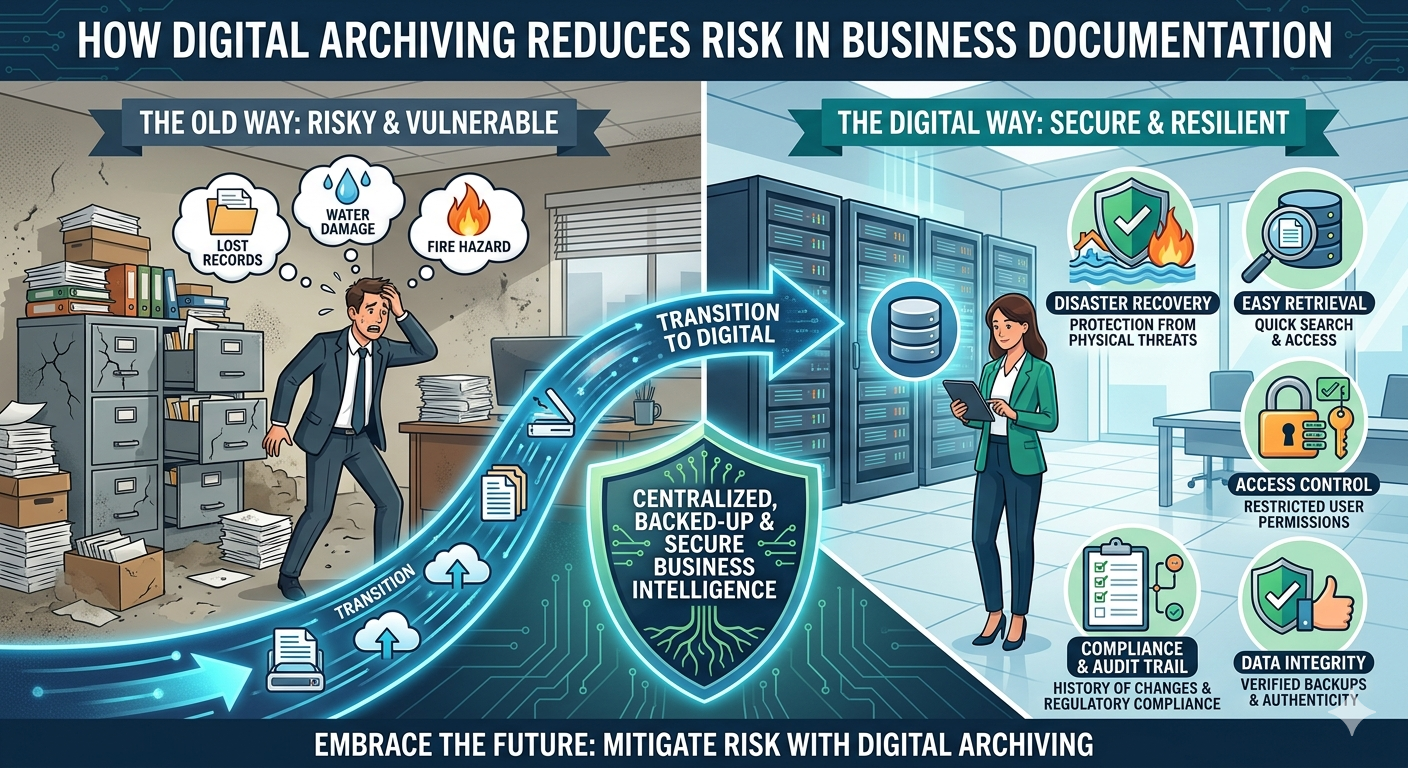
In today’s fast-paced business world, managing critical documents effectively is essential for operational success. Manual storage systems and unstructured digital files can lead to errors, lost records, and compliance issues. Companies are increasingly adopting Digital Archiving to safeguard sensitive information, streamline workflows, and reduce risk. By storing documents in a structured, secure, and accessible system, organizations can protect themselves from legal challenges, operational delays, and data loss while improving overall efficiency.
What Is Digital Archiving?
Digital Archiving involves the systematic capture, storage, and management of business documents in an electronic format. Unlike simple scanning or cloud storage, digital archiving focuses on long-term preservation, security, and compliance. Documents are indexed, searchable, and stored in a way that ensures integrity, accessibility, and traceability.
Key features include:
-
Secure storage with access controls and encryption.
-
Automated indexing and metadata tagging.
-
Version control and audit trails for regulatory compliance.
-
Seamless integration with enterprise software like ERP, CRM, and document management systems.
According to AIIM’s 2024 report, organizations using certified digital archiving solutions reduced document retrieval times by up to 60%, highlighting the operational and compliance advantages.
Reducing Legal and Compliance Risks
One of the most significant benefits of Digital Archiving is mitigating legal and compliance risks. Businesses across finance, healthcare, and legal industries are subject to stringent record-keeping regulations. Misplaced or incomplete records can result in regulatory fines, penalties, and reputational damage.
How digital archiving reduces risk:
-
Audit-ready documentation: All actions on documents are tracked and time-stamped.
-
Regulatory compliance: Ensures documents are retained according to legal requirements.
-
Secure access: Only authorized personnel can view or modify sensitive information.
For example, financial institutions that implemented digital archiving reported a 70% decrease in audit-related errors, ensuring smoother regulatory reviews and fewer compliance violations.
Preventing Data Loss and Operational Errors
Manual processes, physical storage, and unorganized digital folders expose organizations to significant operational risks. Documents can be lost, damaged, or accidentally deleted, impacting business continuity.
Digital Archiving mitigates these risks by:
-
Automated backups and disaster recovery: Ensures data is preserved even in emergencies.
-
Structured storage: Reduces the likelihood of misplaced or duplicated files.
-
Access tracking and version control: Prevents unauthorized modifications and errors.
A multinational manufacturing company reported that after implementing digital archiving, they reduced document-related operational errors by 55%, ensuring smoother workflows across departments and locations.
Enhancing Efficiency and Decision-Making
Beyond risk reduction, Digital Archiving enhances operational efficiency and supports faster, data-driven decision-making. Employees can retrieve critical documents instantly, eliminating delays caused by searching through paper files or disorganized digital storage.
Benefits for efficiency include:
-
Instant search and retrieval across large volumes of documents.
-
Automated document routing and approval workflows.
-
Centralized access for remote and distributed teams.
For instance, a global consulting firm integrated digital archiving with its project management software, reducing document retrieval time by 45% and enabling teams to respond quickly to client requests.
Real-World Applications
Businesses across industries are leveraging Digital Archiving to protect critical information and reduce risks:
Healthcare: Patient records, lab results, and insurance documentation are digitized for secure access and HIPAA compliance.
Finance: Invoices, contracts, and audit records are archived to meet SEC and regulatory retention requirements.
Legal Services: Contracts, filings, and case documents are managed electronically, reducing the risk of misplacement or errors.
Corporate Offices: Daily business correspondence, HR documents, and operational records are securely stored, enabling faster decision-making and audit readiness.
A 2025 Forrester study found that organizations using certified digital archiving systems experienced a 60% reduction in document-related delays and a 40% improvement in compliance tracking.
Key Considerations for Implementation
To maximize the benefits of Digital Archiving, companies should consider:
-
Choosing a certified platform: Ensures compliance and long-term reliability.
-
Integrating with enterprise systems: Seamless connection with ERP, CRM, and document management platforms enhances workflows.
-
Employee training: Staff should understand workflows and how to access and manage archived documents.
-
Ongoing monitoring: Regular audits and performance checks ensure the system continues to meet operational and compliance needs.
Proper planning and execution ensure that digital archiving delivers measurable risk reduction and operational improvements.
Conclusion:
Digital Archiving is no longer optional for modern businesses it is essential. It reduces legal and compliance risks, prevents data loss, eliminates operational errors, and improves efficiency. Organizations relying solely on paper files or unstructured digital storage face inefficiencies, regulatory exposure, and potential financial losses.
By implementing a certified digital archiving system, businesses can safeguard critical information, improve workflow efficiency, and ensure compliance with industry regulations. Digital archiving transforms document management from a manual, error-prone process into a secure, reliable, and strategic business function, enabling organizations to make faster decisions and operate with confidence.
 English
Join our community to interact with posts!