
The explosion of connected devices is creating an unprecedented volume of data at the network edge. Organizations today are under pressure to process this data instantly to improve operational efficiency, reduce downtime, and support real-time decision-making. This growing need for immediate intelligence is driving rapid growth in the IoT Edge Analytics Platforms Market.
Traditional cloud-centric models often struggle with latency, bandwidth limitations, and data privacy concerns. As industrial environments become increasingly connected, organizations require solutions capable of processing and analyzing data where it is generated. This is where IoT Edge Analytics Platforms are creating significant value.
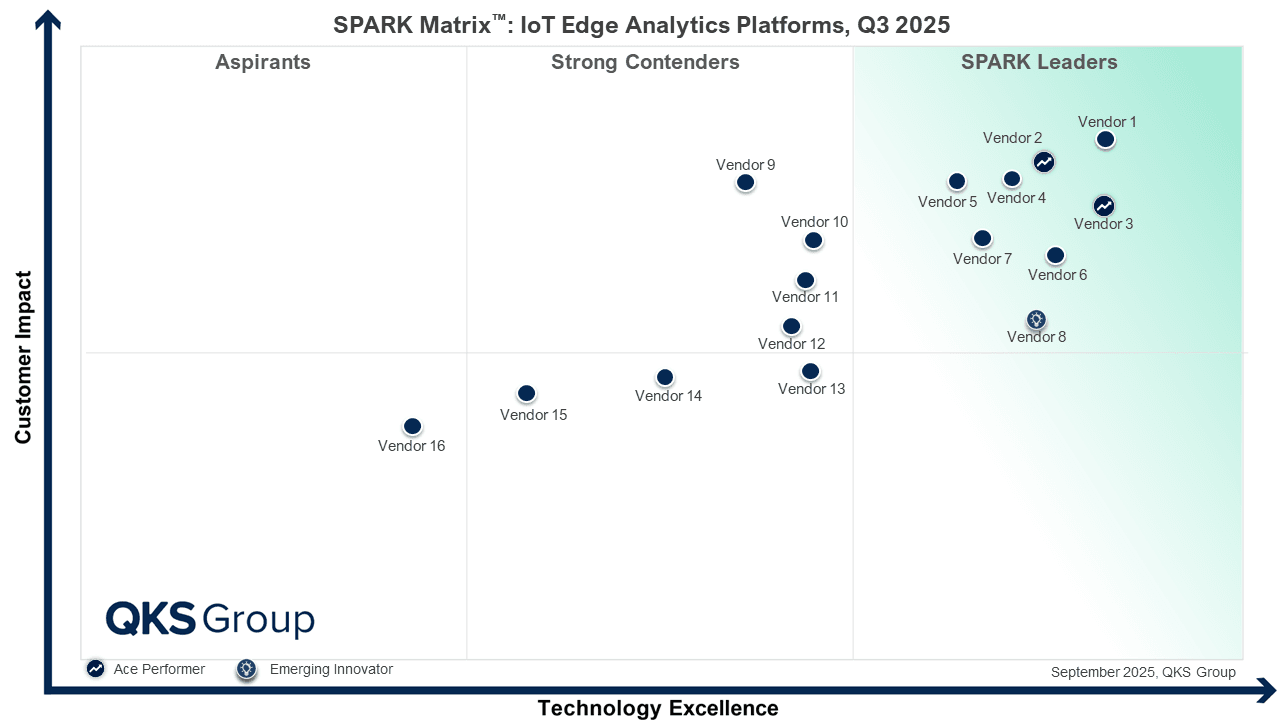
QKS Group's latest market research on the IoT Edge Analytics Platforms industry provides a comprehensive analysis of technology advancements, competitive dynamics, market opportunities, and future growth outlook. The study also includes the proprietary SPARK Matrix™ evaluation, positioning leading vendors based on technology excellence and customer impact.
IoT Edge Analytics Platforms are designed to collect, process, and analyze data generated by IoT devices directly at the edge of the network. Rather than transmitting all information to centralized cloud environments, these platforms perform analytics locally, enabling near-instant insights and actions. This capability is particularly critical in manufacturing, energy, transportation, healthcare, and smart city environments where milliseconds can influence business outcomes.
The increasing adoption of Industry 4.0 initiatives is significantly accelerating demand within the IoT Edge Analytics Platforms Market. Manufacturers are leveraging edge analytics to monitor equipment performance, predict failures, optimize production processes, and improve worker safety. By analyzing data closer to industrial assets, organizations can respond to operational issues faster and reduce costly downtime.
Another major driver is the rise of artificial intelligence at the edge. Modern platforms are integrating machine learning and AI models directly into edge environments, enabling intelligent automation and predictive decision-making without relying on constant cloud connectivity. This trend is empowering enterprises to achieve higher levels of operational efficiency while maintaining data sovereignty.
Organizations are also prioritizing cybersecurity and regulatory compliance. As data privacy regulations continue to evolve globally, many enterprises prefer processing sensitive information locally rather than transferring it to centralized locations. Edge analytics platforms help organizations meet compliance requirements while improving security posture through localized data processing.
The competitive landscape is evolving rapidly as vendors enhance platform capabilities across edge device management, connectivity management, analytics, application orchestration, security, and interoperability. Companies are investing heavily in simplified deployment models, low-code application development, AI integration, and scalable edge architectures to support growing enterprise requirements.
QKS Group's SPARK Matrix™ evaluates major vendors including AVEVA, AWS, C3 AI, ClearBlade, Cloudera, Cumulocity, Edge Impulse (Qualcomm), Eurotech, HPE, KX, Landing AI (Bosch Rexroth), Litmus Automation, Microsoft, SAS, Seeq, and Sight Machine. The evaluation provides detailed insights into each vendor's technology capabilities, innovation roadmap, market presence, and customer value proposition.
A significant trend shaping the future of the market is edge-to-cloud convergence. Enterprises increasingly seek integrated architectures that combine edge intelligence with cloud scalability. Vendors are responding by creating seamless environments that allow workloads, analytics models, and applications to move dynamically between edge and cloud infrastructures.
The emergence of 5G networks is also creating new opportunities. High-speed, low-latency connectivity enables more sophisticated edge applications, supporting use cases such as autonomous systems, remote operations, smart factories, and advanced video analytics. As 5G adoption expands, organizations will increasingly deploy edge analytics solutions to maximize network performance and operational responsiveness.
Looking ahead, the IoT Edge Analytics Platforms Market is expected to witness substantial growth as enterprises continue investing in digital transformation initiatives. Demand for real-time intelligence, AI-driven automation, cybersecurity, and operational resilience will remain key growth catalysts.
The future belongs to organizations that can convert data into actionable insights at the speed of business. IoT Edge Analytics Platforms are emerging as the foundation of this transformation, enabling enterprises to unlock new efficiencies, reduce operational risks, and accelerate innovation across increasingly connected ecosystems.
 English
Join our community to interact with posts!