
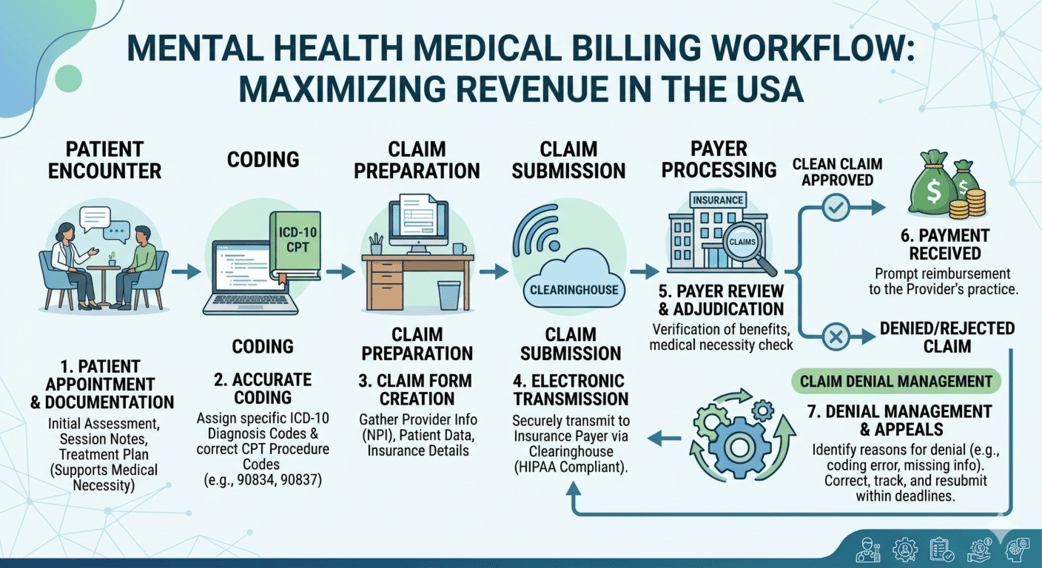
The demand for psychiatric and behavioral health care has reached unprecedented heights across the USA. In California, a state known for its progressive healthcare policies but notoriously complex insurance landscape, mental health providers face a dual challenge. They must deliver high-quality, compassionate care to patients while simultaneously managing a intricate administrative web to ensure they get paid. Navigating insurance claims in this specialty is uniquely difficult, which is why a growing number of practices are turning to specialized mental health billing services in California to maintain financial viability.Unlike standard medical claims, behavioral health claims face rigorous scrutiny from payers. Prior authorizations, strict limits on session frequencies, and the deeply personal nature of psychiatric documentation mean that a single administrative error can lead to a costly denial. For a solo practitioner or a growing counseling clinic, managing these hurdles internally often leads to burnout and lost revenue. Utilizing professional medical billing services tailored specifically to the nuances of behavioral health is no longer just a luxury—it is becoming a operational necessity for sustainable practice growth.
Why Mental Health Billing Disconnects from Traditional Medicine
Many providers mistakenly believe that any standard medical billing firm can handle psychiatric claims. However, behavioral health operates under an entirely different set of rules than traditional physical medicine.
The Challenge of Time-Based and Interactive Complexity Codes
In standard medicine, a procedure is often a discrete physical action. In mental health, billing is heavily tied to time increments and the nature of the therapeutic session. For example, distinguishing between a 45-minute psychotherapy session (CPT Code 90834) and a 60-minute session (CPT Code 90837) requires meticulous documentation. Furthermore, adding an "interactive complexity" code (90785) for patients with complicating factors requires specific justification that standard billing platforms might not prompt you for.
Strict Pre-Authorization Hurdles
In California, insurance companies frequently mandate prior authorizations for intensive outpatient programs (IOP), partial hospitalization, or even routine psychological testing. Failing to secure these approvals beforehand guarantees a denial. Specialized medical coding services ensure that the exact diagnostic codes (ICD-10) align perfectly with the procedural codes to demonstrate medical necessity from day one.
The Strategic Importance of Integrated Medical Billing and Coding Services
A seamless revenue cycle requires absolute harmony between documentation and claim submission. This is where comprehensive medical billing and coding services play a transformative role. When clinical notes are translated into alphanumeric codes, even a minor discrepancy in modifiers can trigger an audit or a rejection.
[Clinical Documentation] ➔ [Accurate CPT/ICD-10 Selection] ➔ [Claim Scrubbing] ➔ [Submission]
For California providers, staying compliant with state-specific mandates—such as the California Mental Health Parity Act—is vital. This law requires health care service plans and disability insurance policies to cover the diagnosis and medically necessary treatment of mental health and substance use disorders under the same terms and conditions applied to other medical conditions. Specialized coders understand how to leverage these laws to challenge unlawful insurer denials.
Optimizing the Financial Ecosystem: Revenue Cycle Management Services
For a mental health practice to thrive anywhere in the USA, looking at billing as a series of isolated claims is a mistake. Instead, it must be viewed as an ongoing ecosystem. Implementing robust revenue cycle management services (RCM) allows practices to track every dollar from the moment a patient schedules an appointment to the day the final balance is cleared.
An effective RCM strategy for mental health encompasses:
-
Eligibility Verification: Checking insurance benefits before the first session to clear up copays, deductibles, and coverage limits.
-
Denial Management: Analyzing why a claim was rejected, correcting the root cause, and aggressively appealing it within the payer's strict time windows.
-
Patient Accounts Receivable: Offering clear, compassionate statement billing to patients for their out-of-pocket responsibilities.
By outsourcing these tasks, clinicians can reclaim hours of administrative time every week, allowing them to focus entirely on patient clinical outcomes rather than chasing insurance companies for payments.
Payer Enrollment and Credentialing Services
Before you can even submit a claim to a commercial insurance network or California's Medi-Cal system, you must be properly credentialed. The enrollment process across the USA is notoriously slow, frequently taking anywhere from 90 to 180 days.
Securing professional credentialing services prevents your application from gathering dust or being rejected due to missing documentation, such as outdated CAQH profiles or incorrect NPI alignments. Dedicated credentialing specialists handle the tedious follow-ups with insurance panels, ensuring your provider profiles remain active, re-attested, and properly contracted to maximize your in-network patient reach.
Selecting the Right Partner for Your Practice
When searching for an administrative partner, look for a team that understands the heartbeat of mental health practices. 247 Medical Billing Services stands out as a trusted industry partner, providing comprehensive support across the entire operational spectrum.
By seamlessly blending medical billing services, precise medical coding services, and holistic medical billing and coding services, they alleviate the heavy lifting of administrative compliance. Furthermore, their specialized revenue cycle management services minimize claim delays, while their proactive credentialing services ensure your providers are fully authorized to provide care under the best possible contract terms. Partnering with dedicated specialists ensures that your California or nationwide practice remains both compliant and financially resilient.
Frequently Asked Questions
1. Why are mental health claims denied more frequently than general medical claims?
Mental health claims face unique hurdles such as strict medical necessity criteria, specific time-based coding requirements, and frequent mandates for prior authorizations. Insurers also scrutinize documentation closely to ensure that the therapy type matches the diagnostic code provided.
2. What is the California Mental Health Parity Act, and how does it affect billing?
This law mandates that insurance plans in California provide coverage for mental health and substance use disorders equal to their coverage for physical health conditions. It prevents insurers from placing arbitrary or more restrictive limits on mental health treatments, which gives billing services stronger ground to appeal unjust denials.
3. How do professional credentialing services save my practice money?
If a provider is not properly credentialed with a network, any claims submitted for services rendered during that period will be denied outright as "out-of-network" or "unauthorized." Credentialing services ensure your paperwork is processed accurately and promptly, avoiding periods where you cannot bill for a new clinician's time.
4. Can a general medical billing company handle psychiatric and behavioral health claims?
While they technically can, general billing companies often lack deep familiarity with behavioral health nuances, such as interactive complexity modifiers, telehealth-specific mental health modifiers, and the detailed documentation needed to survive an insurance audit.
5. What is the typical turnaround time for a clean mental health claim submission?
When handled by an experienced RCM team utilizing clean claim scrubbing technology, electronic claims are typically processed and paid by major payers within 14 to 21 days, compared to 45+ days for flawed or paper submissions.
 English
Join our community to interact with posts!