
Mental health providers spend their time helping patients manage anxiety, depression, trauma, addiction, and many other conditions. However, behind every successful practice is another important responsibility—accurate medical billing. Even the best clinical care can be affected by delayed reimbursements, denied claims, or insurance errors.
Finding the best mental health billing services is more than choosing a company to submit claims. It means partnering with professionals who understand behavioral health regulations, insurance requirements, documentation standards, and the unique challenges of mental health reimbursement.
Whether you run a private practice, counseling center, psychiatry clinic, or group practice, this guide explains what makes a billing service reliable and how the right support can improve your financial health without affecting patient care.
Why Mental Health Billing Is More Complex Than Other Specialties
Behavioral health billing follows many of the same insurance rules as other specialties, but it also comes with unique requirements.
Mental health providers often deal with:
- Time-based psychotherapy codes
- Telehealth billing requirements
- Prior authorization rules
- Frequent documentation audits
- Multiple payer-specific policies
- Coordination of benefits
- Recurring therapy sessions
A small coding mistake or missing modifier can result in claim denials or delayed payments. That's why many practices rely on experienced medical billing services instead of managing billing internally.
What Makes the Best Mental Health Billing Services?
Not every billing company has experience with behavioral health. The best providers understand the daily challenges mental health professionals face and have systems in place to reduce billing errors.
Here are the qualities to look for.
Specialized Behavioral Health Knowledge
Mental health billing requires expertise in psychotherapy, psychiatric evaluations, medication management, crisis intervention, and telepsychiatry coding.
Experienced billing teams stay updated with payer guidelines and coding changes, helping practices submit cleaner claims from the beginning.
Strong Claim Accuracy
Claim accuracy directly affects reimbursement speed.
High-quality billing services focus on:
- Complete patient eligibility verification
- Accurate CPT and ICD coding
- Correct modifiers
- Proper documentation review
- Timely claim submission
Fewer errors generally lead to fewer denials and faster payments.
Effective Denial Management
Even well-prepared claims can sometimes be denied.
The best billing services actively:
- Identify denial patterns
- Correct rejected claims quickly
- Submit appeals when appropriate
- Monitor payer responses
- Prevent repeated billing mistakes
Instead of simply resubmitting claims, they investigate the root cause to reduce future denials.
The Role of Medical Coding in Mental Health Billing
Billing cannot succeed without accurate coding.
Professional medical coding services ensure diagnoses and procedures are translated correctly into standardized medical codes.
Proper coding helps:
- Reduce claim rejections
- Support medical necessity
- Improve compliance
- Maintain accurate patient records
- Maximize appropriate reimbursement
Because coding regulations change regularly, ongoing education and quality checks are essential.
Revenue Cycle Management Matters More Than Most Practices Realize
Billing is only one part of the financial process.
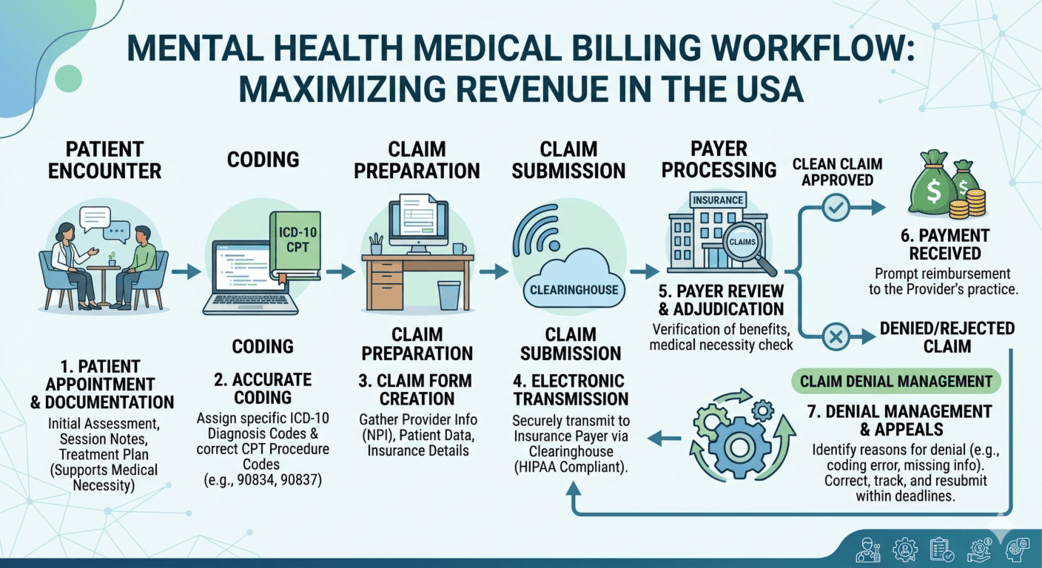
Comprehensive revenue cycle management begins before the patient's appointment and continues until the final payment is collected.
A complete revenue cycle typically includes:
- Patient registration
- Insurance verification
- Prior authorization
- Charge capture
- Medical coding
- Claim submission
- Payment posting
- Denial management
- Patient billing
- Financial reporting
When every stage works together efficiently, practices experience healthier cash flow and fewer outstanding claims.
How Credentialing Supports Faster Reimbursements
Many providers focus on billing but overlook credentialing, which plays an important role in getting paid.
If a provider is not properly enrolled with insurance companies, claims may be denied regardless of coding accuracy.
Proper credentialing helps practices:
- Join insurance networks
- Maintain payer enrollment
- Prevent payment interruptions
- Update provider information
- Meet compliance requirements
Keeping credentialing current helps avoid unnecessary reimbursement delays.
Signs Your Current Billing Process Needs Improvement
Many practices continue using inefficient billing systems without realizing how much revenue they're losing.
Common warning signs include:
- Increasing claim denials
- Slow insurance payments
- High accounts receivable
- Frequent coding errors
- Missing documentation
- Patient billing complaints
- Limited financial reporting
- Staff spending excessive time on billing
Addressing these issues early can improve operational efficiency and reduce administrative stress.
Questions to Ask Before Choosing a Mental Health Billing Partner
Choosing a billing service should involve more than comparing prices.
Consider asking these questions:
Do they specialize in behavioral health?
Experience with mental health practices often leads to better claim accuracy and payer communication.
How do they manage denied claims?
A proactive denial management process can recover revenue that might otherwise be lost.
What reporting do they provide?
Regular financial reports help practices monitor collections, denials, outstanding balances, and overall performance.
Are they familiar with telehealth billing?
Telehealth remains an important service for many behavioral health providers, making updated billing knowledge essential.
How do they protect patient information?
HIPAA compliance, secure data handling, and privacy safeguards should always be priorities.
Benefits of Outsourcing Mental Health Billing
Outsourcing is becoming increasingly common among behavioral health providers because it allows clinicians to spend more time with patients instead of administrative tasks.
Some of the biggest advantages include:
- Improved claim acceptance rates
- Faster reimbursement cycles
- Lower administrative workload
- Better compliance with payer rules
- Reduced billing errors
- More predictable cash flow
- Greater focus on patient care
For growing practices, outsourcing can also reduce hiring and training costs associated with maintaining an in-house billing department.
Technology Is Changing Mental Health Billing
Modern billing services use advanced software to improve efficiency and reduce manual work.
Today's systems often include:
- Electronic claim submission
- Automated eligibility verification
- Real-time claim tracking
- Electronic payment posting
- Denial analytics
- Financial dashboards
- Secure document management
These tools provide greater visibility into the billing process while helping practices identify opportunities for improvement.
Choosing a Trusted Billing Partner
Every mental health practice has different needs based on its size, specialty, patient volume, and payer mix.
Some practices only require claim submission, while others need complete support that includes medical billing services, medical coding services, credentialing, and revenue cycle management.
A provider like 247 Medical Billing Services offers solutions designed to support healthcare organizations across multiple specialties, including behavioral health. The most important consideration is selecting a billing partner with proven expertise, transparent communication, strong compliance standards, and a commitment to helping practices improve operational efficiency.
Rather than choosing solely based on cost, practices should evaluate experience, technology, reporting capabilities, responsiveness, and industry knowledge.
Final Thoughts
Selecting the best mental health billing services can significantly improve the financial stability of a behavioral health practice. Accurate billing, proper coding, effective denial management, updated credentialing, and efficient revenue cycle processes all contribute to stronger reimbursement performance.
As insurance requirements continue to evolve, partnering with experienced billing professionals allows providers to focus on delivering quality mental health care while maintaining healthy financial operations. The right billing support not only reduces administrative burdens but also creates a smoother experience for both healthcare providers and their patients.
Frequently Asked Questions
1. Why is mental health billing different from general medical billing?
Mental health billing often involves time-based psychotherapy codes, behavioral health documentation requirements, telehealth regulations, and payer-specific coverage rules that require specialized expertise.
2. What should I look for in the best mental health billing services?
Look for behavioral health experience, accurate coding, denial management, transparent reporting, HIPAA compliance, and knowledge of insurance regulations.
3. How do medical coding services improve reimbursement?
Accurate medical coding services reduce claim errors, support medical necessity, improve documentation quality, and help practices receive timely reimbursements.
4. Why is credentialing important for mental health providers?
Credentialing allows providers to participate in insurance networks and ensures claims are processed correctly, reducing payment delays and denials.
5. What is revenue cycle management in healthcare?
Revenue cycle management covers the entire financial process from patient registration and insurance verification to claim submission, payment collection, and reporting.
6. Can outsourcing mental health billing reduce claim denials?
Yes. Experienced billing professionals review claims carefully, correct errors before submission, manage denials efficiently, and monitor payer requirements to improve claim acceptance rates.
7. Is outsourcing medical billing suitable for small mental health practices?
Yes. Small practices often benefit from outsourced medical billing services because they gain access to specialized expertise, reduce administrative workload, and improve revenue without maintaining a large in-house billing team.
 English
Join our community to interact with posts!