
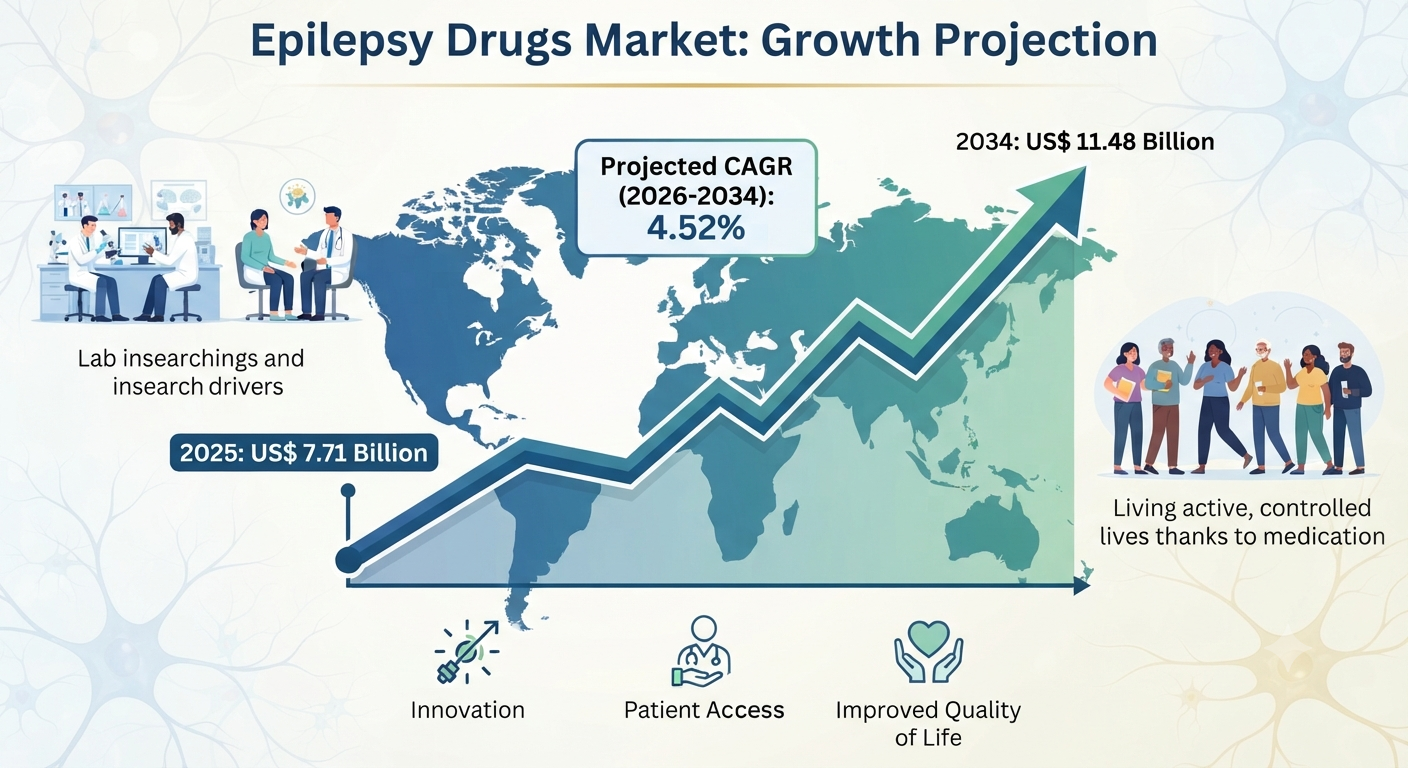
The landscape of neurological healthcare is undergoing a transformative period, with the global epilepsy drugs market standing at the forefront of this evolution. As medical science transitions from broad-spectrum treatments to precision, patient-centric therapies, the ability to manage and potentially control seizure disorders has reached unprecedented levels of efficacy. According to data from Renub Research, the epilepsy drugs market is expected to register significant growth, rising from US$ 7.71 billion in 2025 to US$ 11.48 billion in 2034. This represents a steady Compound Annual Growth Rate (CAGR) of 4.52% between 2026 and 2034.
This growth trajectory is driven by a confluence of factors: the increasing global prevalence of neurological disorders, significant advancements in pharmaceutical research, and an improved diagnostic landscape that ensures more patients receive life-altering care. In this article, we explore the forces shaping this essential market and how they are redefining patient outcomes worldwide.
Download Free Sample Report: https://www.renub.com/request-sample-page.php?gturl=epilepsy-drugs-market-p.php
Understanding the Epilepsy Drugs Market
Epilepsy medications, medically categorized as antiepileptic drugs (AEDs), are foundational to managing the electrical signaling within the brain. Epilepsy is a chronic neurological condition characterized by recurrent, unprovoked seizures, which are essentially bursts of abnormal electrical activity. AEDs work primarily through three mechanisms: sodium channel blockers, calcium channel modulators, and gamma-aminobutyric acid (GABA) enhancers.
The demand for these pharmaceuticals is rising globally, fueled by better diagnosis rates and a greater societal awareness of neurological health. We are no longer limited to "one-size-fits-all" legacy medications; current research has ushered in a new generation of drugs that are not only more potent but also come with significantly improved tolerability profiles. As investments in the healthcare sector grow—particularly in emerging markets—accessibility to these specialized medications is expanding, offering hope to millions who were previously underserved.
Primary Growth Drivers
1. Rising Global Prevalence and Aging Populations
Epilepsy remains one of the most burdensome neurological conditions globally, affecting roughly 50 million people. Current estimates suggest that between 4 and 10 per 1,000 people live with active epilepsy. This prevalence is rising due to a combination of genetic factors, traumatic brain injuries, infections, and tumors.
Crucially, the global demographic shift toward an aging population is a major driver of market demand. Older adults are inherently more vulnerable to stroke, dementia, and other neurodegenerative conditions that frequently trigger epilepsy. Because epilepsy often requires lifelong management to ensure quality of life, this aging population base creates a predictable, steady demand for chronic drug therapy.
2. Pharmaceutical Innovation and Precision Medicine
The shift toward personalized medicine is arguably the most exciting development in the field. Pharmaceutical companies are increasingly focusing on "precision epilepsy" treatments, utilizing genetic profiling to match the right medication to the right patient.
Modern research is producing next-generation AEDs that offer better efficacy and fewer cognitive or physical side effects compared to older versions. Furthermore, the integration of technology into the patient journey is accelerating. For instance, in August 2025, the Epilepsy Foundation of America (EFA) launched a groundbreaking AI Assistant, "Sage." Developed in partnership with Amazon Web Services and powered by Anthropic’s Claude, this tool is designed to provide empathetic, real-time support to patients. Such digital innovations are helping to bridge the gap between clinical appointments and daily management, fostering better patient compliance.
3. Healthcare Expansion in Emerging Economies
Asia-Pacific, Latin American, and African nations are witnessing a rapid transformation of their healthcare infrastructure. Increased government spending, insurance expansion, and a growing middle class are reducing the "treatment gap" that has historically plagued these regions. As specialized neurological care centers and hospitals proliferate in these areas, the accessibility of both branded and generic epilepsy medications is improving, fundamentally changing the prognosis for millions of patients.
Challenges: Bridging the Gap in Care
Despite the positive outlook, the market faces persistent hurdles that require strategic solutions:
-
Safety and Side Effects: The "burden of treatment" remains a major issue. Many AEDs are associated with fatigue, dizziness, and mood changes. In some cases, long-term use is linked to bone density loss or liver complications. These side effects can decrease patient compliance, leading to irregular medication intake and, consequently, breakthrough seizures.
-
The Problem of Drug-Resistant Epilepsy: Approximately one-third of patients do not achieve seizure control with current drug therapies. For these individuals, the search for effective treatment is a grueling process of trial and error, emphasizing the need for continued R&D in novel targets.
-
Financial Toxicity: Newer, high-efficacy medications often come with premium price tags. In low-income regions, or even for underinsured patients in developed nations, the lifelong cost of medication creates a significant financial burden. While generic options offer relief, they are not always sufficient for patients with complex, treatment-resistant epilepsy.
Segmented Analysis: How Treatment is Delivered
The First-Line Treatment Landscape
First-line drugs are the bedrock of epilepsy management. Upon initial diagnosis, neurologists select these medications based on the patient’s age, seizure type, and the drug’s safety profile. Because these drugs have been studied for decades, they are widely accessible in generic form, making them the primary tool for stabilizing brain activity and preventing the progression of the disease.
Focal vs. Generalized Seizure Markets
The market is further divided by the type of seizure being treated:
-
Focal Seizures: Originating in one part of the brain, these are common in adults. The market for these drugs is expanding as better imaging technology (MRI and EEG) allows for earlier, more precise diagnosis and targeted, localized therapy.
-
Generalized Seizures: Affecting both sides of the brain, these require broad-spectrum medications. The market for generalized seizure drugs is seeing steady growth, particularly in pediatric and adolescent medicine, where clinicians focus on managing syndromes that impact long-term cognitive development.
Distribution Channels: The Digital Shift
While hospital pharmacies remain the critical distribution point for newly diagnosed patients and those requiring complex management, the online provider market is booming. Telemedicine and digital pharmacies are revolutionizing care for patients in remote areas. With automatic refills, home delivery, and remote consultations, digital platforms are ensuring that treatment continuity—a life-saving necessity for epilepsy patients—is more reliable than ever before.
Regional Perspectives
United States: A Hub of Innovation
The U.S. market leads the globe, supported by an advanced R&D ecosystem and a highly specialized neurology workforce. Recent regulatory milestones reflect this leadership; in April 2025, for instance, the FDA approved Neurelis’ VALTOCO (diazepam nasal spray) for seizure clusters, providing a non-invasive, highly effective alternative to traditional rescue medications.
United Kingdom: Quality-Focused Healthcare
The U.K.’s National Health Service (NHS) ensures that epilepsy management is integrated and accessible. The regulatory landscape remains favorable for innovation, highlighted by the March 2024 approval of ganaxolone (Ztalmy) for CDKL5 deficiency disorder, marking a milestone in treating rare, genetic-based epilepsy.
India: The Global Generic Leader
India represents a massive, growing market. The nation’s unique position as a global manufacturing hub for high-quality, affordable generic drugs is crucial for global health equity. Initiatives like the launch of Clasepi (synthetic CBD) for complex syndromes demonstrate the country’s commitment to adopting cutting-edge treatments alongside its massive generic infrastructure.
Saudi Arabia: Investing in Specialized Infrastructure
Saudi Arabia’s "National Healthcare Transformation Strategy" is propelling its market forward. The King Faisal Specialist Hospital and Research Centre has become a global leader in Stereo-Electroencephalography (Stereo-EEG), proving that the Middle East is rapidly becoming a center of excellence for advanced surgical and pharmacological epilepsy interventions.
Future Outlook (2026–2034)
The future of the epilepsy drugs market is defined by the convergence of chemistry and connectivity. As we look toward 2034, the market will likely move away from systemic drug delivery toward more localized and personalized approaches. The continued investment in clinical trials, coupled with a deeper understanding of the genetic drivers of epilepsy, ensures that the market will not only grow in value but also in its ability to offer a "seizure-free" life to an increasing number of patients.
Frequently Asked Questions (FAQs)
1. What is the projected market size of the epilepsy drugs market by 2034, according to Renub Research? According to Renub Research, the epilepsy drugs market is projected to reach US$ 11.48 billion by 2034, growing from US$ 7.71 billion in 2025.
2. What is the expected CAGR for the epilepsy drugs market between 2026 and 2034? The market is anticipated to expand at a Compound Annual Growth Rate (CAGR) of 4.52% throughout the forecast period of 2026 to 2034.
3. What are the key drivers propelling the growth of the epilepsy drugs market? The primary drivers include the rising global incidence of neurological disorders, an aging population more susceptible to age-related epilepsy, advancements in precision medicine and pharmaceutical innovation, and expanded healthcare infrastructure in emerging markets.
4. How does the "digital shift" impact the distribution of epilepsy drugs? The growth of online pharmacies and telemedicine platforms has significantly improved access, especially for patients in rural or underserved areas. These digital channels ensure treatment continuity through home delivery and efficient, remote management of prescriptions.
5. Why is the 18–24 age group and the geriatric population particularly relevant to this market? The geriatric population is increasingly vulnerable to epilepsy due to stroke and neurodegenerative conditions, creating a high demand for chronic care. Simultaneously, advancements in diagnosing pediatric and young-adult onset epilepsy continue to expand the patient base requiring early, specialized intervention.
6. What role do AI-based tools play in the current epilepsy market? AI tools, such as the AI Assistant "Sage" launched by the Epilepsy Foundation of America, are revolutionizing patient support. These tools help patients navigate their journey, improve medication compliance, and provide emotional support, which is critical for long-term management.
7. How are hospitals and retail pharmacies adapting to the changing needs of epilepsy patients? Hospital pharmacies remain essential for complex, severe cases and post-surgical care, ensuring high-level monitoring. Meanwhile, retail and online pharmacies are focusing on affordability and supply-chain reliability for chronic, daily-use medications, catering to the broad spectrum of patient needs.
 English
Join our community to interact with posts!