
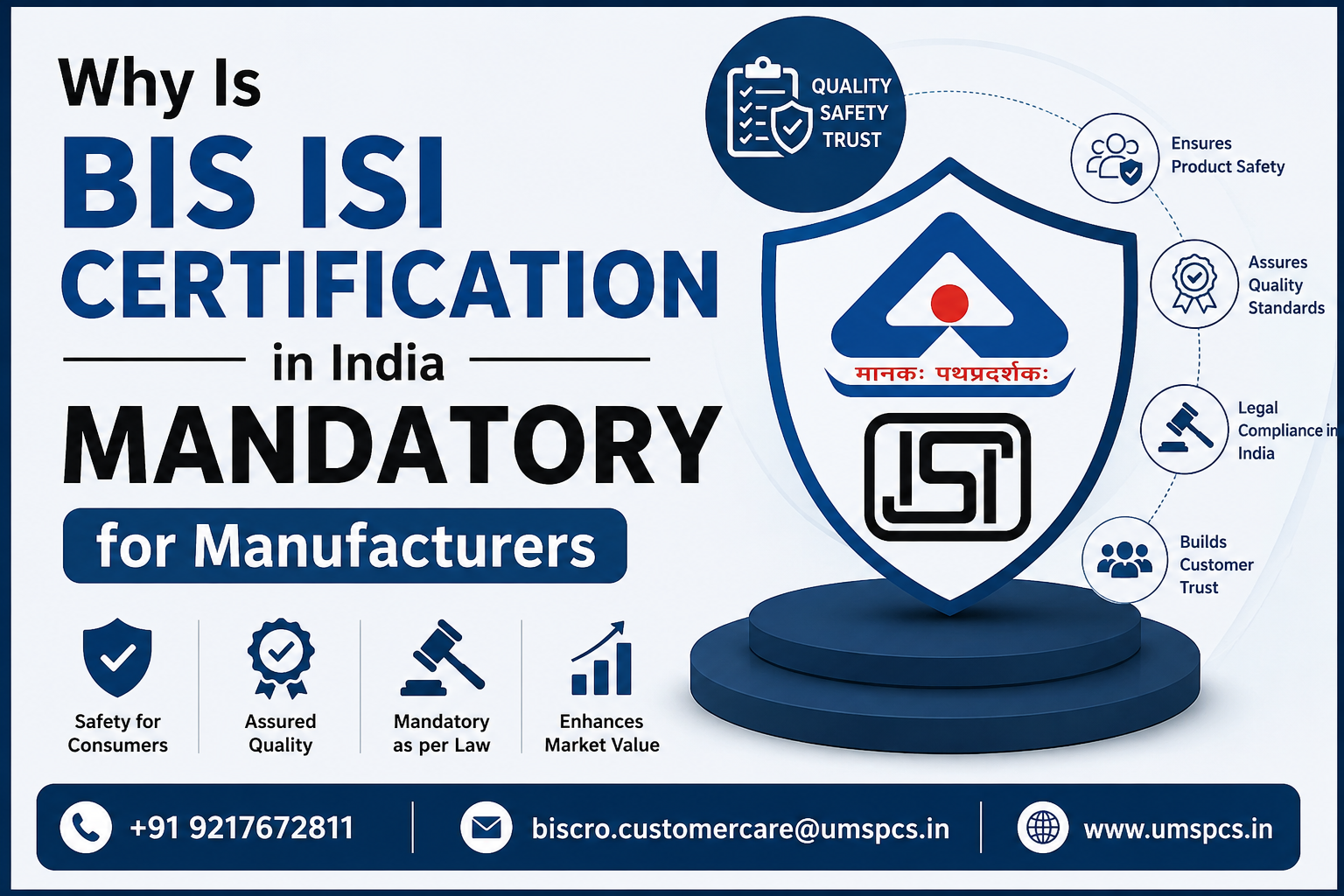
If you manufacture or plan to sell regulated products in India, you may have come across the requirement for BIS ISI Certification in India. Many manufacturers, importers, and business owners often wonder whether this certification is mandatory and how it benefits their business. The answer depends on your product category, but for many products covered under the Bureau of Indian Standards (BIS), obtaining the ISI mark is a legal requirement.
The BIS ISI Certification in India not only demonstrates compliance with Indian quality standards but also assures customers that the product has been tested and manufactured according to prescribed safety requirements. Whether you are producing electrical appliances, cement, steel, LPG cylinders, or household products, obtaining the correct certification is essential for entering the Indian market.
At UMSPCS, an experienced BIS Consultant, we help manufacturers complete the certification process smoothly through expert documentation, testing coordination, factory inspection support, and application management.
What Is BIS ISI Certification in India?
BIS ISI Certification in India is a product certification scheme managed by the Bureau of Indian Standards (BIS). The ISI mark indicates that a product complies with the applicable Indian Standard (IS) and has undergone the required quality checks before reaching consumers.
The certification helps ensure that products available in the Indian market meet safety, reliability, and performance standards. Manufacturers whose products fall under mandatory certification must obtain a BIS license before selling them in India.
The ISI mark is recognized across the country as a symbol of quality and consumer trust.
Why Is BIS ISI Certification in India Important?
The primary objective of BIS ISI Certification in India is to protect consumers by ensuring that products meet established safety and quality standards.
Some key advantages include:
-
Ensures compliance with Indian regulations
-
Builds customer confidence
-
Enhances product quality
-
Improves brand credibility
-
Increases market acceptance
-
Reduces the risk of product recalls
-
Supports long-term business growth
For manufacturers, complying with BIS regulations is not just about meeting legal requirements—it also creates a competitive advantage in the marketplace.
Read more:- BIS CRS Registration
Which Products Require BIS ISI Certification in India?
Several products are covered under the mandatory certification scheme. Some common examples include:
-
Electrical appliances
-
Household switches
-
Steel products
-
Cement
-
Pressure cookers
-
Packaged drinking water
-
LPG valves
-
Gas stoves
-
Cables and wires
-
Industrial products
-
Construction materials
Before applying, businesses should confirm whether their product falls under the mandatory BIS certification list.
Who Needs BIS ISI Certification in India?
The BIS ISI Certification in India is generally required for:
-
Indian manufacturers
-
Domestic production units
-
Businesses manufacturing regulated products
-
Companies launching new certified products
-
Manufacturers supplying products to government projects
Importers of products requiring ISI certification should ensure that the manufacturer has obtained the appropriate BIS license before selling the products in India.
What Is the Process for BIS ISI Certification in India?
Obtaining BIS ISI Certification in India involves several structured steps. Following the correct process helps avoid unnecessary delays.
Step 1: Product Identification
Identify the applicable Indian Standard (IS) for your product.
Step 2: Documentation
Prepare all technical and business documents required by BIS.
Step 3: Application Submission
Submit the online application along with supporting documents.
Step 4: Product Testing
The product is tested at a BIS-recognized laboratory to verify compliance.
Step 5: Factory Inspection
BIS officials inspect the manufacturing facility and quality control system.
Step 6: Review by BIS
The Bureau reviews the application, inspection report, and laboratory results.
Step 7: Grant of License
After successful verification, the manufacturer receives the BIS ISI license and can use the ISI mark on approved products.
Read more:- FMCS Consultant in India
What Documents Are Required for BIS ISI Certification in India?
The documentation requirements vary depending on the product category. However, commonly required documents include:
-
Company Registration Certificate
-
Manufacturing License
-
Factory Address Proof
-
Product Specifications
-
Manufacturing Process Details
-
Quality Control Documents
-
Test Reports
-
Authorized Signatory Details
-
Trademark Documents (if applicable)
Proper documentation significantly improves the approval timeline.
Why Choose UMSPCS for BIS ISI Certification in India?
Applying for BIS ISI Certification in India can be time-consuming without professional guidance. Regulatory procedures, documentation, testing requirements, and inspections require careful planning.
UMSPCS offers end-to-end BIS consulting services that help manufacturers complete every stage efficiently.
Our services include:
-
Product eligibility assessment
-
Documentation support
-
BIS application filing
-
Laboratory coordination
-
Factory inspection assistance
-
Compliance guidance
-
Post-certification support
With years of experience as a trusted BIS Consultant, we assist businesses across India in obtaining BIS approvals with accuracy and transparency.
Common Challenges During BIS ISI Certification
Manufacturers often face several issues during the certification process, such as:
-
Incorrect product classification
-
Incomplete documentation
-
Delays in laboratory testing
-
Factory inspection observations
-
Technical queries from BIS
-
Application errors
Working with an experienced consultant helps minimize these challenges and improves the chances of timely approval.
Benefits of Hiring a BIS Consultant
A professional consultant simplifies the certification journey by offering technical expertise and regulatory support.
Benefits include:
-
Faster documentation preparation
-
Accurate application filing
-
Reduced chances of rejection
-
Guidance on Indian Standards
-
Better coordination with testing laboratories
-
Timely responses to BIS queries
-
End-to-end project management
Choosing the right consultant saves both time and operational costs.
Conclusion
Obtaining BIS ISI Certification in India is essential for manufacturers producing products covered under mandatory BIS regulations. It not only ensures legal compliance but also enhances customer trust and product credibility.
Partnering with an experienced BIS Consultant like UMSPCS makes the certification process simple and hassle-free. From identifying applicable standards to final license approval, our experts provide complete support to help your business meet BIS requirements efficiently.
If you are planning to manufacture or sell regulated products in India, now is the right time to begin your BIS ISI Certification in India journey with professional guidance.
Frequently Asked Questions (FAQs)
1. What is BIS ISI Certification in India?
BIS ISI Certification in India is a product certification issued by the Bureau of Indian Standards that confirms a product complies with the relevant Indian Standard and quality requirements.
2. Is BIS ISI Certification in India mandatory?
Yes. BIS ISI Certification in India is mandatory for many products notified by the Government of India under the Quality Control Orders (QCOs).
3. Who can apply for BIS ISI Certification in India?
Indian manufacturers producing products covered under mandatory BIS standards can apply for BIS ISI Certification in India.
4. How long does it take to obtain BIS ISI Certification in India?
The timeline depends on product testing, document verification, factory inspection, and BIS approval. Proper documentation can help reduce delays.
5. What is the cost of BIS ISI Certification in India?
The cost varies depending on the product category, laboratory testing, BIS fees, and consulting requirements.
6. Can UMSPCS help with BIS ISI Certification in India?
Yes. UMSPCS provides complete assistance for BIS ISI Certification in India, including documentation, testing coordination, application filing, inspection support, and post-certification compliance.
7. Why should I hire a BIS Consultant?
An experienced BIS Consultant helps ensure accurate documentation, faster application processing, regulatory compliance, and a smoother certification experience, reducing the risk of delays or rejections.
 English
Join our community to interact with posts!