
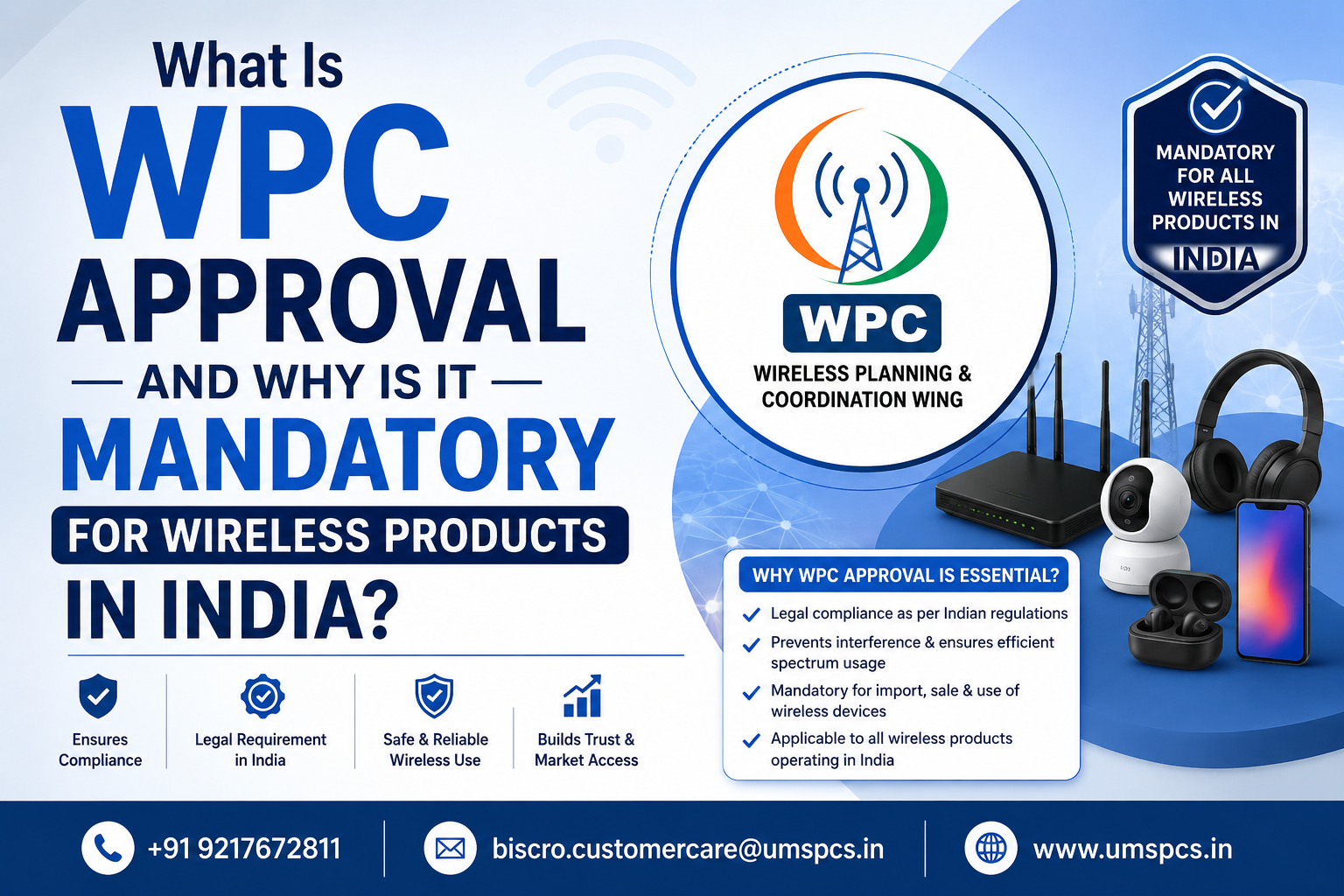
Wireless technology has become an essential part of modern life. From smartphones and Wi-Fi routers to Bluetooth speakers, smartwatches, and IoT devices, almost every electronic product today uses radio frequency technology. Before these products can be legally imported, manufactured, or sold in India, many require WPC Approval from the Wireless Planning & Coordination (WPC) Wing of the Department of Telecommunications (DoT).
If you are planning to launch a wireless product in the Indian market, understanding WPC Approval is one of the first compliance steps. Working with an experienced consultant like UMSPCS makes the process faster, easier, and fully compliant with Indian regulations.
What Is WPC Approval?
WPC Approval is an authorization issued by the Wireless Planning & Coordination (WPC) Wing under the Department of Telecommunications (DoT), Government of India. It ensures that wireless and radio frequency-enabled devices operate only on approved frequency bands and comply with Indian telecom regulations.
Products using license-exempt frequency bands generally require an Equipment Type Approval (ETA), which is the most common form of WPC Approval. This approval confirms that the device will not interfere with existing communication networks.
Without WPC Approval many wireless products cannot be legally imported, distributed, or sold in India.
Why Is WPC Approval Required?
The Government of India regulates wireless communication to maintain efficient spectrum management and prevent interference between electronic devices.
Obtaining WPC Approval helps businesses:
-
Comply with Indian telecom regulations
-
Import wireless products legally
-
Avoid customs clearance issues
-
Prevent penalties and legal complications
-
Improve customer confidence
-
Ensure products operate on approved frequencies
Whether you are an importer, manufacturer, or online seller, WPC Approval is an essential compliance requirement for many wireless products.
Read more:- BIS ISI Certification in India
Which Products Need WPC Approval?
Many electronic products with wireless communication modules require WPC Approval before entering the Indian market.
Common examples include:
-
Wi-Fi Routers
-
Bluetooth Speakers
-
Smart Watches
-
Wireless Earbuds
-
Mobile Phones
-
Tablets
-
Wireless Keyboards
-
Wireless Mouse
-
IoT Devices
-
Smart Home Products
-
GPS Devices
-
RFID Equipment
-
Drone Controllers
-
Wireless Cameras
-
Point-of-Sale (POS) Machines
If your product transmits or receives radio signals, there is a strong possibility that WPC Approval will be required.
Who Needs WPC Approval?
Several types of businesses may need WPC Approval, including:
-
Manufacturers
-
Importers
-
Brand Owners
-
E-commerce Sellers
-
Foreign Manufacturers
-
Electronics Startups
-
Telecom Equipment Suppliers
Regardless of your company size, obtaining WPC Approval before launching wireless products helps avoid unnecessary delays.
What Documents Are Required for WPC Approval?
The documentation requirements may vary depending on the product type, but commonly required documents include:
-
Product Technical Specifications
-
Radio Frequency Test Report
-
Authorization Letter
-
Import Export Code (IEC)
-
Company Registration Certificate
-
GST Registration
-
Product User Manual
-
Product Photographs
-
RF Module Details
-
Manufacturer Authorization (if applicable)
Preparing complete and accurate documentation significantly improves the approval process.
Read more:- BIS CRS Registration in india
What Is the WPC Approval Process?
The WPC Approval process generally involves the following steps:
Step 1: Product Evaluation
Experts verify whether the product requires WPC ETA Approval and identify the applicable frequency band.
Step 2: Document Collection
Technical and legal documents are collected and reviewed for accuracy.
Step 3: Application Submission
The application is prepared and submitted to the WPC authority.
Step 4: Technical Verification
Authorities examine the technical specifications and radio frequency reports.
Step 5: Approval Issuance
After successful verification, the WPC ETA Approval Certificate is granted.
Working with an experienced consultant ensures that each stage is completed correctly and without unnecessary delays.
Why Choose UMSPCS for WPC Approval?
Obtaining WPC Approval involves technical documentation, regulatory compliance, and communication with government authorities. Even a small mistake can delay product launches.
UMSPCS provides complete assistance throughout the certification journey.
Our services include:
-
Product eligibility assessment
-
Documentation preparation
-
ETA Approval consultation
-
Application filing
-
Technical guidance
-
Compliance support
-
Regular application updates
-
End-to-end approval assistance
With years of experience in regulatory compliance, UMSPCS helps businesses obtain WPC Approval efficiently and professionally.
Common Mistakes to Avoid During WPC Approval
Many businesses experience delays because of avoidable mistakes, such as:
-
Submitting incomplete documents
-
Incorrect product specifications
-
Invalid RF Test Reports
-
Choosing the wrong approval category
-
Missing authorization letters
-
Filing incorrect applications
Professional guidance helps eliminate these errors and speeds up the approval process.
Read more:- FMCS Consultant in India
Benefits of Obtaining WPC Approval
Businesses that obtain WPC Approval enjoy several advantages:
-
Faster customs clearance
-
Legal market access
-
Improved brand credibility
-
Compliance with Indian regulations
-
Reduced regulatory risks
-
Better business opportunities
-
Increased customer trust
-
Smooth product launches
For importers and manufacturers, WPC Approval is more than a regulatory requirement—it is an investment in business growth and market credibility.
Why Should You Work with a Professional WPC Consultant?
Regulatory procedures can be complex, especially for first-time applicants. An experienced consultant understands current government guidelines, documentation standards, and approval procedures.
Choosing UMSPCS allows businesses to focus on their products while experts manage the compliance process. From document verification to final approval, every stage is handled with professionalism and transparency.
Conclusion
If you are planning to manufacture, import, or sell wireless products in India, obtaining WPC Approval is an important legal requirement. The approval ensures that your products comply with Indian radio frequency regulations and can be marketed without compliance issues.
Whether your business deals with Bluetooth devices, Wi-Fi products, smart gadgets, or IoT equipment, working with UMSPCS and BIS Certification can simplify the entire WPC Approval process. Our experienced professionals provide complete guidance, helping businesses achieve faster approvals with minimal hassle.
Choosing the right compliance partner today can save valuable time, reduce costs, and ensure a successful product launch in the Indian market.
Frequently Asked Questions (FAQs)
1. What is WPC Approval?
WPC Approval is an authorization issued by the Wireless Planning & Coordination Wing (WPC), Department of Telecommunications, for wireless and radio frequency-enabled products operating in India.
2. Is WPC Approval mandatory in India?
Yes. Many wireless products that use Wi-Fi, Bluetooth, RFID, or other radio frequency technologies require WPC Approval before they can be imported or sold in India.
3. Which products require WPC Approval?
Products such as Wi-Fi routers, Bluetooth speakers, wireless headphones, smartwatches, IoT devices, POS machines, tablets, and wireless keyboards commonly require WPC Approval.
4. How long does the WPC Approval process take?
The timeline depends on document accuracy and regulatory verification. Complete documentation helps reduce approval delays.
5. Can foreign manufacturers apply for WPC Approval?
Yes. Foreign manufacturers can obtain WPC Approval through their authorized Indian importer or representative.
6. What is the difference between WPC Approval and ETA Approval?
ETA (Equipment Type Approval) is the most common type of WPC Approval issued for wireless products operating in license-exempt frequency bands.
7. Why should I choose UMSPCS for WPC Approval?
UMSPCS provides complete support for WPC Approval, including eligibility assessment, documentation, application filing, technical guidance, and end-to-end compliance assistance, helping businesses achieve approvals efficiently.
 English
Join our community to interact with posts!