
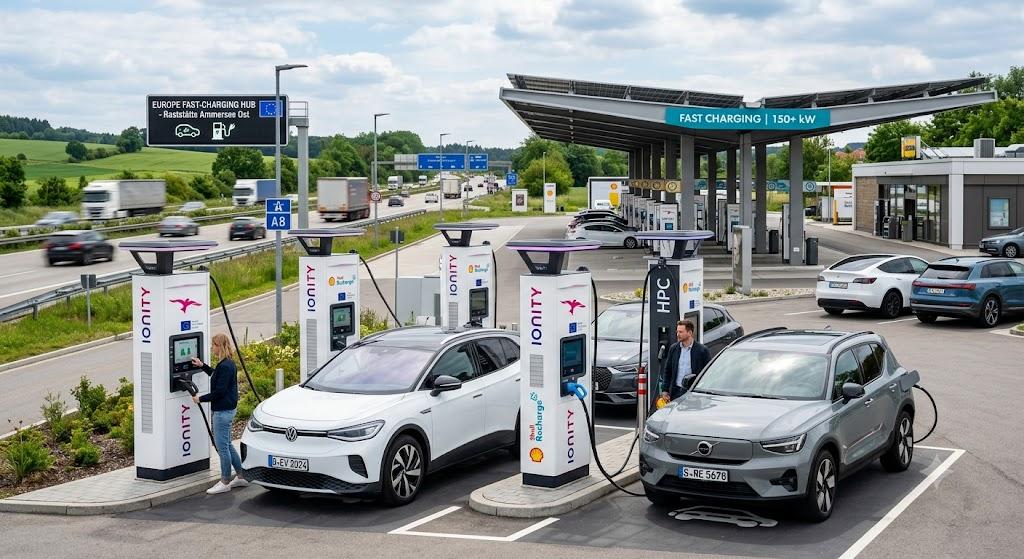
Analyzing Europe’s Fast-Charging Infrastructure Opportunity
Europe’s shift toward electric mobility is creating a new infrastructure challenge: charging must keep pace with vehicles that can travel farther, carry more passengers, and operate for longer periods. Public fast charging is especially valuable because it reduces the time required to replenish batteries when drivers cannot rely on overnight charging. The result is a growing infrastructure ecosystem involving utilities, charging operators, automakers, governments, property owners, and technology providers.
Urban charging is one of the most visible parts of this transition. Dense cities often have limited private parking and fewer opportunities for home charging. Public fast chargers can serve residents without dedicated parking, commercial drivers, visitors, and travelers moving through urban districts. However, city deployment requires careful attention to pedestrian access, traffic circulation, parking rules, noise, electrical capacity, and equitable geographic coverage.
Highway charging presents a different opportunity. Long-distance journeys require predictable intervals between charging stops, and drivers tend to value stations with multiple connectors, convenient amenities, clear pricing, and dependable uptime. Highway sites also need enough electrical capacity to handle simultaneous charging. Developers must consider future demand because replacing infrastructure can be costly when vehicle numbers and charging power increase.
The expansion of fast charging is closely connected with grid modernization. A charging hub can represent a significant new electricity load, particularly where dozens of vehicles may charge during busy periods. Distribution networks may need reinforcement, while developers can use energy management systems to coordinate charging loads. On-site batteries can provide additional flexibility by storing electricity and releasing it when demand peaks.
Renewable electricity can further strengthen the sustainability case for public charging. Solar generation at suitable sites may offset some energy purchases, while renewable power contracts can reduce the carbon intensity associated with charging. Yet the business case still depends on utilization, energy costs, connection charges, maintenance expenses, land availability, and financing conditions.
Interoperability is becoming increasingly important for drivers who cross national borders. A fragmented charging experience can create uncertainty even when physical infrastructure is plentiful. Roaming agreements, common payment methods, accurate station information, and reliable digital services can make public charging easier to use. Operators that simplify these interactions can build stronger relationships with both private motorists and commercial customers.
For investors and infrastructure developers, the Europe Public Fast-Charging Infrastructure Market Analysis requires attention to several connected variables. Vehicle registrations indicate potential demand, but they do not alone determine charger utilization. Local driving patterns, fleet activity, competing stations, electricity prices, road traffic, and site accessibility can materially influence revenue potential.
Technology is also moving beyond simple plug-and-charge functionality. Network software can monitor equipment, predict faults, optimize energy use, manage payments, and provide utilization insights. Advanced platforms may support dynamic load balancing across several charging points, helping operators use available electrical capacity more efficiently.
Competition will increasingly focus on reliability and service quality. Drivers may prefer a slightly less powerful charger that consistently works over a nominally faster unit that is frequently unavailable. Clear tariffs, functional payment systems, clean sites, adequate lighting, and responsive support can also influence repeat usage.
Over time, public fast charging should become more integrated with broader mobility and energy systems. Charging hubs may connect with retail destinations, parking facilities, fleet operations, renewable generation, and storage assets. This integration can create diversified revenue opportunities while improving the usefulness of charging infrastructure.
Europe’s electrification journey therefore depends not only on installing more chargers, but on developing networks that are convenient, resilient, financially sustainable, and aligned with real travel behavior. Strategic deployment, coordinated grid investment, and strong digital services will determine whether public fast charging evolves into a dependable backbone for electric mobility across the region.
 English
Join our community to interact with posts!