
Introduction
The shift toward distributed computing is changing how enterprises deploy and manage applications. Organizations are increasingly processing data closer to where it is generated, whether at industrial facilities, retail locations, branch offices, remote sites, telecom networks, or other edge environments.
While Kubernetes has become a foundational technology for modern application deployment, operating Kubernetes across geographically distributed and resource-constrained environments introduces a new set of challenges. IT teams must manage numerous clusters, inconsistent infrastructure, connectivity limitations, security requirements, and operational policies across locations that may be far from centralized data centers.
Download Sample Report Here: https://qksgroup.com/download-sample-form/spark-matrix-edge-kubernetes-platforms-q3-2026-10463
Edge Kubernetes Platforms are emerging to address these challenges. These platforms extend Kubernetes management beyond basic cluster deployment by providing centralized lifecycle management, fleet orchestration, zero-touch provisioning, observability, security governance, policy enforcement, and automation.
QKS Group's Edge Kubernetes Platform research examines the evolving technology landscape, emerging trends, competitive dynamics, and future market outlook while evaluating leading vendors through the proprietary SPARK Matrix framework.
What Are Edge Kubernetes Platforms?
Edge Kubernetes Platforms enable organizations to deploy, orchestrate, secure, govern, and operate Kubernetes environments across distributed edge infrastructure.
Unlike conventional Kubernetes management approaches designed primarily for centralized environments, edge-focused platforms address the unique operational requirements of geographically dispersed deployments.
These environments may include:
- Industrial facilities
- Remote operational sites
- Retail and branch locations
- Telecom edge nodes
- Manufacturing environments
- Transportation infrastructure
- Hybrid cloud locations
- Resource-constrained edge devices
Centralized management is particularly important when organizations need to manage hundreds or thousands of Kubernetes clusters across different locations.
Click Here For More Information: https://qksgroup.com/market-research/spark-matrix-edge-kubernetes-platforms-q3-2026-10463
Why Edge Kubernetes Is Becoming Important
The growth of IoT, AI, real-time analytics, and distributed applications is driving enterprises to move workloads closer to users, devices, and data sources.
Sending every data point to a centralized cloud can introduce latency, bandwidth costs, and connectivity dependencies. Edge computing enables organizations to process data closer to its source and make faster decisions.
However, distributed infrastructure creates operational complexity. Each edge location may have different hardware configurations, network conditions, application requirements, and security policies.
Edge Kubernetes Platforms provide a management layer that can help enterprises standardize these environments while maintaining centralized control.
Key Trends Shaping the Edge Kubernetes Landscape
1. Centralized Fleet Management
Managing individual Kubernetes clusters manually becomes increasingly difficult as deployments scale.
Fleet management capabilities allow organizations to centrally monitor and manage multiple clusters. Administrators can apply configurations, policies, updates, and application workloads across distributed environments.
This helps create greater operational consistency while reducing manual management requirements.
2. Zero-Touch Provisioning
Edge locations may be geographically remote or difficult to access physically. Sending IT teams to configure infrastructure at every location is inefficient and expensive.
Zero-touch provisioning allows organizations to automate the deployment and configuration of Kubernetes environments with minimal onsite intervention.
This capability is particularly valuable for large-scale deployments where new edge locations need to be brought online quickly.
3. Edge Observability Is Becoming Essential
Visibility becomes more challenging when infrastructure is distributed across multiple locations.
Edge Kubernetes Platforms increasingly provide observability capabilities that allow IT teams to monitor cluster health, workloads, resource utilization, application performance, and infrastructure conditions from a centralized environment.
Effective observability helps organizations identify issues before they significantly affect business operations.
4. Security and Policy Governance
Distributed infrastructure expands the enterprise attack surface. Organizations need consistent security controls across every Kubernetes environment.
Edge Kubernetes Platforms can help centralize policy enforcement, access controls, security configurations, and governance requirements.
This enables enterprises to establish consistent standards while still supporting the operational flexibility required at the edge.
5. Automation for Resource-Constrained Environments
Edge infrastructure can have significantly fewer compute, storage, and networking resources than centralized cloud environments.
Platforms therefore need to support lightweight deployments and operational automation that can function effectively under constrained conditions.
Automation can help optimize resource utilization while reducing the amount of manual intervention required to maintain edge environments.
Edge Kubernetes and AI Workloads
The growth of AI at the edge is creating another important use case for Kubernetes-based infrastructure.
Organizations increasingly want to process AI workloads closer to devices and operational environments. Examples include computer vision, predictive analytics, anomaly detection, intelligent automation, and real-time decision-making.
Edge Kubernetes Platforms can provide a consistent infrastructure layer for deploying and managing these workloads across distributed environments.
This can help organizations move AI applications closer to the point where data is generated while maintaining centralized governance and lifecycle management.
Challenges Enterprises Need to Consider
Despite the benefits, implementing Edge Kubernetes at scale is not straightforward.
Organizations must address infrastructure heterogeneity, intermittent connectivity, security risks, limited resources, operational skills, and lifecycle management.
Updating thousands of distributed clusters can also create significant operational challenges if automation is not available.
Enterprises should therefore evaluate platforms based on their ability to simplify the complete lifecycle of edge Kubernetes environments rather than focusing only on Kubernetes distribution capabilities.
Competitive Landscape and SPARK Matrix
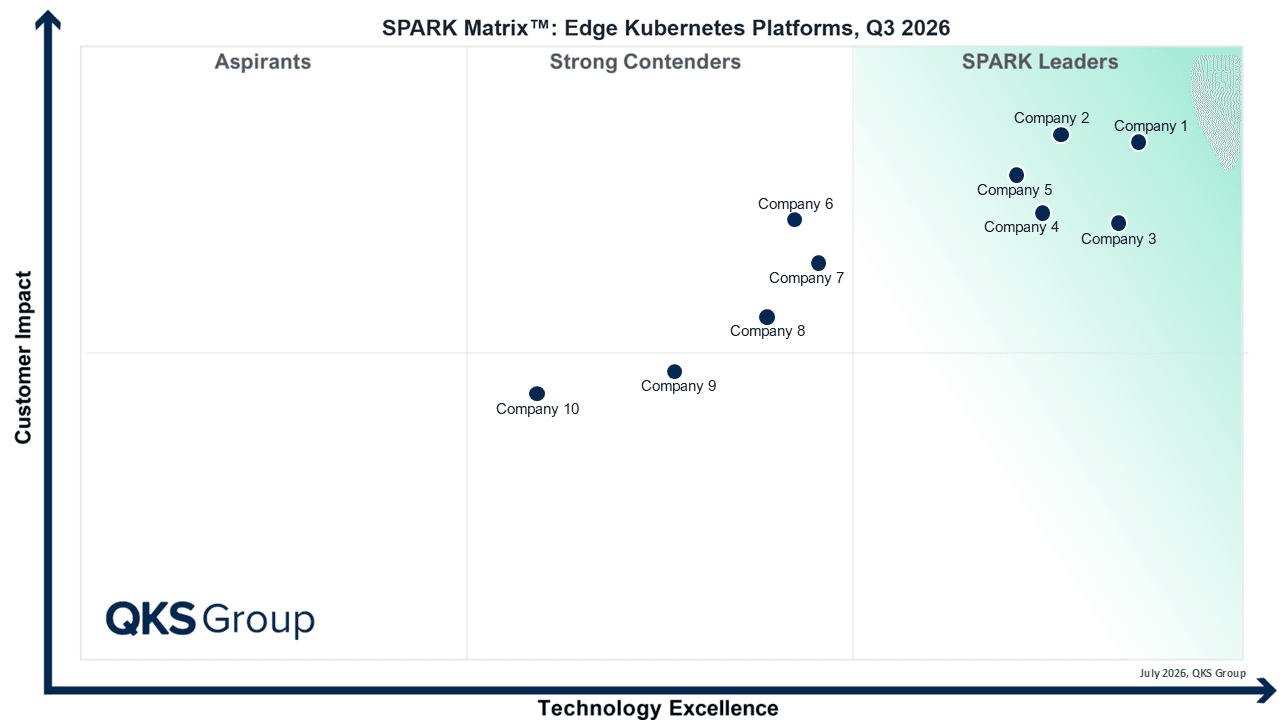
QKS Group's research provides a detailed competitive assessment of leading Edge Kubernetes Platform vendors with global impact.
The proprietary SPARK Matrix evaluates vendors based on technology excellence and market presence, helping enterprise technology leaders understand competitive positioning and vendor differentiation.
The research includes Canonical, Giant Swarm, Kubermatic, Mirantis, Nutanix, Rafay, Red Hat, Spectro Cloud, SUSE, and Wind River.
The SPARK Matrix provides buyers with a structured framework to compare vendor capabilities and understand how different platforms address the operational requirements of distributed Kubernetes environments.
For technology vendors, the analysis provides insights into competitive strengths, market positioning, and areas of opportunity as the Edge Kubernetes ecosystem evolves.
What Should Enterprises Look for in an Edge Kubernetes Platform?
Organizations evaluating Edge Kubernetes Platforms should consider the following capabilities:
- Centralized cluster lifecycle management
- Multi-cluster and fleet orchestration
- Zero-touch provisioning
- Edge observability
- Security and policy governance
- Automated upgrades and configuration management
- Support for resource-constrained environments
- Hybrid and multi-cloud integration
- Application lifecycle management
- Infrastructure and workload automation
- Support for AI and edge workloads
- Centralized monitoring and operational control
The ideal platform should enable organizations to operate distributed Kubernetes infrastructure with the same level of control and governance expected from centralized environments.
The Future of Edge Kubernetes
The future of enterprise computing is becoming increasingly distributed. As organizations adopt edge computing, IoT, AI, and real-time applications, the need for reliable infrastructure management across remote environments will continue to increase.
Kubernetes provides a strong foundation for containerized workloads, but managing Kubernetes at scale across distributed locations requires capabilities specifically designed for edge operations.
Edge Kubernetes Platforms are therefore evolving into strategic infrastructure management layers. Their role is expanding from cluster deployment toward centralized orchestration, automation, governance, observability, and lifecycle management.
As enterprises move toward larger and more diverse edge deployments, platforms that simplify complexity while maintaining security and operational consistency are likely to become increasingly important.
Connect With Our Analyst: https://qksgroup.com/analyst-briefing?analystId=5&reportId=10463
Conclusion
Edge Kubernetes Platforms are helping organizations overcome one of the biggest challenges associated with distributed computing: managing infrastructure consistently across numerous locations.
By combining Kubernetes with fleet management, zero-touch provisioning, observability, security governance, policy enforcement, and automation, these platforms enable enterprises to build more scalable and manageable edge environments.
QKS Group's Edge Kubernetes Platform research and SPARK Matrix analysis provide valuable insights into the evolving market and the competitive positioning of leading vendors.
For organizations planning their edge strategy, the key question is no longer simply “Can we run Kubernetes at the edge?” It is “Can we manage, secure, automate, and scale Kubernetes across every edge location efficiently?”
 English
Join our community to interact with posts!