
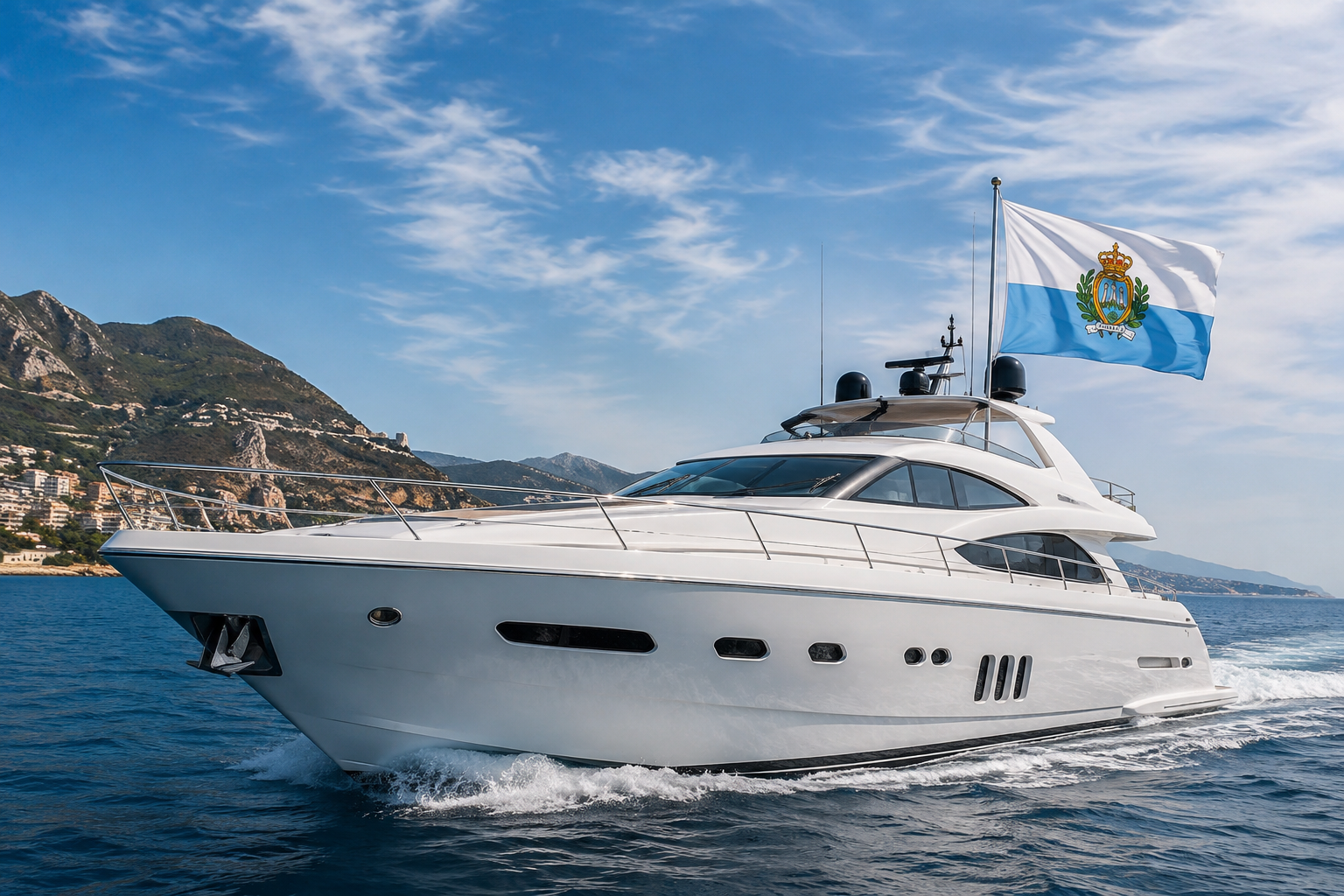
Navigating the international waters of yacht ownership requires selecting a flag state that prioritizes efficiency, regulatory clarity, and global recognition. Over the past decade, San Marino yacht registration has emerged as one of the most prestigious, versatile, and streamlined choices for boat owners worldwide. Recognized for its modern maritime administration, white-list compliance standards, and fast-track digital procedures, the San Marino flag offers an exceptional registry experience for both private pleasure craft and commercial superyachts.
Whether you are acquiring a brand-new vessel, transferring ownership, or reflagging an existing yacht, understanding the full framework of the San Marino Maritime Authority ensures a smooth transition and seamless international cruising.
The Rise of the San Marino Flag State
San Marino may be an enclave landlocked within central Italy, but its maritime navigation registry operates with top-tier international standards. Operating under the San Marino Maritime Authority (SMMA) in partnership with San Marino Ship Register (SMSR), the registry adheres strictly to international maritime conventions, including SOLAS, MARPOL, and STCW.
The registry designed its framework from the ground up to eliminate the bureaucratic red tape traditionally associated with historic European registries. By integrating fully digital document verification, flexible registration durations, and clear compliance pathways, San Marino provides a modern alternative for discerning yacht owners.
Primary Advantages of Registering Your Yacht in San Marino
Yacht owners choose flag states based on administrative speed, cost efficiency, tax neutrality, and worldwide port acceptance. San Marino excels across all these key metrics.
-
Rapid Processing Times: The administration processes application files swiftly, frequently issuing provisional navigation certificates within 48 to 72 hours.
-
Global Port Recognition: Ships flying the flag of San Marino enjoy full diplomatic recognition and smooth port clearance worldwide, backed by the republic's white-list reputation.
-
Flexible Ownership Requirements: Physical residency or local citizenship is never required. Individuals, offshore entities, European companies, or foreign corporations can directly own and register vessels under their existing legal structures.
-
Long-Term Certificate Validity: Unlike jurisdictions that require annual renewals, San Marino offers flexible registration validity periods ranging from 1 to 5 years, saving owners from constant administrative hassle.
Detailed Feature Comparison: Private vs. Commercial Charter Use
Choosing between private pleasure registration and commercial charter registration depends on your operational intentions. The table below outlines how the San Marino registry structures both categories:
| Operational Feature | Private Yacht Registration | Commercial Charter Registration |
| Primary Purpose | Personal leisure, family use, and private guest cruising | Commercial charter operations, paid passenger transport |
| Length Restrictions | Applies to all sizes (under and over 24 meters) | Applies to vessels under and over 24 meters with specific safety codes |
| Survey Requirements | Simplified inspection standards for vessels under 24m | Mandatory compliance with San Marino Commercial Yacht Code |
| Crew Requirements | Flexible crew certification; owner-driver permitted | Professional crew required with endorsed STCW certifications |
| Tax Framework | Zero local wealth or asset holding taxes | Tax-efficient commercial operating structures available |
Operational Benefits for Boat Owners and Operators
Beyond administrative ease, operating a vessel under the San Marino flag provides practical daily advantages for captains, managers, and owners out on the water.
-
No Radio Operator Restrictions: San Marino issues Maritime Mobile Service Identity (MMSI) radio licenses efficiently, recognizing international operator permits without forcing unnecessary local exams.
-
Simplified Commercial Rules for Yachts Under 24m: Small-scale commercial operators benefit from a tailor-made safety code that balances safety with low operational overhead.
-
Recognized Classification Societies: The administration delegates technical surveys to top international classification societies, ensuring you can perform inspections anywhere in the world.
-
No Maximum Age Limits: The registry accepts older, well-maintained vessels provided they pass standard safety and tonnage surveys.
Essential Requirements & Documentation Checklist
To guarantee a fast application turnaround, vessel owners must collect and verify all necessary documentation before submitting their file to the maritime authority.
1. Ownership & Corporate Records
-
Proof of Ownership: A notarized Bill of Sale (BOS) or an official Builder's Certificate for new builds.
-
Corporate Documents: Certificate of Incorporation, Good Standing, and Articles of Association if an entity owns the vessel.
-
Identification: Valid passport copies for all individual owners or beneficial company directors.
2. Vessel Technical Documentation
-
Deletion Certificate: Official proof of deletion from the previous flag registry (or an undertaking to delete).
-
Existing Registration Certificate: Copy of the previous flag state's registration document.
-
Tonnage & Safety Certificates: Tonnage measurements and safety evaluation reports provided by an approved surveyor.
3. Insurance & Radio Compliance
-
Third-Party Liability Insurance: Proof of adequate coverage matching international maritime liability standards.
-
Radio Station Application: Equipment list for the issuance of the MMSI radio license and call sign.
Step-by-Step Yacht Registration Process
Registering a vessel through the San Marino Maritime Authority follows a clear, efficient four-step pipeline.
Step 1: File Preparation and Application
Gather all ownership proof, technical specifications, and identity records. Submit the compiled dossier through an authorized registry representative or maritime consultancy. The registry conducts an initial review to confirm document completeness and owner verification.
Step 2: Issuance of Provisional Certificate
Once the authority approves the initial filing, they issue a Provisional Certificate of Registry along with a temporary radio license. This stage typically takes between 2 to 3 business days. The provisional certificate gives your vessel full legal authority to fly the San Marino flag and navigate international waters while final steps take place.
Step 3: Technical Survey & Inspection
Depending on the size, age, and classification of the yacht, an approved classification society (such as RINA, Lloyd's Register, DNV, or ABS) carries out a standard tonnage and safety survey. Small private pleasure craft under 24 meters often benefit from simplified inspection protocols.
Step 4: Definitive Registration & MMSI Allocation
Upon receiving and verifying the official survey reports, the maritime authority issues the Definitive Certificate of Registry. At this point, the administration also issues your permanent MMSI number, call sign, and ship station license. You choose the validity duration—from 1 year up to 5 years—giving you complete peace of mind.
Tax Neutrality and Fiscal Considerations
Tax strategy plays a major role when picking a flag state. San Marino operates as a tax-neutral registry for international boat owners.
-
Zero Asset Taxes: The Republic of San Marino levies no direct wealth taxes, annual property taxes, or capital gains taxes on foreign-owned vessels registered within its jurisdiction.
-
VAT Considerations in Europe: Registering under the San Marino flag does not automatically grant VAT-paid status within the European Union. However, non-EU residents can utilize the San Marino flag under the EU Temporary Admission regime, allowing them to sail within EU waters for up to 18 months at a time without incurring customs duties or VAT.
Maintaining Compliance and Renewing Your Registration
Maintaining your registration under the San Marino flag requires minimal administrative effort. Because the authority offers multi-year certificates, owners avoid annual paperwork burdens.
-
Monitoring Survey Expiry: Ensure safety and tonnage surveys remain current according to your classification society’s schedule.
-
Insurance Updates: Keep valid third-party liability insurance on file with the registry representative.
-
Simple Renewal Procedure: Requesting a renewal at the end of your 1-to-5-year term simply requires verifying that ownership details remain unchanged and paying the standard renewal fee.
Frequently Asked Questions (FAQs)
How fast can I obtain a San Marino yacht registration?
The maritime authority processes applications remarkably fast. In most cases, owners receive a provisional registration certificate within 2 to 3 business days, provided all legal and ownership documents are correctly submitted.
Does San Marino require me to bring my yacht to their territory for inspection?
No, you never need to bring your vessel to San Marino. Authorized international classification societies and recognized surveyors carry out all required inspections wherever your boat is currently berthed or docked worldwide.
Can an offshore or non-European company register a vessel in San Marino?
Yes, San Marino allows individuals and legal entities of any nationality or jurisdiction to hold direct ownership of registered vessels. You do not need to incorporate a local company in San Marino to complete the registration process.
 English
Join our community to interact with posts!