
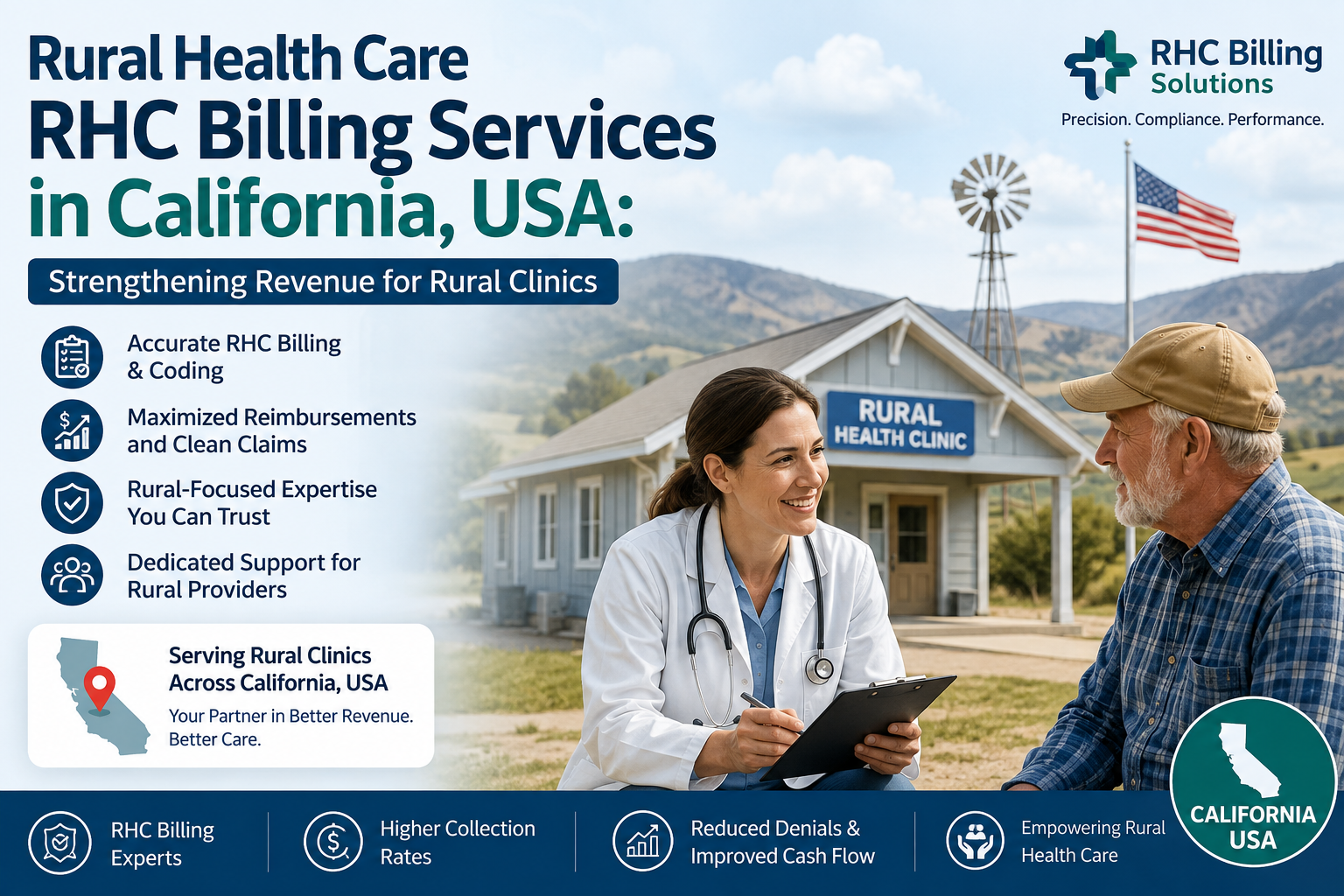
Rural healthcare providers in Florida face a challenge that goes beyond delivering quality patient care. Running a financially healthy practice requires accurate claims, timely reimbursement, proper documentation, payer compliance, and consistent follow-up. For many Rural Health Clinics (RHCs), managing all of these responsibilities internally can become difficult, particularly when administrative teams are small and clinical demands continue to grow.
This is where outsourcing rural health care RHC billing services in Florida can make a meaningful difference. Instead of asking physicians, office managers, or a limited billing team to handle every part of the revenue cycle, an experienced billing partner can manage specialized financial and administrative tasks while the clinic concentrates on patient care.
Florida's rural communities have unique healthcare needs, and RHCs must balance accessibility, regulatory requirements, staffing limitations, and financial sustainability. A knowledgeable rural health care RHC billing company can help clinics create a more organized billing process, reduce avoidable claim problems, and improve visibility into outstanding revenue.
Why RHC Billing Requires Specialized Knowledge
RHC billing is not simply a matter of submitting a claim after a patient visit. Rural Health Clinics operate under specific Medicare and Medicaid requirements, reimbursement methodologies, documentation expectations, and payer rules.
A claim can be affected by several factors, including:
- Patient eligibility and insurance coverage
- Provider enrollment and credentialing
- Correct procedure and diagnosis coding
- RHC-specific billing requirements
- Payer-specific claim edits
- Documentation supporting the services reported
- Claim submission accuracy
- Denial and rejection management
- Payment posting and reconciliation
- Accounts receivable follow-up
A general billing approach may not address these details effectively. Clinics benefit from working with professionals who understand both standard healthcare reimbursement and the operational requirements associated with RHCs.
For this reason, choosing a professional rural health care RHC billing company is less about simply transferring administrative work and more about gaining access to specialized billing knowledge.
The Financial Pressure on Rural Clinics
Rural clinics often operate with fewer resources than larger healthcare organizations. One missing claim, delayed payment, or unresolved denial may not seem significant individually, but repeated revenue leakage can create substantial financial pressure over time.
Consider a rural clinic that sees hundreds of patients every month. If a portion of claims is rejected because of demographic errors, eligibility issues, coding discrepancies, or missing information, staff members must spend additional time correcting and resubmitting those claims.
Meanwhile, unresolved accounts receivable continue to age.
This creates a cycle:
More claim problems → more staff follow-up → slower reimbursement → higher administrative workload → less time for patient-focused activities.
Outsourcing can interrupt that cycle by assigning billing responsibilities to a team that focuses specifically on revenue cycle activities.
What Outsourcing Rural Health Care RHC Billing Services Can Include
The exact scope depends on the clinic and its payer mix, but a comprehensive outsourcing arrangement can cover multiple stages of the billing lifecycle.
1. Patient Registration and Eligibility Verification
Accurate information at the beginning of the revenue cycle helps prevent problems later. Billing teams can review demographic information, insurance details, eligibility, and other necessary data before claims move forward.
Early identification of coverage issues can help clinics avoid preventable denials and unexpected patient balances.
2. Charge Entry and Claim Submission
Claims must accurately reflect the services provided and the documentation available in the medical record. A specialized billing team can review charges, apply appropriate billing workflows, and submit claims within payer requirements.
Clean claim submission is especially important for rural practices where administrative resources may already be stretched.
3. Medical Coding Support
Coding directly influences reimbursement and claim accuracy. Professional medical coding services can help ensure that diagnoses and procedures are reported appropriately based on provider documentation.
Coding teams may work with CPT, HCPCS, ICD-10-CM, and other applicable coding requirements while monitoring payer-specific considerations.
The goal is not to maximize coding unnecessarily. The goal is to report the services accurately and compliantly.
Why Medical Billing and Coding Should Work Together
Separating billing and coding completely can sometimes create communication gaps. A coding issue may eventually become a billing problem, while a payer denial may reveal a documentation or coding concern.
Integrated medical billing and coding services allow these functions to communicate more effectively.
For example, suppose a claim is repeatedly denied because the diagnosis and procedure combination does not satisfy a payer's requirements. Simply resubmitting the same claim will not solve the underlying problem. The billing team needs to identify the denial reason, while the coding team may need to determine whether the original coding accurately represented the documentation.
This coordinated approach can turn individual claim issues into opportunities to improve the overall revenue cycle.
Denial Management and Accounts Receivable Follow-Up
Denials are one of the most frustrating parts of medical billing because they require additional work after the original service has already been delivered.
A strong RHC billing workflow does not treat denial management as an afterthought. Instead, denials can be categorized and analyzed to identify recurring patterns.
Common areas may include:
- Eligibility-related denials
- Missing or incorrect information
- Coding-related issues
- Authorization problems
- Duplicate claims
- Timely filing concerns
- Documentation-related requests
- Payer-specific processing issues
Once patterns are identified, the clinic can address the underlying cause rather than repeatedly correcting individual claims.
Accounts receivable follow-up is equally important. Aging claims should be monitored according to payer, balance, age, and status so that high-priority accounts do not remain unresolved indefinitely.
Revenue Cycle Management Beyond Claims
Effective revenue cycle management services extend beyond claim submission. The objective is to create a connected process from patient registration through final payment.
A comprehensive RCM workflow may include:
- Patient registration
- Insurance verification
- Charge capture
- Coding review
- Claim submission
- Rejection correction
- Denial management
- Payment posting
- Patient balance management
- Accounts receivable follow-up
- Reporting and performance analysis
When these activities are managed as one process, clinic leaders gain a clearer picture of where revenue is being delayed or lost.
For example, if denials increase after a payer policy change, management can investigate the issue before it affects a larger portion of monthly revenue.
Credentialing Matters More Than Many Clinics Realize
Billing performance can be affected before a claim is ever submitted. Provider enrollment and payer participation are fundamental parts of the revenue cycle.
Credentialing services can support clinics with processes such as provider enrollment, payer applications, documentation management, recredentialing, and maintaining accurate provider information.
A provider may deliver excellent care, but if enrollment information is incomplete, outdated, or incorrectly maintained, reimbursement can become unnecessarily complicated.
For growing rural clinics, credentialing becomes even more important when adding physicians, nurse practitioners, physician assistants, or other eligible healthcare professionals.
Choosing the Right Rural Health Care RHC Billing Agency
Not every outsourcing company offers the same level of RHC expertise. Clinics should evaluate potential partners carefully instead of selecting a vendor based only on price.
A capable rural health care RHC billing agency should demonstrate an understanding of:
RHC-Specific Billing
Ask whether the company has experience working with Rural Health Clinics and understands the operational differences between RHC billing and conventional physician-practice billing.
Payer Complexity
Florida clinics may work with Medicare, Medicaid, Medicare Advantage plans, commercial insurers, and other payers. A billing partner should have processes for monitoring different payer requirements.
Denial Analysis
A good vendor should explain not only how it resolves denials but also how it identifies recurring causes.
Reporting
Clinic leadership should be able to understand what is happening with claims, payments, denials, aging accounts, and other important financial indicators.
Data Security
Because billing operations involve protected health information, vendors should have appropriate security procedures and HIPAA-conscious workflows.
How Outsourcing Can Help Rural Clinic Staff
Outsourcing does not mean removing the clinic's control over its finances. Done correctly, it gives staff more time to focus on activities that require their direct involvement.
A practice manager, for instance, may spend hours each week checking unpaid claims or resolving repetitive billing questions. Delegating specialized revenue cycle work can allow that person to focus on scheduling, staffing, patient experience, operational improvements, and clinic coordination.
The benefit is therefore not simply fewer billing tasks. It is better allocation of limited staff resources.
A Practical Example
Imagine a rural Florida clinic that has experienced increasing claim rejections. The internal team submits claims regularly but has limited time to analyze why certain claims repeatedly fail.
After reviewing the revenue cycle, an outsourced team discovers that several problems are connected to registration data and payer-specific billing requirements. Instead of repeatedly correcting rejected claims, the clinic introduces stronger front-end verification and claim review procedures.
Over the following months, staff have fewer repetitive corrections to manage, and management has clearer reporting on outstanding accounts.
The important lesson is that outsourcing works best when it addresses process weaknesses, not simply when it moves existing tasks to another company.
Why 247 Medical Billing Services Can Be Part of the Conversation
For RHCs evaluating outsourcing options, 247 Medical Billing Services can provide a broader approach to healthcare revenue cycle support. Its service portfolio can include medical billing services, medical coding services, integrated medical billing and coding services, revenue cycle management services, and credentialing services.
The value of such support should ultimately be measured by the quality of the workflow, accuracy of billing operations, responsiveness to payer issues, visibility into financial performance, and ability to help the clinic maintain a consistent revenue cycle.
For a rural practice, the right partner should function as an extension of the administrative team rather than simply acting as a claim submission vendor.
Building a More Sustainable RHC Revenue Cycle
Rural healthcare depends on financially sustainable clinics. When administrative inefficiencies consume too much time or prevent providers from collecting appropriate reimbursement, the effects can extend beyond accounting.
A stable revenue cycle can help clinics maintain staffing, invest in technology, improve patient services, and continue serving communities that may have fewer healthcare alternatives.
Outsourcing rural health care RHC billing services in Florida can therefore be viewed as a strategic operational decision. With the right partner, clinics can gain specialized expertise while reducing the pressure placed on internal administrative teams.
The strongest approach is not simply to outsource everything. It is to identify the parts of the revenue cycle that require specialized knowledge, establish clear performance expectations, maintain strong communication, and continuously review results.
For Florida's Rural Health Clinics, that combination can create a billing operation that is more organized, responsive, and prepared for the demands of modern healthcare reimbursement.
Frequently Asked Questions
1. What are outsourcing rural health care RHC billing services in Florida?
They are specialized billing and revenue cycle services provided by an external company to help Rural Health Clinics manage activities such as eligibility verification, charge entry, coding, claim submission, denial management, payment posting, and accounts receivable follow-up.
2. Why should an RHC choose a specialized billing company?
RHCs operate under specific reimbursement and regulatory requirements. A specialized rural health care RHC billing company can bring experience with RHC workflows, payer requirements, coding processes, claim management, and revenue cycle operations.
3. Can outsourcing reduce billing errors?
Outsourcing may help reduce preventable errors when experienced billing and coding professionals use structured review processes. However, results depend on documentation quality, workflow design, payer requirements, and the effectiveness of the selected billing partner.
4. Does RHC outsourcing include medical coding?
It can. Many comprehensive billing arrangements include medical coding support alongside claim preparation and billing operations. Clinics should confirm whether the vendor provides dedicated medical coding services and whether its coding team understands the clinic's specialties and payer requirements.
5. What should an RHC look for in a billing agency?
Look for demonstrated RHC experience, knowledgeable billing and coding staff, strong denial management, transparent reporting, secure handling of patient information, responsive communication, and a clearly defined workflow for accounts receivable and payer follow-up.
6. Is outsourcing RHC billing suitable for smaller rural clinics?
Yes. Smaller clinics can particularly benefit when internal teams have limited time or specialized billing expertise. The right outsourcing arrangement can provide access to experienced billing resources without requiring the clinic to build a large in-house revenue cycle department.
 English
Join our community to interact with posts!